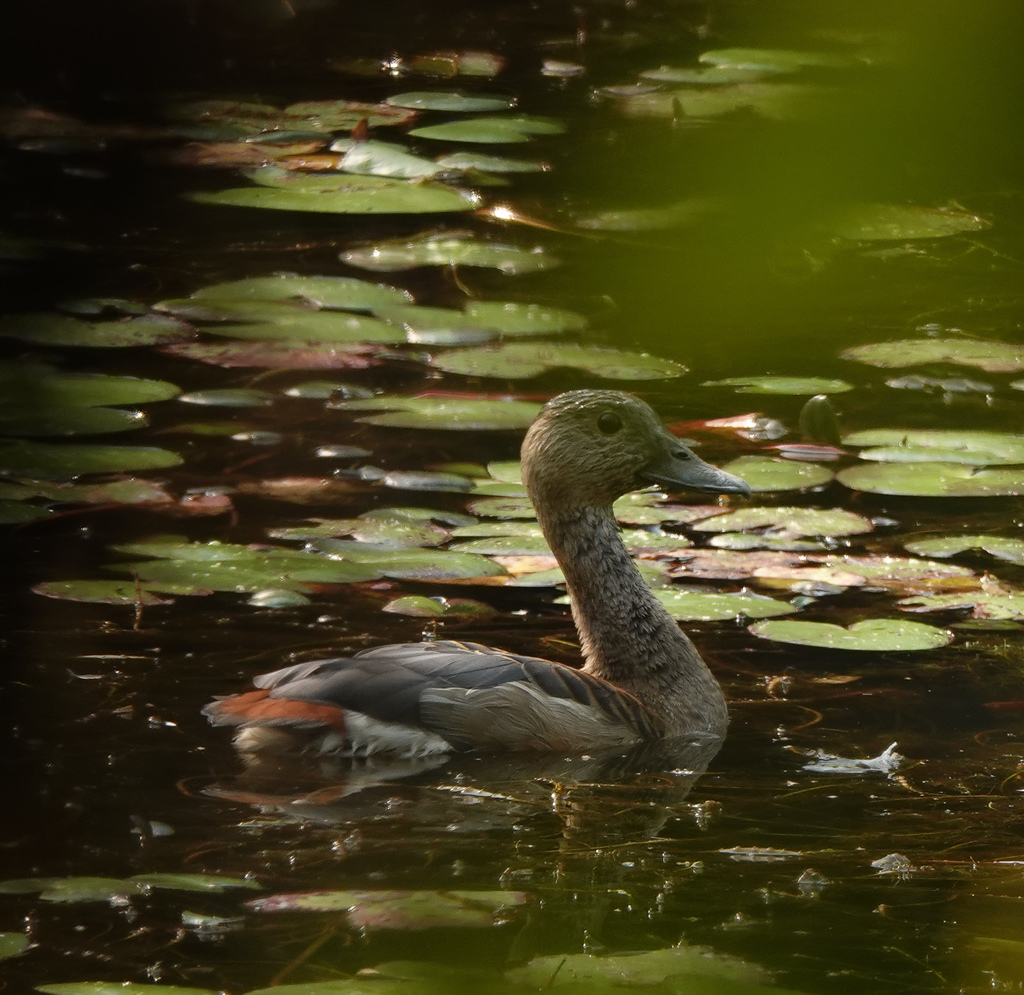
Lesser Whistling Duck
Photo © Rejoice Gassah
Photo © Rejoice Gassah — CC BY 4.0 — Source: iNaturalist #70385537Identification
The lesser whistling duck is a distinctive long-necked, chestnut-brown waterfowl with broad wings visible in flight. The most reliable field mark is its chestnut rump, which distinguishes it from its larger relative, the fulvous whistling duck, which has a creamy white rump instead. The crown appears dark, and the ring around the eye is orange to yellow. Both sexes are alike in plumage. When flying, these ducks characteristically hold their head below the level of the body and fly slowly with rapid wing-flapping, producing a loud, repetitive two-note wheezy call that inspired local names such as "sili" and "silhahi" in India. They produce very prominent whistling sounds during flight.
Range & Habitat
The lesser whistling duck is a largely resident species widely distributed across the lowland wetlands of the Indian subcontinent and Southeast Asia, with populations extending to islands including the Andamans, Nicobars, and Maldives. More northern birds may winter further south in response to weather and water availability changes. They inhabit freshwater wetlands with good vegetation cover and are commonly found resting during the day on banks or even on open sea in coastal areas. Large numbers are sometimes observed in urban wetlands, particularly during winter in locations such as Kolkata and Goa.
Behaviour & Diet
Lesser whistling ducks are highly gregarious and notably nocturnal feeders, often resting during daylight hours in flocks around lakes and wet paddy fields. They possess a remarkable ability to perch on trees and sometimes nest in tree hollows. Their diet consists mainly of aquatic plants and grains from cultivated rice, supplemented with small fish, frogs, molluscs, worms, and other invertebrates. They both dabble and dive in water and frequently waddle on land.
Breeding occurs during the monsoon or rainy season, with clutches typically ranging from 7 to 12 white eggs incubated by both parents. Nests may be located in tree holes lined with twigs and grass, in tree forks, or sometimes reused nests of kites or herons. Eggs hatch after approximately 22–24 days, and more than one brood may be raised in a single season. Young birds are sometimes carried on their parents' backs.
Best Time & Places to See It
Lesser whistling ducks can be found year-round across their range, though winter months bring larger concentrations to urban wetlands. Urban wetland areas in Kolkata and Goa are particularly productive locations during winter. Look for them during late afternoon and evening hours as they become active for nocturnal feeding. During the day, scan the banks and open water of lakes and paddy fields, where they rest in flocks. The monsoon season is optimal for observing breeding behaviour.
Photography Tips
The chestnut rump is the key identifying feature to capture, so aim for side-on shots that show the upper-tail coverts clearly. In-flight photography is rewarding, as the broad wings and the distinctive head-below-body posture are characteristic and photogenic. The orange-yellow eye-ring provides detail for close-up portraits. Their nocturnal habits mean early morning and late afternoon light often provides the best conditions. Since they are gregarious, you can often find multiple individuals in frame, capturing their social behaviour. Patience is essential, as they rest during much of the day, but their tendency to perch in trees offers unique compositional opportunities compared to other ducks.
Lunugamvehera National Park
Sri Lanka
+204 birds+14 mammals
Dry scrubland and shallow wetlands converge in Sri Lanka's southeastern lowlands, where Lunugamvehera National Park anchors one of the island's most ecologically vital landscapes. The park's…
VIEW NATIONAL PARKMinneriya National Park
Sri Lanka
+158 birds+9 mammals
Across the dry zone of Sri Lanka's North Central Province spreads a landscape of shallow tanks, grassland margins, and scattered dry forest—a mosaic of water and…
VIEW NATIONAL PARKWasgamuwa National Park
Sri Lanka
+156 birds+8 mammals
Dry deciduous forest and open grassland sweep across the North Central lowlands where Wasgamuwa National Park protects one of Sri Lanka's largest remaining tracts of this…
VIEW NATIONAL PARKOrang National Park
Rangagarapathar, India
+298 birds+1 mammals
Where the Brahmaputra's floodplains meet the foothills of Assam, Orang National Park unfolds across a mosaic of riverine grasslands, forests and wetlands that pulse with the…
VIEW NATIONAL PARKRanthambhore National Park
Sawai Madhopur, India
+294 birds+20 mammals
Granite ridges and ravines carved through the Aravalli Range frame this protected landscape in eastern Rajasthan, where deciduous forest mingles with open scrubland and seasonal water…
VIEW NATIONAL PARKHat Noppharat Thara-Mu Ko Phi Phi National Park
Ao Nang, Thailand
+253 birds+9 mammals
Where limestone karsts rise dramatically from turquoise waters, Hat Noppharat Thara-Mu Ko Phi Phi National Park unfolds across a mosaic of beach, mangrove forest, and island…
VIEW NATIONAL PARKKhao Yai National Park
Prachantakham District, Thailand
+377 birds+46 mammals
Evergreen dipterocarp forest blankets the rolling terrain of this national park in eastern Thailand, where limestone hills rise abruptly from the forest floor and seasonal streams…
VIEW NATIONAL PARKKhao Laem Ya-Mu Ko Samet National Park
Mueang Rayong District, Thailand
+159 birds+3 mammals
Where limestone hills meet the Gulf of Thailand, Khao Laem Ya–Mu Ko Samet National Park stitches together a mosaic of terrestrial and marine worlds that few…
VIEW NATIONAL PARKKhao Laem National Park
Sangkhla Buri District, Thailand
+197 birds
Where the Vajiralongkorn Reservoir sprawls across the forested valleys of Kanchanaburi's northern borderlands, Khao Laem National Park protects a landscape where limestone ridges rise dramatically from…
VIEW NATIONAL PARKKanha Tiger Reserve
Kanha Kisli F.V., India
+321 birds+23 mammals
Where sal forests give way to emerald meadows and crystalline streams carve through ancient valleys, one of India's finest wilderness reserves unfolds across the Maikal Range.…
VIEW NATIONAL PARKTadoba National Park
Palasgaon Singru, India
+270 birds+20 mammals
Where sal forests meet open grasslands and rocky outcrops rise from red laterite soil, central India's landscape unfolds in raw, untamed beauty. Ancient teak woodlands and…
VIEW NATIONAL PARKBandhavgarh National Park
Garhpuri, India
+285 birds+17 mammals
Where granite ridges rise dramatically above sal and bamboo forests, one of India's most pristine tiger reserves unfolds across the Vindhyan plateau. Ancient rock formations tower…
VIEW NATIONAL PARKPanna National Park
Badgadi Kalan, India
+271 birds+17 mammals
Where granite gorges slice through central India's Vindhyan plateau, a landscape of stark beauty unfolds across nearly six hundred square kilometers. The Ken River carves through…
VIEW NATIONAL PARKKaziranga National Park
Kohora, India
+422 birds+26 mammals
Dawn breaks over the floodplains of the Brahmaputra, where tall grasslands stretch endlessly beneath monsoon-heavy skies. This sprawling wilderness of northeastern Assam is a mosaic of…
VIEW NATIONAL PARKKeoladeo National Park
Shreenagar Rural, India
+326 birds+14 mammals
Where shallow wetlands shimmer beneath vast Rajasthani skies, one of Asia's finest bird sanctuaries pulses with extraordinary life. This former maharaja's hunting reserve, now spanning 29…
VIEW NATIONAL PARKPampadum Shola National Park
Vattavada, India
+258 birds+14 mammals
Where misty shola forests cling to the high plateaus of the Nilgiri Mountains, ancient evergreen remnants create a world apart. This 2,316-hectare reserve protects one of…
VIEW NATIONAL PARKBandipur National Park
Hirehalli, India
+302 birds+19 mammals
Where the Western Ghats descend into the Deccan plateau, ancient deciduous forests blanket a landscape carved by the Nugu River. Bandipur unfolds across 880 square kilometres…
VIEW NATIONAL PARKNagarahole Tiger Reserve
Nalkeri Forest, India
+323 birds+23 mammals
Where granite escarpments rise above dense deciduous forests and the Kabini River carves through pristine wilderness, one of India's most biodiverse landscapes unfolds across the Western…
VIEW NATIONAL PARKTaman Negara National Park
Kampong Samas, Malaysia
+393 birds+48 mammals
Where ancient rainforest meets limestone peaks, one of Southeast Asia's oldest protected wilderness preserves sprawls across 4,343 square kilometers of primordial landscape. Dipterocarp giants tower overhead,…
VIEW NATIONAL PARKWest Bali National Park
Gerokgak, Indonesia
+240 birds+8 mammals
Across West Bali's northwestern reaches, where the Indian Ocean meets volcanic slopes and limestone cliffs plunge toward turquoise shallows, sprawls a protected realm of roughly 325…
VIEW NATIONAL PARKWay Kambas National Park
Lampung Timur, Indonesia
+237 birds+20 mammals
Across the low swamplands of eastern Lampung, where freshwater wetlands merge into tidal mangrove forests along the Sunda Strait, sprawls one of Sumatra's most vital sanctuaries.…
VIEW NATIONAL PARKGir National Park
Asundrali, India
+258 birds+13 mammals
Dry deciduous forests cloak the rolling hills of western Gujarat where the Gir landscape rises as a final sanctuary for one of the world's rarest felids:…
VIEW NATIONAL PARKNo community photos yet. Log in to add the first one.
No community observations of this species yet.