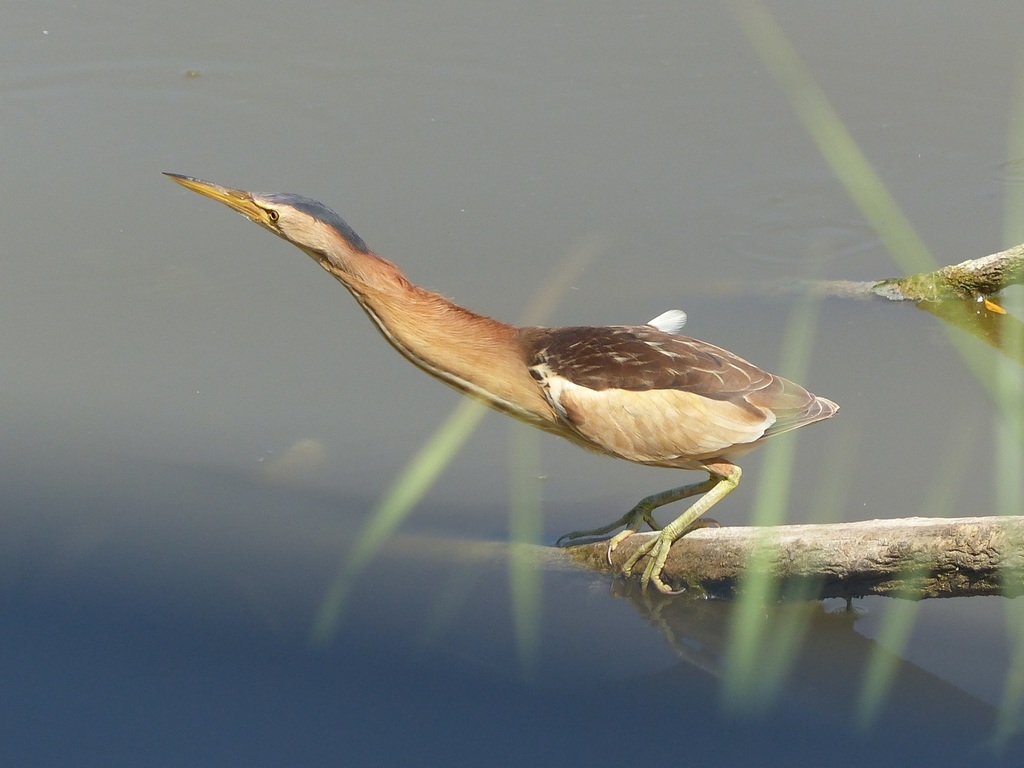
Identification
The Little Bittern is the smallest breeding heron of Europe, measuring just 33–38 centimetres in length with a wingspan of 52–58 centimetres. Despite its diminutive size, it is a distinctive and striking bird characterised by its long, sharp bill and notably thick neck. Males are boldly patterned with black upperparts showing a faint green sheen on the crown, nape, back, tail and scapulars. A distinctive feature is the pinkish-buff oval wing panel formed by the inner wing coverts, which contrasts sharply against otherwise black wings. The underparts are pale buff and the underwing is whitish. Females are considerably duller, with brownish-black upperparts and paler feather margins visible at close range. Their underparts are streaked with dark buff and brown, and the wing panel is less prominent than in males. Both sexes display pale forewing panels. Juveniles are duller and more rufous than females, heavily streaked on both upper and underparts.
Range & Habitat
The Little Bittern is native to the Old World, with breeding populations across Africa, central and southern Europe, western and southern Asia, and Madagascar. European and western Asian birds are migratory, wintering in Africa and further south in Asia, while tropical populations are sedentary. The species occurs from Europe (excluding regular breeding in Great Britain, Ireland and Scandinavia) to West Siberia, with isolated populations in Madagascar and Australia. It is a poorly distributed lowland breeding bird, occurring sporadically up to low mountain ranges. The Little Bittern is rare north of its established breeding range. In Britain, breeding records remained unproven until the first confirmed nesting in Yorkshire in 1984, followed by the Avalon Marshes in Somerset in 2010, where the species was present for nine consecutive years by 2017.
Behaviour & Diet
The Little Bittern is a crepuscular species, skulking and typically solitary in habit. It feeds on fishes, amphibians and insects, which it catches within reedbeds or at their edges by slowly stalking its prey. Males claim territories in spring, advertising their presence with a deep barking or croaking call. The species is monogamous, with pairs remaining together for at least one breeding season. Eggs are laid from mid-May onwards in nests situated in dense reedbeds, rushes or bushes above water. A single brood of normally 5–6 eggs is typical, with incubation lasting 17–19 days and fledging occurring after 25–30 days. In Europe, spring migration from Africa begins in early spring, with birds arriving at breeding wetlands from mid-April onwards. Return migration to Africa occurs in August and September, with few juveniles remaining in Europe by October. European breeders migrate as far south as the Eastern Cape and Transvaal regions.
Best Time & Places to See It
For European observers, the best time to encounter Little Bitterns is from mid-April through September during the breeding season. The species should be sought in extensive reedbeds and wetland habitats where it remains characteristically secretive. Key populations exist across Central Europe, particularly in Hungary, which hosts most Central European breeding pairs. Significant populations also occur in Russia, Ukraine, Romania and Turkey. Britain remains a rare destination for this species, though the Avalon Marshes in Somerset has proven reliable in recent years. The bird's crepuscular habits mean dawn and dusk provide the best viewing opportunities.
Photography Tips
Photographing the Little Bittern presents considerable challenges due to its skulking, secretive nature and preference for dense reedbed cover. Success requires patience and early morning or evening visits when the bird is most active. The species' small size demands a good telephoto lens to capture useful detail. Males are far more distinctive and photogenic than females, displaying their striking black and buff plumage and characteristic pale wing panel. Position yourself near reedbed edges and margins where birds hunt for fish and amphibians. Silence and slow, deliberate movement are essential to avoid flushing this wary species. The bird's habit of slowly stalking prey provides fleeting opportunities for action shots, though static perched birds in reeds offer the most reliable photographic chances.
S’Albufera Natural Park
Platja de Muro, Spain
+253 birds+6 mammals
Where Mediterranean lagoons meet the Balearic coast, S'Albufera stretches across nearly 1,600 hectares of wetland and dune systems that rank among Europe's most ecologically vital shallow-water…
VIEW NATURAL PARKMarjal Pego-Oliva Natural Park
Molinell, Spain
+219 birds+2 mammals
Where the Valencian littoral flattens into wetland and reed-bed, Marjal Pego-Oliva straddles the boundary between the Mediterranean and its inland margins, a mosaic of shallow lagoons,…
VIEW NATURAL PARKL’Albufera Natural Park
València, Spain
+321 birds+18 mammals
Where shallow lagoons meet Mediterranean coastal marshland, L'Albufera Nature Park unfolds as one of Spain's most vital wetland complexes. This protected landscape, designated under IUCN Category…
VIEW NATURAL PARKDoñana National Park
Hinojos, Spain
+300 birds+13 mammals
Where the Guadalquivir River delta spreads into the Atlantic, vast marshes, cork woodlands, and coastal dunes converge to create one of southwestern Europe's most biodiverse wetland…
VIEW NATIONAL PARKTablas de Daimiel National Park
Daimiel, Spain
+246 birds+6 mammals
Where the Guadiana River spreads into a labyrinth of shallow lagoons and reed beds across the sun-baked plains of central Spain, Tablas de Daimiel National Park…
VIEW NATIONAL PARKMabamba Swamp
Memere, Uganda
+464 birds+2 mammals
Across the Central Region of Uganda spreads one of Africa's most biodiverse freshwater wetlands, a sprawling nature reserve of roughly 283 square kilometres where papyrus swamps…
VIEW NATURE RESERVETúria Natural Park
València, Spain
+150 birds+21 mammals
Where the Túria riverbed winds through the lowlands south of Valencia, a sprawling natural park of nearly 440 square kilometres unfolds across one of Spain's most…
VIEW NATURAL PARKNo community photos yet. Log in to add the first one.
No community observations of this species yet.