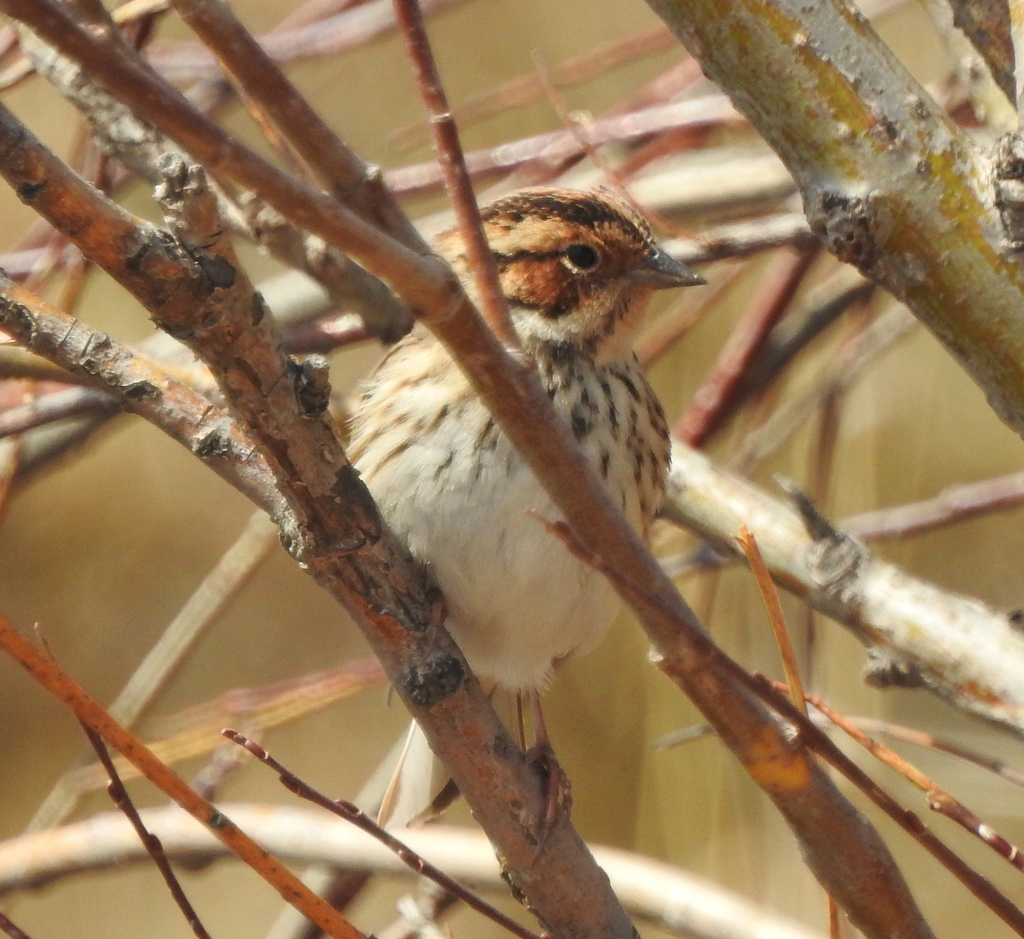
Little Bunting
Photo © Анна Васильченко
Photo © Анна Васильченко — CC BY 4.0 — Source: iNaturalist #44700839Identification
The Little Bunting is a diminutive bunting measuring just 12–14 cm in length, making it one of the smallest members of its family. Its most distinctive features include a chestnut face with a white malar stripe, black crown stripes, and a fine dark border to the rear of its cheeks. A prominent white eye-ring is another key identifying mark. The underparts are white with dark streaking on the breast and sides. Despite their small size, the sexes are similar in plumage, though females may show slightly duller tones. The bird's call is a distinctive, sharp zik, while its song is a distinctive rolling siroo-sir-sir-siroo.
Range & Habitat
This monotypic species breeds across the taiga of far north-east Europe and northern Eurosiberia, extending eastward to the Russian Far East. It is highly migratory, abandoning its breeding grounds to winter in the subtropics of northern India, southern China, and northern south-east Asia, where birds may remain until late March. It is a rare vagrant to western Europe. The species is remarkably adaptable; in mountainous regions such as Bhutan, it winters in agricultural habitats typically between 1,000 and 2,000 metres elevation. During breeding season, it favours open coniferous woodland, often interspersed with birch or willow.
Behaviour & Diet
Little Buntings are seed-eaters throughout most of the year, foraging for seeds in their winter quarters and breeding grounds. During the breeding season, when feeding young, they supplement their diet with insects to meet the protein demands of growing chicks. The species nests in trees, where females lay four to six eggs per clutch. Their vocal repertoire, though modest, is distinctive and carries well across open habitats.
Best Time & Places to See It
For those seeking this species, the primary opportunity lies in its wintering grounds across the Indian subcontinent and south-east Asia, particularly in agricultural areas of northern India, southern China, and Bhutan. Winter months through early spring offer the best chance of encounter, with birds remaining in these regions until late March. Its rarity in western Europe makes sightings there unpredictable and largely dependent on vagrant movements. The species' preference for open habitats and agricultural areas makes it relatively approachable during winter.
Photography Tips
The Little Bunting's small size and preference for open habitats present both challenges and opportunities for photographers. Winter birds in agricultural areas of Asia can be more approachable than breeding birds in remote taiga. Focus on capturing the distinctive facial pattern—the chestnut face, white eye-ring, and black crown stripes are key identification features. Early morning light is ideal for rendering the subtle plumage details and highlighting the white underparts against darker streaking. Since the bird often forages on the ground or in low vegetation, be prepared to work from a low angle. Patient stalking of wintering birds in their preferred habitats will yield the best results.
Baikal National Park
Baima Snow Mountain National Nature Reserve
Cabo Peñas
Camargue Regional Nature Park
Caohai National Nature Reserve
Cape Clear Island
Chitwan National Park
De Groote Peel National Park
Doi Inthanon National Park
Nothing matches these filters.
No community photos yet. Log in to add the first one.
No community observations of this species yet.