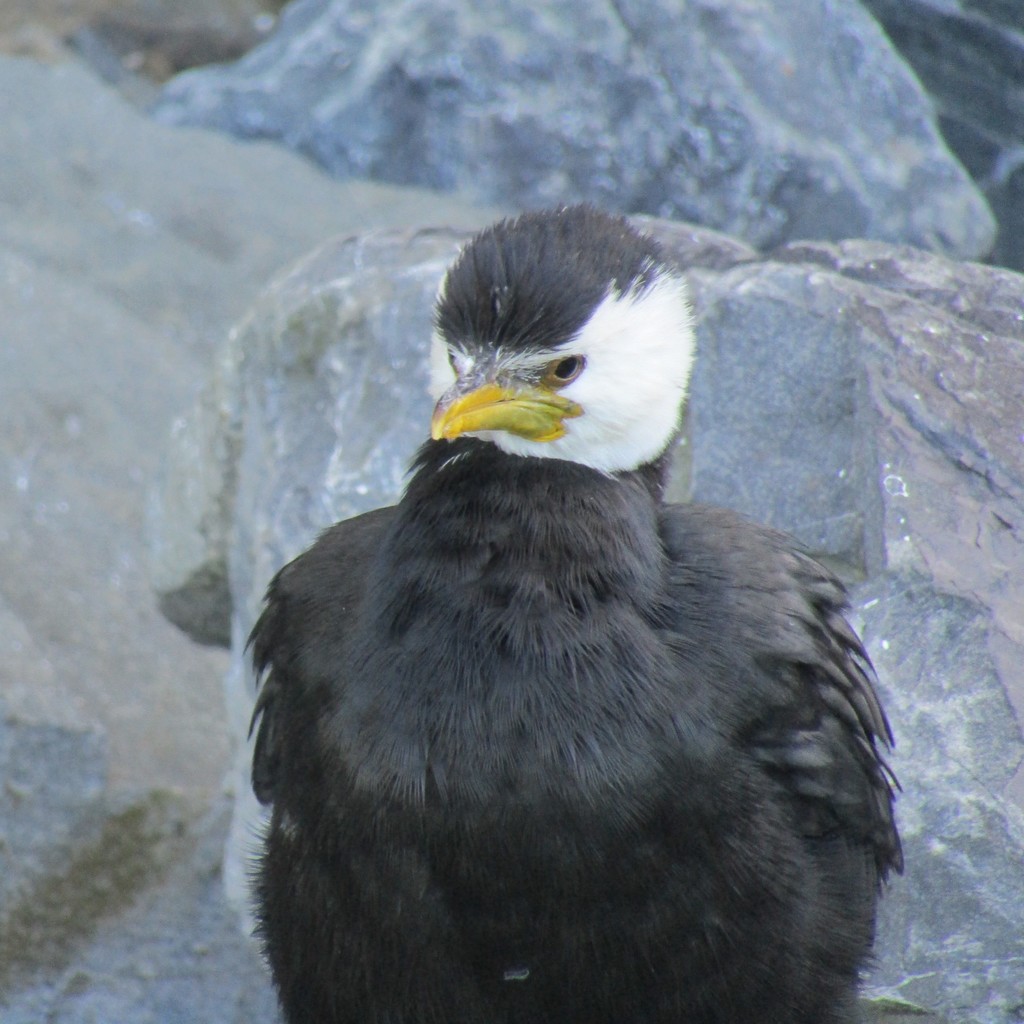
Little Pied Cormorant
Photo © wild_wind
Photo © wild_wind — CC BY 4.0 — Source: iNaturalist #70026664Identification
The little pied cormorant is a small waterbird measuring 56–58 cm (22–23 in) with a notably short bill of just 3 cm (1.2 in) and a relatively longer tail than its close relative, the little black cormorant. It sports a small black crest on its head. The species exhibits two distinct colour morphs, particularly in New Zealand. The pied morph features glossy black plumage above with a white face, underparts, and thighs, complemented by a yellow bill and yellow bare skin around the face. The melanistic morph, which predominates in New Zealand, is entirely black with a greenish tinge except for the sides of the head, chin, throat, and upper neck; the bill is yellow with black on top. In both forms, the legs and feet are black. Intermediate forms also occur. Immature birds are dull blackish brown, with pied morph juveniles showing paler underparts.
Range & Habitat
This common Australasian waterbird is widespread throughout Australia (except the arid interior west), New Zealand from Stewart Island to Northland, and Tasmania. Its range extends across the region to Papua New Guinea, Timor-Leste, Indonesia (including Sulawesi, the Lesser Sunda Islands, Maluku Islands, and Western New Guinea), Palau, the Solomon Islands, New Caledonia, and Vanuatu. Non-breeding vagrants occasionally appear in Java, Bali, and off East Kalimantan. The species favours bodies of water including swamps, lakes, lagoons, estuaries, and coastal areas.
Behaviour & Diet
The little pied cormorant is a solitary benthic feeder, diving in relatively shallow water often near the shore to hunt prey on the sea floor. Its dives are characteristically brief, lasting around 15 to 20 seconds, with surface recovery times of 5 to 10 seconds between dives—unless actively swallowing prey. The bird takes a varied diet of fish, but unusually consumes a high proportion of crustaceans, averaging nearly 30% by weight and reaching up to 80% in some individuals. In New Zealand waters, it frequently preys on local flounder and other small flatfish, and also consumes eels and insect larvae. Fish are brought to the surface to be swallowed and often repositioned head-first; this habit of placing fish on the water occasionally makes the bird vulnerable to kleptoparasitism by red-billed gulls. During courtship, the species produces a low cooing call.
Best Time & Places to See It
The little pied cormorant is common and widespread throughout its range, making it relatively easy to encounter. In Australia and New Zealand, breeding occurs in spring or early summer in southern areas, while tropical populations breed after the monsoon season. The pied morph is rare in New Zealand overall but most common in Northland, where it comprises approximately one in every four birds. Look for this species around any suitable waterside habitat—coastal areas, estuaries, swamps, and inland lakes all support populations.
Photography Tips
The species' small size and solitary feeding behaviour in relatively shallow water offer good opportunities for close-approach photography. Patience near favourite feeding spots will reward you with action shots of diving and surfacing. The striking contrast between the glossy black and white plumage of the pied morph provides excellent compositional possibilities, particularly in good light. Remember that birds are often actively feeding, so expect frequent diving sequences. The species' habit of bringing fish to the surface to reorient them before swallowing provides interesting behavioural moments worth capturing.
Abel Tasman National Park
Aketajawe Lolobata National Park
Aoraki / Mount Cook National Park
Arthur’s Pass National Park
Barrington Tops National Park
Belair National Park
Ben Boyd National Park
Blue Mountains National Park
Boodjamulla National Park
Nothing matches these filters.
No community photos yet. Log in to add the first one.
No community observations of this species yet.