Hide 9 Pins
Iberian Green Woodpecker · Great Spotted Woodpecker+17
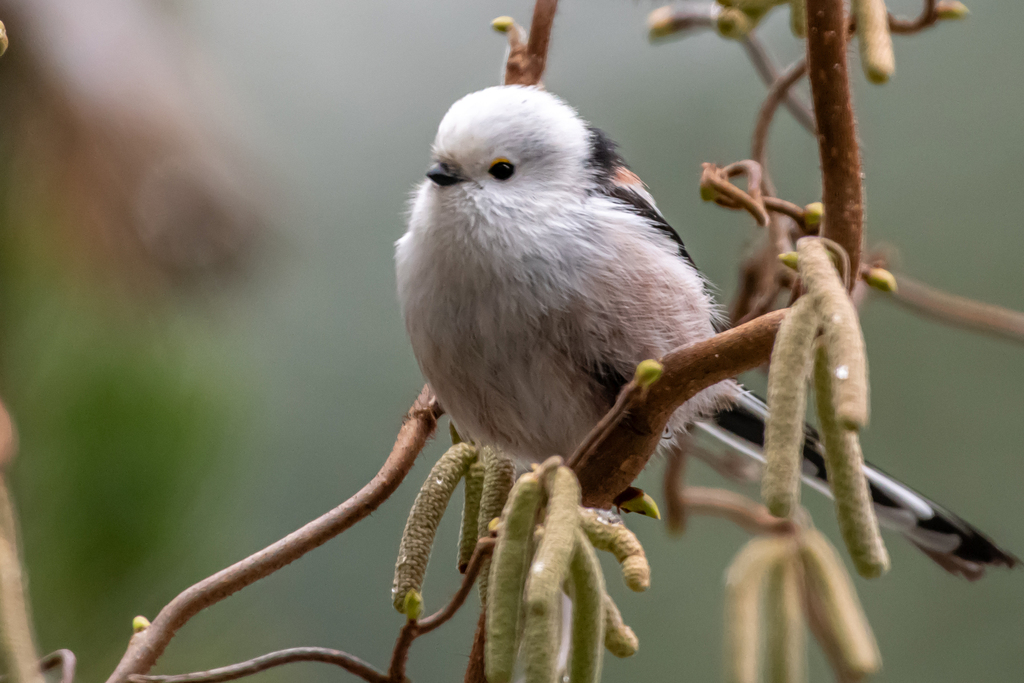
The Long-tailed Tit is a diminutive bird, measuring just 13–15 cm in length, with a distinctively long, narrow tail accounting for 7–9 cm of that total. Despite its tiny, round-bodied frame and short, stubby bill, this species is unmistakable in the field. The plumage is predominantly black and white with variable amounts of grey and pink. A key identifying feature is the geographical variation: northern subspecies are paler with completely white heads, while southern populations display large dark eyebrows. Males and females look identical, and young birds acquire full adult plumage before their first winter.
When scanning woodlands and scrubland, listen for the Long-tailed Tit's distinctive vocalizations before looking for the bird itself. The species produces three main calls: a single high-pitched pit, a triple trill eez-eez-eez, and a rattling schnuur. These calls become noticeably faster and louder when birds cross open ground or when individuals become separated from their group, making detection easier for patient observers.
This species is widespread throughout temperate Northern Europe and the Palearctic region, ranging from boreal Scandinavia south into the Mediterranean zone. The Long-tailed Tit inhabits deciduous and mixed woodlands with well-developed shrub layers, favoring edge habitats and transitional zones. It thrives in scrubland, heathland with scattered trees, hedgerows, farmland, riverine woodland, and parks and gardens—essentially anywhere with suitable shrubby vegetation.
In winter, the bird's year-round insectivorous diet drives its preference for deciduous woodlands dominated by oak, ash, and sycamore with dense understory growth. For breeding, Long-tailed Tits show a strong preference for scrub areas, typically constructing nests in thorny bushes less than 3 metres above the ground, where dense vegetation provides protection from predators.
The Long-tailed Tit is a highly social species, forming compact family flocks of six to seventeen individuals outside the breeding season. These flocks maintain constant contact through their distinctive calls and move together through suitable habitat, making them conspicuous when conditions favor observation. When the breeding season arrives, these flocks break up as pairs establish territories and prepare to nest.
Insectivorous year-round, the Long-tailed Tit feeds predominantly on arthropods, with a particular preference for the eggs and larvae of moths and butterflies. Only occasionally does it supplement its diet with seeds and other vegetable matter during autumn and winter months. The bird's social foraging behavior and reliance on insects throughout the year significantly influence its habitat selection and movement patterns, particularly during the colder months when insect availability becomes critical.
Long-tailed Tits are generally resident throughout their range, making them observable year-round in suitable habitat. The exception is the white-headed northern nominate subspecies, which is significantly more mobile and may move long distances south or west to escape harsh winters. Winter can be an excellent time to observe flocking birds, as they move actively through deciduous and mixed woodlands searching for insects.
Visit deciduous and mixed woodlands with shrubby understories, scrubland, heathland with scattered vegetation, or well-maintained parks and gardens with mature trees and dense hedgerows. Your chances improve dramatically when you first locate a flock by listening for their constant, distinctive calls—the birds are often heard before they are seen. Patient observers positioned near thorny scrub or bramble patches, especially during winter months, will have the best opportunities to observe these charming social tits.
The Long-tailed Tit's small size and active, flocking behavior present both challenges and opportunities for photographers. Position yourself near dense scrub or bramble patches where flocks frequently forage, and wait for birds to move toward you rather than pursuing them through dense vegetation. The birds' constant movement and preference for thorny cover demands a fast shutter speed (at least 1/1000th second) and careful composition to isolate individuals against busy backgrounds.
The striking black-and-white plumage with pink and grey accents photographs beautifully in soft, even light; harsh overhead sun can obscure the subtle coloring of northern subspecies. Early morning light works particularly well. Because these are social birds, capture the behavioral interactions within flocks—birds clinging together, feeding cooperatively, or maintaining contact calls. The bird's extraordinarily long tail relative to its body size is a defining feature; compose your shots to showcase this characteristic proportions, particularly when birds are perched or in flight.
Nothing matches these filters.
Nothing matches these filters.
Nothing matches these filters.
No community photos yet. Log in to add the first one.
No community observations of this species yet.
We'd love to hear from you. We'll reply as soon as possible.
Found an error? Have a suggestion? We read every message.
A compact view of how this species lives, moves and responds to its environment.
Select a card to explore the details.
Please confirm the photo rights and credit terms first.
I'm the author of this photo or hold the rights to it, and I keep full ownership. I grant Wild Atlas Guide a free, non-exclusive licence to display it on the site and in Wild Atlas Guide's own channels, including social media, always credited to me by my display name or the Instagram handle I choose to provide. I confirm it does not reveal a sensitive wildlife location or a recognisable person without their permission. I can withdraw future social use for this photo or ask for it to be removed at any time.
Please accept the photo rights and credit terms to continue.
Uploading…
We use cookies to measure traffic and improve Wild Atlas Guide. You decide. Privacy policy