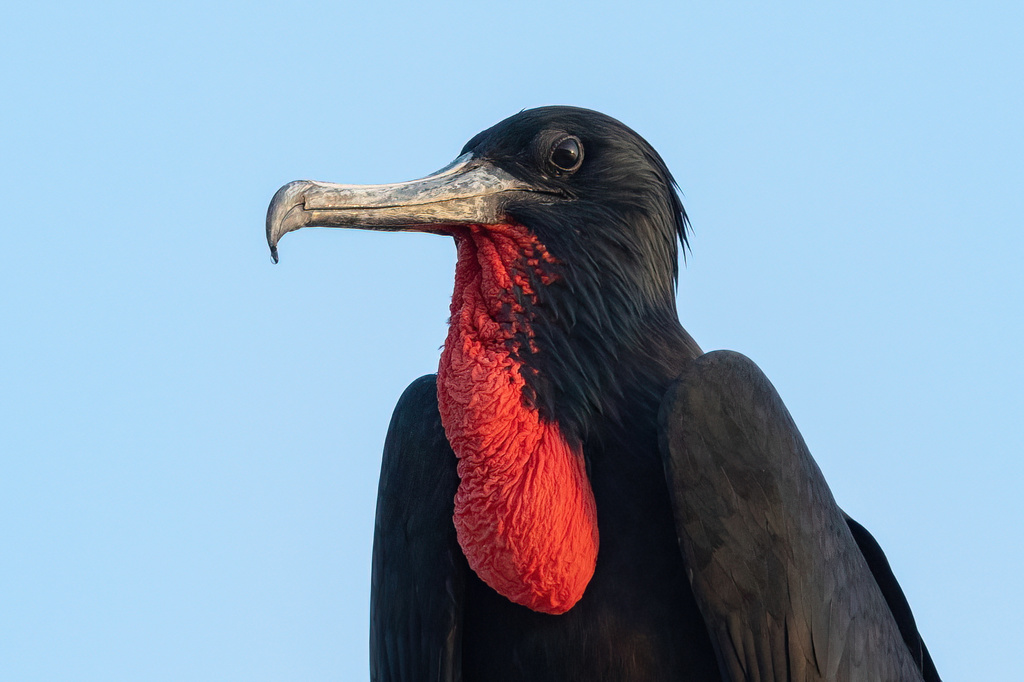
Magnificent Frigatebird
Photo © Thibaud Aronson
Photo © Thibaud Aronson — CC BY-SA 4.0 — Source: iNaturalist photo #189224547Identification
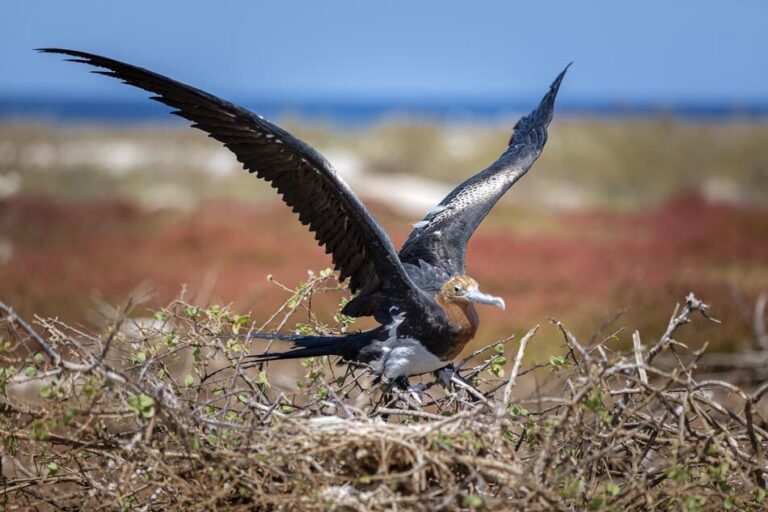
The magnificent frigatebird is the largest species of frigatebird, measuring 89–114 centimetres in length with an impressive wingspan of 2.17–2.44 metres. These are large, lightly built seabirds with brownish-black plumage, long narrow wings, and a deeply forked tail that gives them exceptional manoeuvrability in flight. Males are instantly recognisable by their striking red gular sac—an inflatable throat pouch—which they dramatically display to attract mates. Females are slightly larger than males and can be distinguished by their white breast and belly contrasting with dark upperparts.
Range & Habitat
Magnificent frigatebirds occur over tropical and subtropical waters throughout the Americas, ranging from northern Mexico to Peru along the Pacific coast, and from Florida to southern Brazil along the Atlantic coast. Additional populations inhabit the Galápagos Islands in the Pacific and the Cape Verde islands in the Atlantic. These seabirds breed colonially in trees on islands and coastal regions, with one of the world's largest colonies located in Codrington Lagoon, Barbuda.
Behaviour & Diet
Magnificent frigatebirds are among the fastest birds in the world, capable of flying at speeds up to 153 kilometres per hour. They are exclusively aerial hunters, feeding on fish taken in flight from the ocean's surface, with flying fish being a particular favourite. These remarkable birds employ a fascinating and somewhat notorious feeding strategy: they practise kleptoparasitism, harassing other seabirds in flight to force them to regurgitate their meals, which the frigatebird then catches mid-air. True to their historical descriptions, they rarely alight on water and remain airborne for extended periods, soaring effortlessly on their long, narrow wings.
Best Time & Places to See It
The Galápagos Islands and Cape Verde islands offer reliable opportunities to observe magnificent frigatebirds, as do coastal regions throughout their American range from Florida and the Caribbean to Central and South America. Codrington Lagoon in Barbuda is particularly rewarding for viewing, given the presence of one of the world's largest breeding colonies. Look for them soaring over open tropical and subtropical waters, where their distinctive silhouette and rapid flight make them unmistakable.
Photography Tips
Photograph magnificent frigatebirds in flight against clear skies to capture their dramatic silhouettes and deeply forked tail. During breeding season, focus on males with their inflated red gular sacs for striking portrait shots. The birds' extreme speed and aerial agility demand fast shutter speeds and continuous autofocus. Coastal vantage points near breeding colonies offer the best opportunities for capturing behaviour, including the dramatic kleptoparasitic interactions with other seabirds and the males' theatrical courtship displays.
Galapagos Wildlife Safaris
Nothing matches these filters.
Alligator River National Wildlife Refuge
Arenal Volcano National Park
Arrecifes de Cozumel National Park
Barra del Colorado National Wildlife Refuge
Baru Volcano National Park
Biscayne National Park
Cabo Orange National Park
Cahuita National Park
Caño Negro National Wildlife Refuge
Nothing matches these filters.
No community photos yet. Log in to add the first one.
No community observations of this species yet.