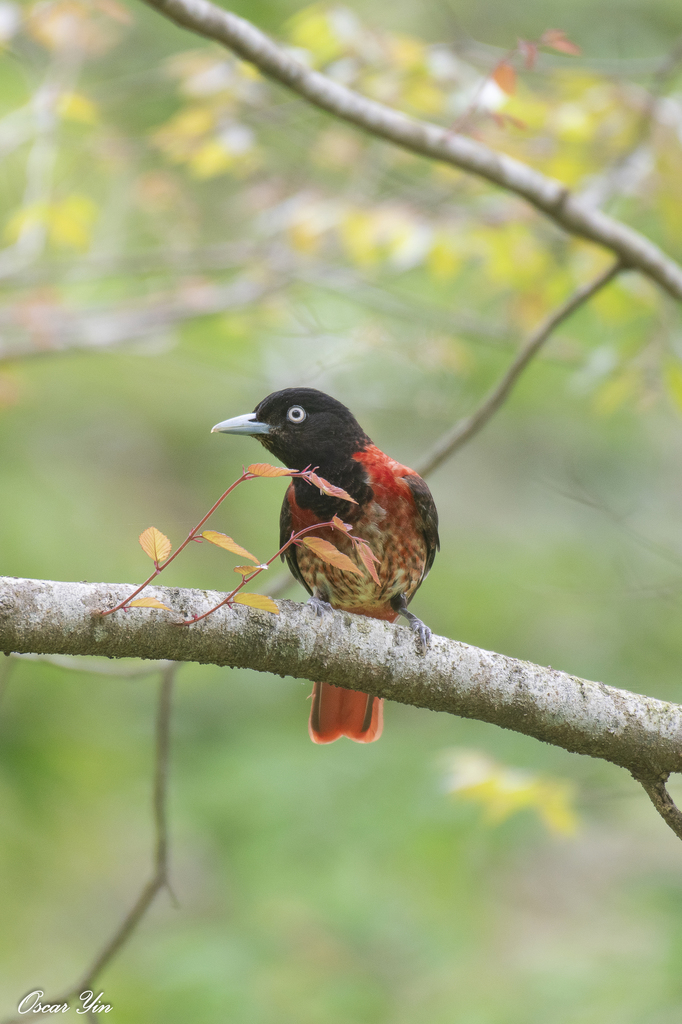
Maroon Oriole
Photo © 尹若宇
Photo © 尹若宇 — CC BY-SA 4.0 — Source: iNaturalist photo #183252665Identification
The maroon oriole is a medium-sized oriole, measuring 25–28 cm in length. Adult males are unmistakable, displaying glossy crimson-maroon plumage on the body and tail, contrasted sharply with a jet-black head, neck, and wings. The bill is distinctively bluish. Females and immature males are notably different, showing greyish-white underparts heavily streaked with black and somewhat darker overall plumage. Plumage coloration varies geographically: birds from the Indian Subcontinent tend to be duller, while those across Southeast Asia display brighter, more reddish tones.
Range & Habitat
The maroon oriole is found across Southeast Asia and the eastern Himalayas, with its range spanning Bangladesh, Bhutan, Cambodia, India, Laos, Myanmar, Nepal, Taiwan, Thailand, Tibet, and Vietnam. In India specifically, the species occurs from Himachal Pradesh eastward through Arunachal Pradesh and the hills of Manipur. Four subspecies are recognised, each occupying distinct regions from the Himalayas through southern China, northern Indochina, Taiwan, Hainan, and southern Indochina. The bird inhabits subtropical and tropical moist lowland forests, showing a preference for forested environments across its wide range.
Behaviour & Diet
Maroon orioles are generally solitary or found in pairs rather than flocks. They are active foragers feeding on wild figs, berries, insects, and nectar. The breeding season occurs from April to May, during which both males and females participate equally in parental care. The species constructs a distinctive deep, massive cup-shaped nest woven from bast fibre and bound together with cobwebs—a characteristic construction typical of orioles and a useful identifying feature if a nest is encountered.
Best Time & Places to See It
The breeding season from April to May offers the best opportunity to observe maroon orioles, as birds are more vocal and active during this period. Travellers should focus on subtropical and tropical moist lowland forests throughout the species' range. Key regions include the forested hills of northeastern India (particularly Arunachal Pradesh and Manipur), the forests of Myanmar, northern Thailand, Laos, and Cambodia. Taiwan and Hainan also support distinct populations. Early morning is typically the best time for birding, as orioles are most active at dawn.
Photography Tips
The striking contrast between the male's glossy maroon plumage and black head makes for compelling photography, particularly when backlighting highlights the crimson sheen. Use fast shutter speeds (at least 1/1000th second) to freeze the birds' often-rapid movements through the forest canopy. Females and immatures present a different challenge; their subtle plumage requires careful exposure metering to capture the streaking on greyish-white underparts. Forest habitats demand high ISO settings and wide apertures. Patient positioning near fruiting fig trees or flowering plants during the breeding season can yield rewarding opportunities, as birds concentrate on feeding and are more predictable in their movements.
Bardiya National Park
Chitwan National Park
Doi Inthanon National Park
Gaoligong Mountain National Nature Reserve
Kaziranga National Park
Khangchendzonga National Park
Khaptad National Park
Langtang National Park
Makalu Barun National Park
Nothing matches these filters.
No community photos yet. Log in to add the first one.
No community observations of this species yet.