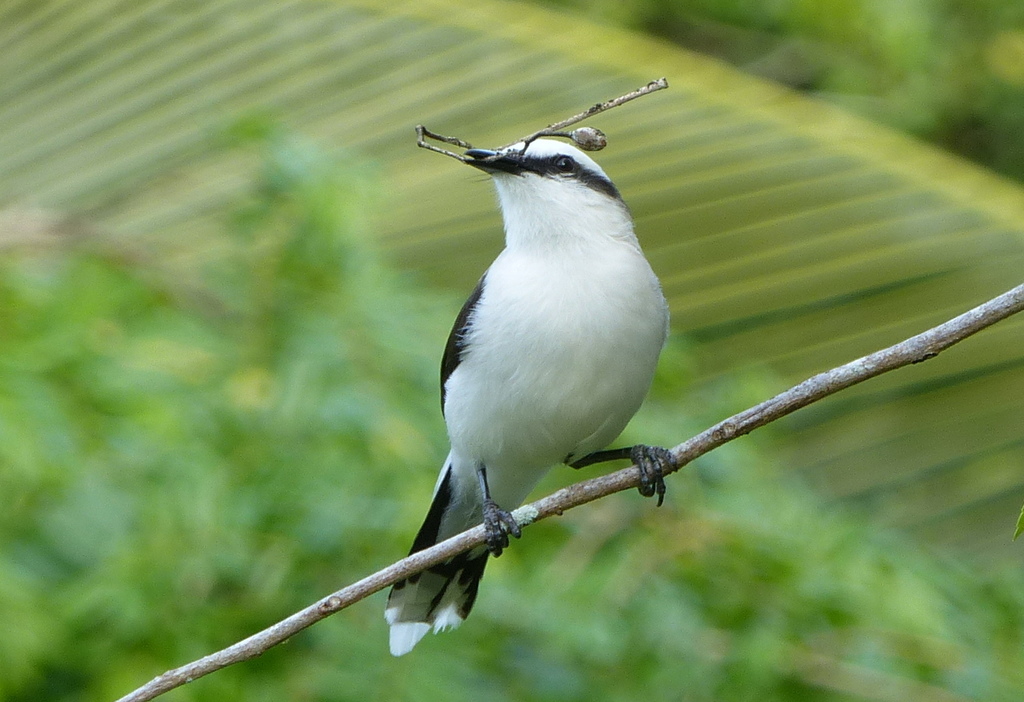
Masked Water Tyrant
Photo © Helio Lourencini
Photo © Helio Lourencini — CC BY 4.0 — Source: iNaturalist photo #100426463Identification
The masked water tyrant is a small bird, 14.5 to 15 cm long, with distinctive plumage that makes it unmistakable in the field. Adults are predominantly white with a striking black stripe running through the eye—the characteristic "mask" that gives the species its name. The back is tinged brownish-gray, while the wings and tail are black; the tail feathers are tipped with white. Both sexes share identical plumage. The bird has a dark iris, black bill, and black legs and feet. Two subspecies exist: the nominate F. n. nengeta and F. n. atripennis, which occurs in northwestern South America and has blacker wings with variable white fringes on the tertial feathers.
Range & Habitat
The masked water tyrant has a highly disjunct distribution across northern and eastern South America. The nominate subspecies is found throughout much of eastern and southern Brazil, from Pará and Tocantins eastward to Rio Grande do Norte, and southward to Mato Grosso do Sul and Santa Catarina, with its range extending into northeastern Argentina's Misiones Province. It has been recorded as a vagrant in Paraguay and Uruguay. Subspecies F. n. atripennis is restricted to extreme southwestern Colombia, western Ecuador, and far northwestern Peru.
This species favors open shrublands near freshwater bodies, especially marshy areas and rice fields. It frequents the banks of ponds, lakes, streams, and rivers, and occasionally ventures into nearby grasslands. In recent decades, it has increasingly colonized urban and suburban parks throughout Brazil. The nominate subspecies typically occurs from sea level to about 300 m elevation, though occasionally higher, while F. n. atripennis remains below 800 m in Ecuador.
Behaviour & Diet
The masked water tyrant is a year-round resident throughout its range. It feeds exclusively on insects, usually foraging singly or in pairs near or on the ground and among floating and emergent vegetation. The bird is notably tame and conspicuous, capturing prey through short sallies, quick runs, and upward leaps. During breeding season, pairs engage in elaborate displays, raising, spreading, and bobbing their tails; males may also fan their tail and spread their wings. The nest is a distinctive ball constructed from grass and stems with a side entrance. Females lay clutches of three brown-spotted white eggs and incubate them alone for approximately 15 days, while both parents feed the nestlings.
Best Time & Places to See It
As a year-round resident, the masked water tyrant can be encountered throughout the year in its range. In Brazil, look for it in marshy areas, rice fields, and wetland margins, particularly in the states of the southeast and south. Urban and suburban parks in major Brazilian cities now offer reliable viewing opportunities. For the western subspecies, Ecuador's wetlands and marshy habitats provide the best chances. The species' tame nature and preference for open habitats make it relatively easy to locate compared to many tropical birds.
Photography Tips
The masked water tyrant's white plumage and dark markings offer excellent contrast for photography. The bird's conspicuous behavior and tendency to forage in open areas near water allow for relatively close approach. Early morning light will best showcase the striking facial mask and white underparts. Photograph the bird in its preferred habitat of marshes or rice fields for environmental context, or capture behavioral sequences as it performs its characteristic tail displays and leaping feeding sallies. The bird's small size and low perching habits require careful positioning to avoid backlighting.
Carlos Botelho State Park
Catimbau National Park
Cerros de Amotape National Park
Chapada Diamantina National Park
Emas National Park
Encontro das Águas State Park
Guirá State Park
Ibitipoca State Park
Iguaçu National Park
Nothing matches these filters.
No community photos yet. Log in to add the first one.
No community observations of this species yet.