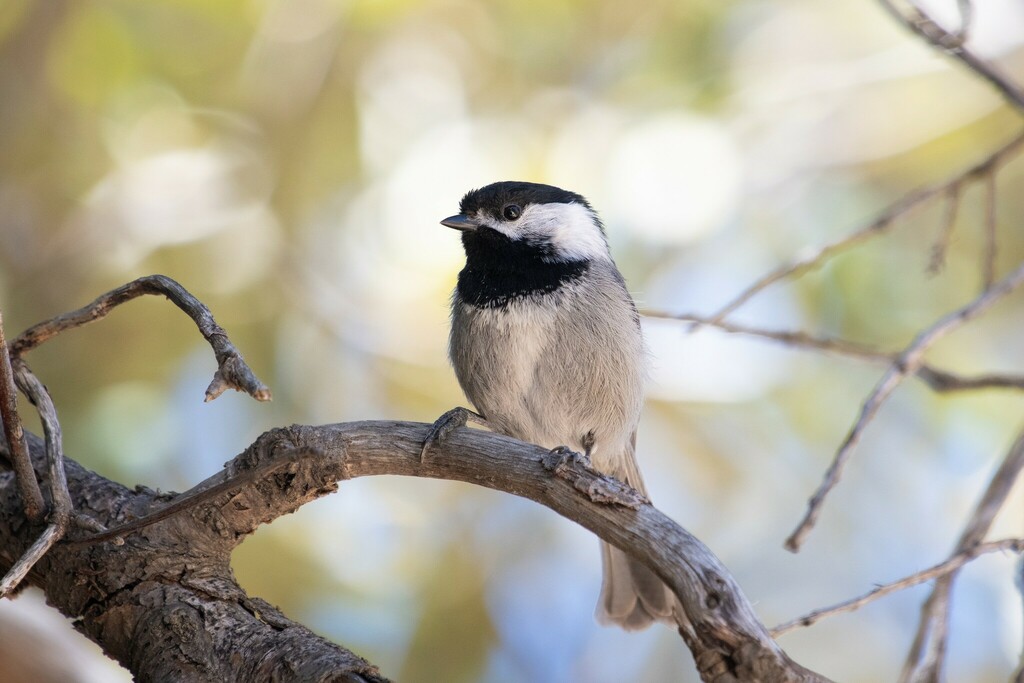
Mexican Chickadee
Photo © Adam Jackson
Photo © Adam Jackson — CC0 1.0 — Source: iNaturalist photo #339594969Identification
The Mexican Chickadee is a small songbird, approximately 13 cm (5.1 in) long and weighing 9–12 g. Both sexes share identical plumage. The most distinctive feature is an extensive black cap extending from eye level upward, combined with a black hindneck displaying a subtle bluish gloss. The face is predominantly white, but the chin, throat, and upper breast are pure black—notably more extensive than in other chickadee species. The back is deep olive-gray or mouse-gray, while wings and tail appear slate-gray with paler edges. The belly and lower breast are white, with paler olive-gray flanks. The eyes are dark brown, the bill black, and the legs and feet bluish. Juveniles display grayer heads than adults, though subspecies differences are too subtle for field identification.
Range & Habitat
The Mexican Chickadee occupies a disjunct range across Mexico and the southwestern United States, with four geographically separated subspecies. In the U.S., it occurs in extreme southeastern Arizona and southwestern New Mexico; historically it was also found in Texas's Davis Mountains. Within Mexico, populations extend from Sinaloa through the Sierra Madre Occidental to Durango, and in separate populations from Coahuila to Oaxaca. The species inhabits pine, pine-oak, and spruce-fir forests in subtropical and tropical zones, typically between 1,500–3,900 m (4,900–12,800 ft) elevation, with higher elevations preferred in the U.S. breeding range.
Behaviour & Diet
The Mexican Chickadee is primarily a year-round resident, though some populations in Arizona, New Mexico, and scattered Mexican locations descend to lower elevations during winter. It feeds predominantly on adult and larval insects, gleaning food from leaves and twigs throughout coniferous trees, with a preference for the crowns and periphery of deciduous trees. Feeding birds often hang upside-down and may briefly hover to snatch prey. In winter, they commonly join mixed-species feeding flocks numbering up to 100 birds. During breeding season (early April to mid-July), females construct cup nests of soft materials inside natural or artificial cavities, sometimes excavating their own. Clutches reach up to nine dull-white eggs with pale reddish-brown spots. Remarkably, this species uniquely applies crushed toxic beetles to the nest hole exterior, presumably as a predator deterrent—a behavior unrecorded in any other Paridae family member.
Best Time & Places to See It
The Mexican Chickadee is a permanent resident throughout most of its range, making it viewable year-round in appropriate habitat. In the U.S., visit the mountain forests of southeastern Arizona and southwestern New Mexico at elevations above 2,100 m. In Mexico, higher-elevation pine and mixed forests from Sinaloa southward, particularly above 2,200 m, offer the best viewing opportunities. Winter months may provide easier observation in the U.S., as some lowland Mexican populations descend seasonally and mixed-species feeding flocks are particularly active, improving detection rates.
Photography Tips
The Mexican Chickadee's small size and canopy-foraging habits demand patience and a telephoto lens (at least 400–600 mm recommended). Position yourself quietly near pine or mixed-oak-pine forest edges where birds forage on outer branches. Early morning produces better light and more active birds. Watch for mixed feeding flocks in winter, as this improves your odds of locating individuals. The bird's distinctive black-and-white face pattern and dark cap provide strong contrast—expose for the white face to retain detail in the extensive black markings. Capture behavior shots of the characteristic upside-down feeding posture by positioning yourself below foraging trees when possible.
Arizona in Winter
Nothing matches these filters.
Cave Creek Canyon
Chiricahua Mountains
Parque Nacional Benito Juárez
Tutuaca
Nothing matches these filters.
No community photos yet. Log in to add the first one.
No community observations of this species yet.