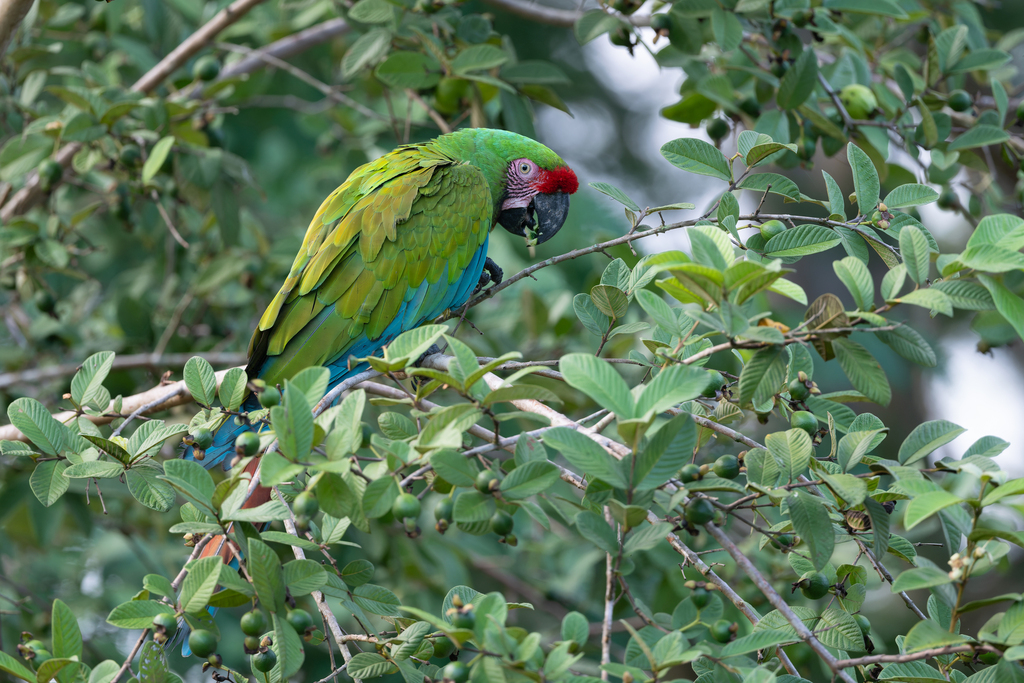
Military Macaw
Photo © Adam Jackson
Photo © Adam Jackson — CC0 1.0 — Source: iNaturalist photo #691132372Identification
The military macaw is a medium to large-sized parrot measuring 70 to 85 centimeters long with a wingspan of 99–110 cm. It is named after its distinctive plumage, which vaguely resembles a military uniform—predominantly green with bright-red patches on the forehead, light-blue and yellow flight and tail feathers. Like all macaws, it has a bare facial patch, whitish in colour with black striations, a large slate-grey to blackish bill, and a yellow iris.
Military macaws are visually similar to great green macaws but can be distinguished by their smaller size, completely black bill, and overall darker, deeper green plumage. The three recognized subspecies vary slightly in size and coloration, with the mexicana subspecies being the largest and militaris the smallest.
Range & Habitat
The military macaw is native from west-central Mexico south through northern Argentina and Bolivia. The three subspecies occupy distinct geographical ranges: A. m. mexicana in Mexico; A. m. militaris in Colombia, northwestern Venezuela, Ecuador, Peru, and Bolivia; and A. m. bolivianus in Bolivia and Argentina. Interestingly, the species is absent from Central America, possibly due to local habitat changes and competition with the closely related great green macaw.
These macaws typically inhabit tropical deciduous and semi-deciduous forests, where they are canopy-dependent species requiring large trees for feeding, breeding, nesting, and protection from predators and heat. They typically live at elevations of 600 to 1500 meters—higher than most other macaw species—though they may seasonally descend to lowlands with humid forests and thorny woodlands. They nest in tree cavities at least 15 meters tall and 90 centimeters wide, or more often in cliff faces over 600 feet above the ground.
Behaviour & Diet
Military macaws are highly social birds living in large flocks and are among the longest-lived parrot species, reaching 50–60 years in the wild. They are notably vocal and can often be heard long before being seen, making a variety of loud cracking and shrieking sounds including a distinctive loud kraa-aak call. Activity is most frequent in the morning and evening, indicating they are likely a crepuscular species.
Their diet consists mostly of seeds supplemented with fruits and leaves, though they have a somewhat narrow dietary range. Flocks forage together from dawn, often gathering at "macaw licks"—clay deposits along riverbanks and in the Amazon rainforest—which appear to remove toxins from seeds and vegetation while providing essential dietary salt. Pair-bonding includes grooming and regurgitation, with courtship beginning as early as March and breeding occurring between March and October, with fledging between January and March.
Best Time & Places to See It
Military macaws are most active and vocal during morning and evening hours, making these the best times for observation and photography. Their presence in large flocks and distinctive loud calls make them relatively conspicuous despite inhabiting the forest canopy. The species remains common in zoos and parks worldwide, but wild populations are concentrated in the Andean regions of Mexico, Colombia, Venezuela, Ecuador, Peru, Bolivia, and Argentina at elevations between 600 and 1500 meters in deciduous and semi-deciduous forests.
Photography Tips
The military macaw's striking green and red plumage and large size make it visually rewarding to photograph. Their crepuscular activity patterns mean that early morning and late afternoon light often provides optimal conditions. The birds' habit of calling frequently before appearing allows photographers to anticipate their presence. Photographing them in their natural canopy habitat at elevation can present challenges due to height and dense foliage, but their gregarious nature means multiple individuals may appear together, offering compositional opportunities. Their bare facial patches and yellow iris provide striking focal points for detailed portrait shots.
Yasuní National Park
Aguarico, Ecuador
+601 birds+43 mammals
Where the western Amazon basin converges with Ecuador's Orellana Province, lowland rainforest reaches toward the horizon in an unbroken canopy of staggering botanical density. Yasuní National…
VIEW NATIONAL PARKSumaco Napo-Galeras National Park
Loreto, Ecuador
+563 birds+4 mammals
Where Ecuador's Amazon transitions into cloud forest, a massive shield volcano rises from the emerald lowlands of Orellana Province, anchoring one of the continent's most biodiverse…
VIEW NATIONAL PARKAntisana National Park
Quijos, Ecuador
+432 birds+21 mammals
Where the eastern Andean slopes descend into the Amazon basin, Antisana National Park sprawls across roughly 2,500 square kilometers of some of South America's most dramatic…
VIEW NATIONAL PARKNatural Sumapaz National Park
Cubarral, Colombia
+368 birds+1 mammals
Where the Andes descend toward the Amazon basin, the high páramo grasslands of Sumapaz National Park sprawl across more than five thousand square kilometers of Meta…
VIEW NATIONAL PARKNatural Sierra de la Macarena National Park
Vista Hermosa, Colombia
+566 birds+15 mammals
Across nearly 20,000 square kilometres of Colombia's Meta Department, the terrain rises from lowland savanna into Andean foothills through a mosaic of gallery forests, palm-fringed wetlands,…
VIEW NATIONAL PARKOtishi National Park
Río Tambo, Peru
+108 birds
Where the Andes descend toward the Amazon basin, vast cloud forests cloak the ridges and valleys of Peru's Río Tambo watershed, and this is where Otishi…
VIEW NATIONAL PARKYanachaga–chemillén National Park
Palcazu, Peru
+639 birds+6 mammals
Where the eastern slopes of Peru's central cordillera plunge into cloud forest, Yanachaga–Chemillén National Park protects nearly three thousand square kilometres of montane wilderness that few…
VIEW NATIONAL PARKManu National Park
Manu, Peru
+892 birds+26 mammals
Across the eastern slopes of the Peruvian Andes, tropical rainforest descends into the Amazon basin with a complexity that few terrestrial ecosystems match. Manu National Park…
VIEW NATIONAL PARKBahuaja Sonene National Park
San Pedro de Putina Punco, Peru
+602 birds+8 mammals
Where the Madre de Dios and Heath rivers converge in southeastern Peru rises one of South America's most biodiverse wilderness regions: a vast protected realm of…
VIEW NATIONAL PARKTingo Maria National Park
Mariano Dámaso Beraún, Peru
+423 birds
Where the eastern slopes of the Peruvian Andes descend toward the Amazon basin, the landscape fractures into a maze of limestone ridges, humid gorges, and cloud-wrapped…
VIEW NATIONAL PARKCordillera Azul National Park
Pampa Hermosa, Peru
+322 birds+1 mammals
Where the eastern Andes descend into the western Amazon basin, Cordillera Azul National Park sprawls across nearly 38,000 square kilometres of some of Peru's most pristine…
VIEW NATIONAL PARKNo community photos yet. Log in to add the first one.
No community observations of this species yet.