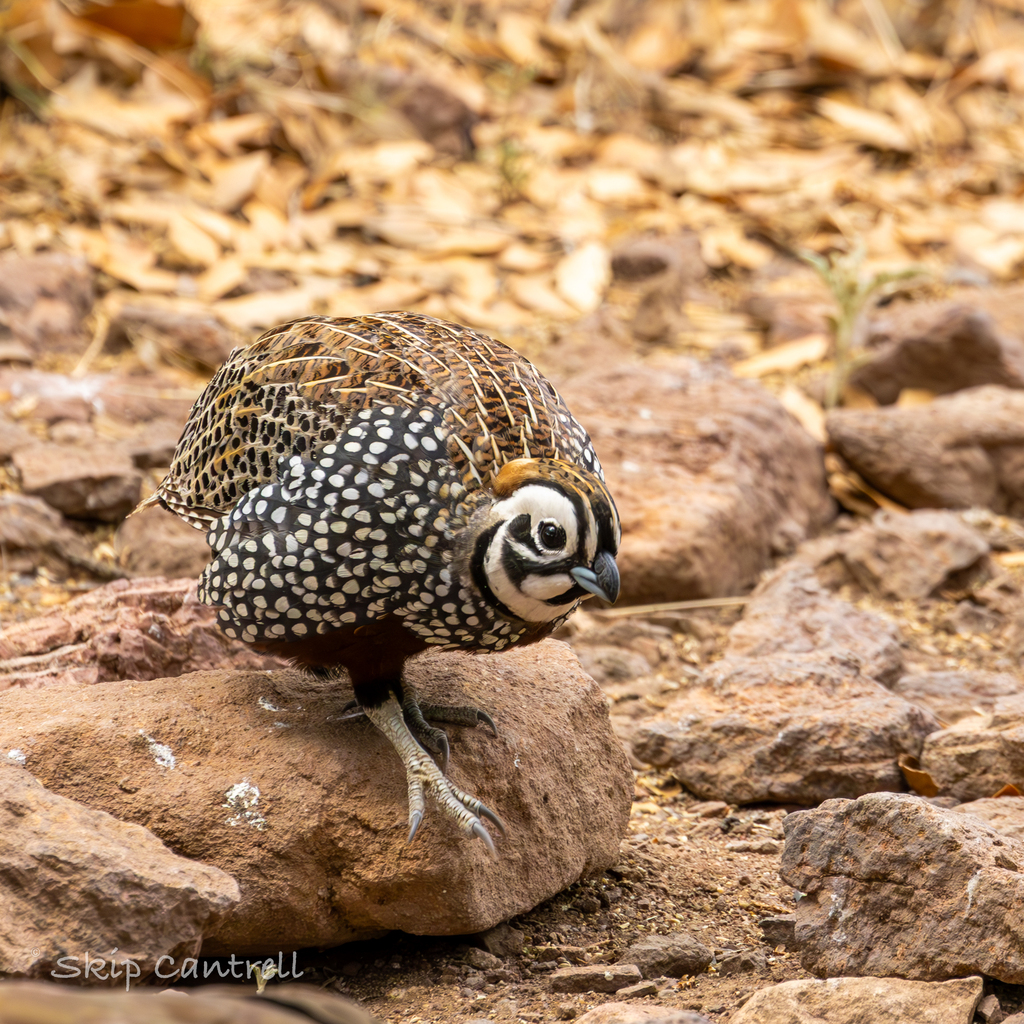
Montezuma Quail
Photo © tcantrell52
Photo © tcantrell52 — CC BY 4.0 — Source: iNaturalist #223643309Identification
The Montezuma quail is one of North America's shortest quails, measuring just 20–23 cm in length, though it weighs as much as some taller species at 122–230 grams. Its compact, plump build and notably short tail distinguish it immediately. The bird's most striking feature is its distinctive long, front-to-back profile created by a prominent crest on the nape, topped with a single tan plume. An unusual adaptation is its long, sickle-shaped claws, used for digging in the soil.
Males display a spectacular face pattern—a striking swirling design of black and white that gives the species one of its alternative names, the harlequin quail. Both sexes share tan backs and wing coverts adorned with light-buff streaks and black spots arranged in bars. The sides are blue-gray (appearing almost black) with bold spots; northern birds show white spotting, while southern birds display white spots fading to chestnut toward the rear. Females lack the bold male face pattern but show a subtle suggestion of it. The bill is distinctively black above and bluish-gray below.
Range & Habitat
This secretive species ranges from Oaxaca in southern Mexico northward through the Mexican interior to the mountains of central and southeastern Arizona, central and southwestern New Mexico, and West Texas. The bird is notably absent from deserts and the Río Balsas valley. Its range is unfortunately decreasing and becoming fragmented, presenting conservation concerns for this understated but fascinating quail.
Montezuma quails favor open woodlands, particularly oak forests, though pine-oak and juniper woodlands also provide suitable habitat. The critical requirement is grass at least 30 centimeters tall for cover. Hill slopes and canyons are particularly favored locations, where the birds can move through this verdant understory relatively unseen.
Behaviour & Diet
Unlike most American quails that form large flocks, Montezuma quails remain remarkably social but in small family units. Fall coveys average just eight birds—typically parents and offspring—though larger gatherings exceeding 25 birds have been documented. These birds are highly sedentary, usually foraging within 50 meters of the previous day's feeding area. Fall and winter territories are tiny, spanning only 1 to 5 hectares, though breeding pairs expand into territories as large as 50 hectares during nesting season.
The species has gained the colloquial name "fool quail" for its behavior: when encountering humans, these birds crouch motionless in tall grass rather than fleeing, sometimes allowing approach to within a meter before erupting into flight with a distinctive loud, popping wing noise. Occasionally, they are approachable enough to be caught by hand. Montezuma quails eat insects extensively during summer months alongside plant foods, particularly bulbs such as Oxalis. Males sing from the ground—unusual among quails—producing an eerie, melancholy descending whistle or insect-like buzz.
Best Time & Places to See It
Montezuma quails breed beginning in July or August, coinciding with monsoon rains across their range. Males begin their territorial vocalizations earlier, from February or March onwards. This timing can help guide observers, as the males' distinctive calls become more frequent during breeding season. The species' sedentary nature means that birds found in one location are likely to remain nearby, improving chances for repeat observation.
The mountainous regions of Arizona, New Mexico, and West Texas offer the most accessible opportunities for northern observers, while central and southeastern Mexico provide habitat throughout the species' range. Focus your search on oak-dominated slopes and canyons with healthy grass cover, paying particular attention to southeast-facing slopes where birds roost at night, gathered around rocks or grass tussocks facing outward in defensive formation.
Photography Tips
Patience and stillness are essential for photographing this cryptic species. The Montezuma quail's tendency to freeze rather than flee offers a unique opportunity—move slowly and deliberately through suitable habitat, watching for the sudden explosive takeoff that betrays a bird's presence. Early morning and late afternoon, when birds are most active in foraging, provide the best light and highest encounter rates.
Given the bird's small size and preference for dense grassland, a telephoto lens of at least 300–400mm is advisable. The male's dramatic black-and-white facial markings and blue-gray sides are photogenic subjects, so position yourself to capture these distinctive field marks. The bird's unusual ground-level calls and breeding behaviors offer opportunities beyond simple perched portraits—document the characteristic posture as birds crouch in grass, and try to capture the explosive, wing-popping takeoff that characterizes their escape behavior.
Big Bend National Park
Brewster County, United States
+345 birds+34 mammals
Where the Chisos Mountains rise abruptly from the Sonoran Desert floor, Big Bend National Park spans over 7,300 square kilometers of one of North America's most…
VIEW NATIONAL PARKSaguaro National Park
Rincon Valley, United States
+354 birds+40 mammals
Where the Sonoran Desert meets sky-island mountains, two geographically separated districts of Saguaro National Park sprawl across nearly two thousand square kilometers of Arizona's most iconic…
VIEW NATIONAL PARKCarlsbad Caverns National Park
Eddy County, United States
+309 birds+18 mammals
Beneath the Chihuahuan Desert floor of southern New Mexico lies one of North America's most spectacular subterranean landscapes. Carlsbad Caverns National Park encompasses over 518 square…
VIEW NATIONAL PARKTutuaca
Tosanachi, Mexico
+147 birds+13 mammals
Where copper canyons plunge deeper than the Grand Canyon itself, Mexico's remote Sierra Madre Occidental unfolds in dramatic vertical relief. Tutuaca anchors this wilderness realm, a…
VIEW PROTECTED LANDSCAPEGuadalupe Mountains National Park
Culberson County, United States
+262 birds+14 mammals
Where fossil-laden limestone ridges thrust skyward above the Chihuahuan Desert floor, Guadalupe Mountains National Park reveals a landscape sculpted by ancient seas and relentless aridity. These…
VIEW NATIONAL PARKBosque del Apache National Wildlife Refuge
Socorro County, United States
+345 birds+17 mammals
Where the Rio Grande emerges from its desert canyon in central New Mexico, a narrow ribbon of riparian woodland defies the arid landscape that surrounds it.…
VIEW WILDLIFE SANCTUARYNo community photos yet. Log in to add the first one.
No community observations of this species yet.