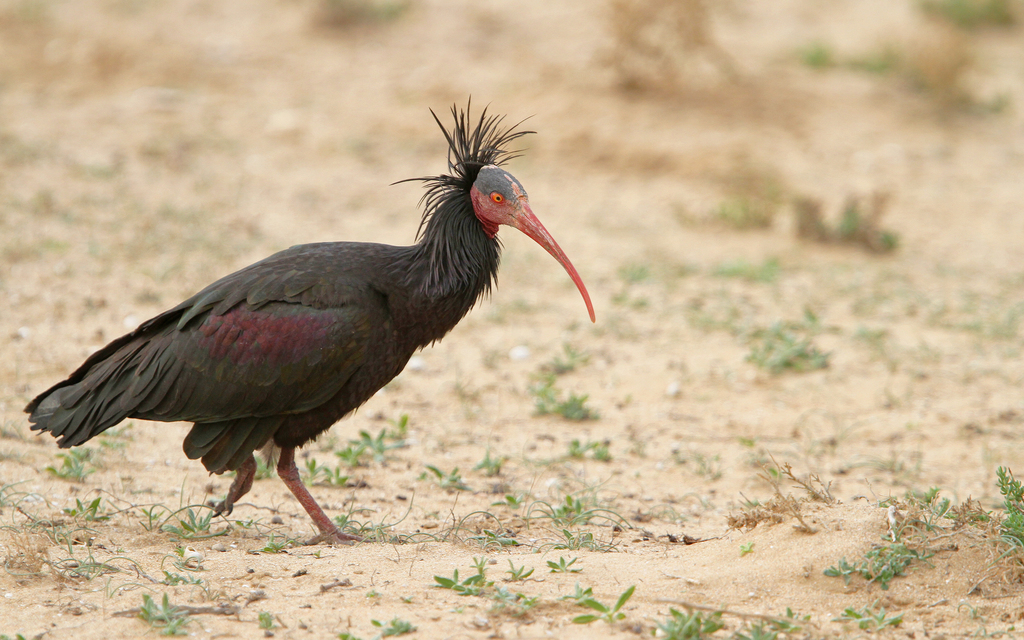
Northern Bald Ibis
Photo © Christoph Moning
Photo © Christoph Moning — CC BY 4.0 — Source: iNaturalist photo #97487498Identification
The Northern Bald Ibis is a striking and unmistakable large black bird, measuring 70–80 cm long with a wingspan of 125–135 cm. Its most distinctive feature is its entirely unfeathered bright red head and face, combined with a long, curved red bill and red legs. The plumage is glossy black with an iridescent bronze-green and violet sheen, and a wispy ruff adorns the hind neck. In flight, the bird displays powerful, shallow, and flexible wing beats. Males are generally larger than females and possess noticeably longer bills—a trait that helps them succeed in attracting mates at breeding colonies. Juveniles can be distinguished by their dark head, light grey legs, and pale bill, with the unfeathered areas gradually becoming red as the bird matures.
Unlike many ibis species, the Northern Bald Ibis is non-wading, setting it apart from its relatives. It can be confused with the similarly dark Glossy Ibis where ranges overlap, but the Northern Bald Ibis is notably larger and stockier. Its closest relative, the Southern Bald Ibis of southern Africa, is easily distinguished by its whitish face rather than red.
Range & Habitat
Once widespread across the Middle East, northern Africa, and southern and central Europe with a fossil record extending back at least 1.8 million years, the Northern Bald Ibis has suffered a dramatic range contraction. The species disappeared entirely from Europe over 300 years ago, though reintroduction programmes are now underway across the continent. By 2019, approximately 700 wild birds remained, concentrated in southern Morocco. The species inhabits open areas including grasslands, rocky mountains, and semi-deserts, typically in locations close to running water.
Current conservation breeding programmes have established semi-wild populations in Turkey (which counted almost 250 birds in 2018), as well as reintroduction sites in Austria, Italy, Spain, and northern Morocco. Approximately 2,000 birds exist in captivity globally, representing crucial backup populations for future restoration efforts.
Behaviour & Diet
The Northern Bald Ibis is a migratory species that breeds colonially on coastal or mountain cliff ledges, a behaviour that distinguishes it from many other ibis species which favour tree colonies. Pairs typically lay two to three eggs in stick nests constructed on these cliff faces. The species feeds on lizards, insects, and other small animals, foraging in open habitats rather than wading in wetlands like its relatives.
At breeding colonies, the bird produces guttural "hrump" calls and high, hoarse "hyoh" sounds, but is otherwise silent. The species is gregarious and highly social, particularly during the breeding season when colonies form on cliff ledges.
Best Time & Places to See It
Southern Morocco offers the most reliable opportunity to see wild Northern Bald Ibises, where the largest remaining population persists. For those interested in reintroduction efforts and semi-wild populations, Turkey hosts a significant breeding colony. Additional reintroduction sites operate in Austria, Italy, and Spain, where sightings may be possible as these programmes expand.
The species' migratory nature means timing varies by location and population. Local guides and conservation organisations working on reintroduction programmes can provide current information on the best seasons and specific sites for observation.
Photography Tips
The Northern Bald Ibis's bold, contrasting plumage and striking red head make it visually dramatic for photography. The glossy black feathers with their bronze-green and violet iridescence photograph particularly well in strong, directional light that accentuates these subtle colours. The unfeathered red face and head are key identifying features that should be clearly captured.
Photographing birds at cliff-breeding colonies offers opportunities for behaviour shots, including nest-building and interaction between pairs. The bird's distinctive silhouette in flight, with its powerful wing beats and long curved bill, provides compelling flight photography subjects. When visiting reintroduction sites or wild populations in Morocco, work with local conservation staff who can advise on ethical and legal photography practices that do not disturb these vulnerable birds.
Vorpommersche Boddenlandschaft National Park
Küstengewässer einschließlich Anteil am Festlandso, Germany
+230 birds+19 mammals
Where the Baltic coast dissolves into a labyrinth of shallow lagoons and coastal wetlands, Vorpommersche Boddenlandschaft National Park protects one of northern Europe's most dynamic and…
VIEW NATIONAL PARKSchleswig-Holsteinisches Wattenmeer National Park
Germany
+378 birds+49 mammals
Where the North Sea ebbs and flows across a vast expanse of exposed mud and sand, the Schleswig-Holsteinisches Wattenmeer National Park reveals one of Europe's most…
VIEW NATIONAL PARKDoñana National Park
Hinojos, Spain
+300 birds+13 mammals
Where the Guadalquivir River delta spreads into the Atlantic, vast marshes, cork woodlands, and coastal dunes converge to create one of southwestern Europe's most biodiverse wetland…
VIEW NATIONAL PARKSierra de Guadarrama National Park
Rascafría, Spain
+179 birds+13 mammals
Where granite peaks rise abruptly from the central Spanish plateau, the Sierra de Guadarrama National Park unfolds across more than eleven hundred square kilometres of montane…
VIEW NATIONAL PARKEstrecho Natural Park
Pedro Valiente, Spain
+281 birds+20 mammals
Where Mediterranean pine forests meet wind-sculpted coastal cliffs, one of Europe's most dynamic ecological crossroads unfolds across the Strait of Gibraltar. Spanning 686 square kilometers of…
VIEW NATURAL PARKGran Paradiso National Park
Cogne, Italy
+120 birds+16 mammals
Where the western Alps rise steeply above the Aosta Valley, granite ridges and alpine meadows converge in a landscape shaped as much by glacial history as…
VIEW NATIONAL PARKDolomiti Bellunesi National Park
Sospirolo, Italy
+76 birds+11 mammals
Where the Dolomites descend into the Veneto foothills near Sospirolo, a landscape of limestone massifs, forested valleys, and rushing waterways creates one of northern Italy's most…
VIEW NATIONAL PARKBelluno Dolomites National Park
Sospirolo, Italy
+72 birds+10 mammals
Where the Dolomites' pale limestone ramparts rise above the Veneto plain, the Belluno Dolomites National Park encompasses a landscape of profound ecological diversity. The park's subarctic-style…
VIEW NATIONAL PARKNo community photos yet. Log in to add the first one.
No community observations of this species yet.