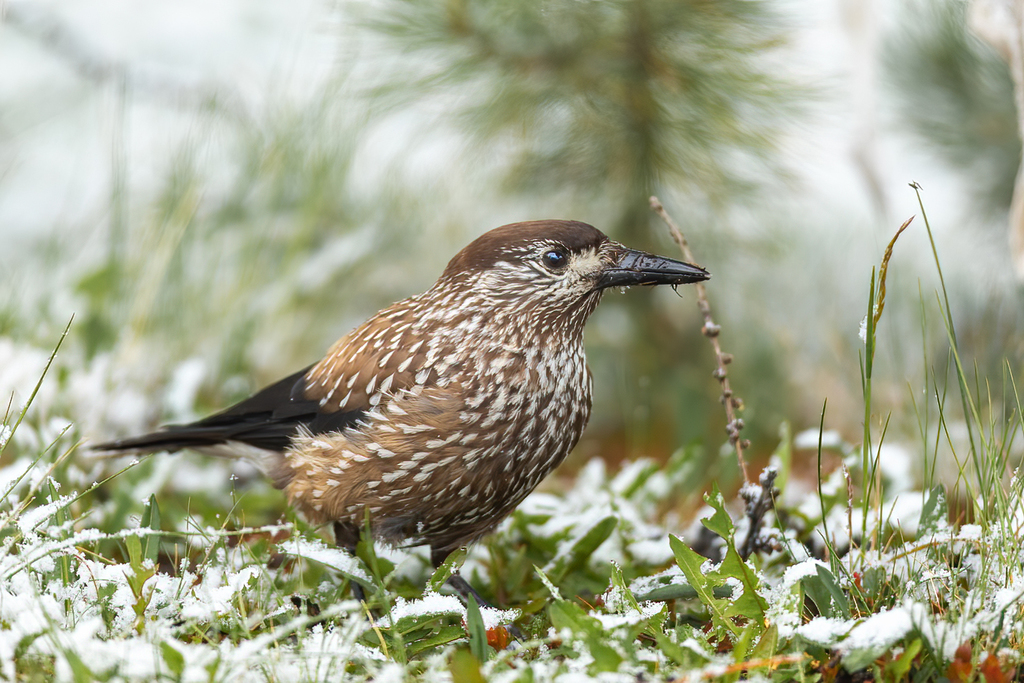
Northern Nutcracker
Photo © egorbirder
Photo © egorbirder — CC BY 4.0 — Source: iNaturalist photo #205729178Identification
The northern nutcracker is a striking corvid, ranging from 32–38 cm in length with a wingspan of 49–53 cm. Slightly smaller than the Eurasian jay, it has a distinctively much larger bill and slimmer head without any crest. The body plumage is mid-to-dark chocolate brown, heavily spotted with white on the face, neck, mantle and underparts. A large white loral spot and white eye-ring are distinctive facial markings. The blackish-brown cap extends onto the nape, while the wings are dark blackish with a striking greenish-blue gloss. In flight, note the broad wings, all-white vent, and short tail with white corners above and a white terminal band on the undertail. The black bill is slender to stout, sharply pointed, and rather long. The voice is loud and harsh—described as kraak-kraak-kraak-kraak—slightly lower-pitched and more monotone than that of a Eurasian jay.
Range & Habitat
The northern nutcracker has an extensive range forming a broad east-west swathe from Scandinavia across northern Europe, Siberia and eastern Asia, including Japan, where it inhabits the vast taiga conifer forests of the north. Disjunct populations also occur in mountain conifer forests further south, in the Alps, Carpathians, and Balkan Peninsula mountains of central and southeast Europe. The species has a global range exceeding 10,000,000 km² with a large global population estimated between 800,000 and 1,700,000 individuals.
Behaviour & Diet
The northern nutcracker is primarily dependent on pine seeds, particularly from cold-climate white pines with large seeds including Swiss pine, Korean pine, Japanese white pine, Macedonian pine, Siberian dwarf pine, and Siberian pine. In regions where these pines don't occur, spruce seeds and hazel nuts become important dietary components. Birds that consume hazel nuts have thicker bills with a special ridge near the base for cracking hard shells. A remarkable adaptation is the forked tip of the tongue, keratinised into nail-like surfaces, which aids in handling and shelling conifer seeds. Beyond seeds, the diet includes various insects, small birds, eggs, nestlings, small rodents, and carrion. The species also avidly excavates bumble bee and wasp nests for grubs. Crucially, nutcrackers store surplus seeds for later use and are responsible for sowing new trees of their favoured pines, including the re-establishment of Swiss pine across large areas of the Alps.
Best Time & Places to See It
Travellers seeking the northern nutcracker should visit conifer forests throughout its extensive range, from Scandinavia and the taiga forests of Siberia to mountainous regions of central and southeast Europe, including the Alps, Carpathians, and Balkans, as well as eastern Asia and Japan. Nesting occurs very early across the species' range to maximise use of stored pine nuts from the previous autumn, with young usually fledged by about 23 days. Pairs remain together for life and maintain territories of 20–30 hectares, so locating established pairs in suitable conifer habitat offers the best opportunities for observation.
Photography Tips
The northern nutcracker's bold white spotting against chocolate-brown plumage and striking white facial markings create excellent photographic subjects in good light. The broad wings and undulating flight pattern offer dynamic shooting opportunities. Look for birds foraging on pine-bearing conifers, particularly on the sunny side of trees where nests are typically built high in the canopy. The bird's characteristic loud, harsh call—the distinctive kraak-kraak-kraak-kraak—can help locate individuals in dense forest habitat. The sharply pointed bill, greenish-blue wing gloss, and contrasting white vent are key field marks worth capturing to document this distinctive corvid.
Aggtelek National Park
Alpilles Regional Nature Park
Åsnens National Park
Baikal National Park
Bavarian Forest National Park
Belluno Dolomites National Park
Białowieża National Park
Biebrza National Park
Bieszczady National Park
Nothing matches these filters.
No community photos yet. Log in to add the first one.
No community observations of this species yet.