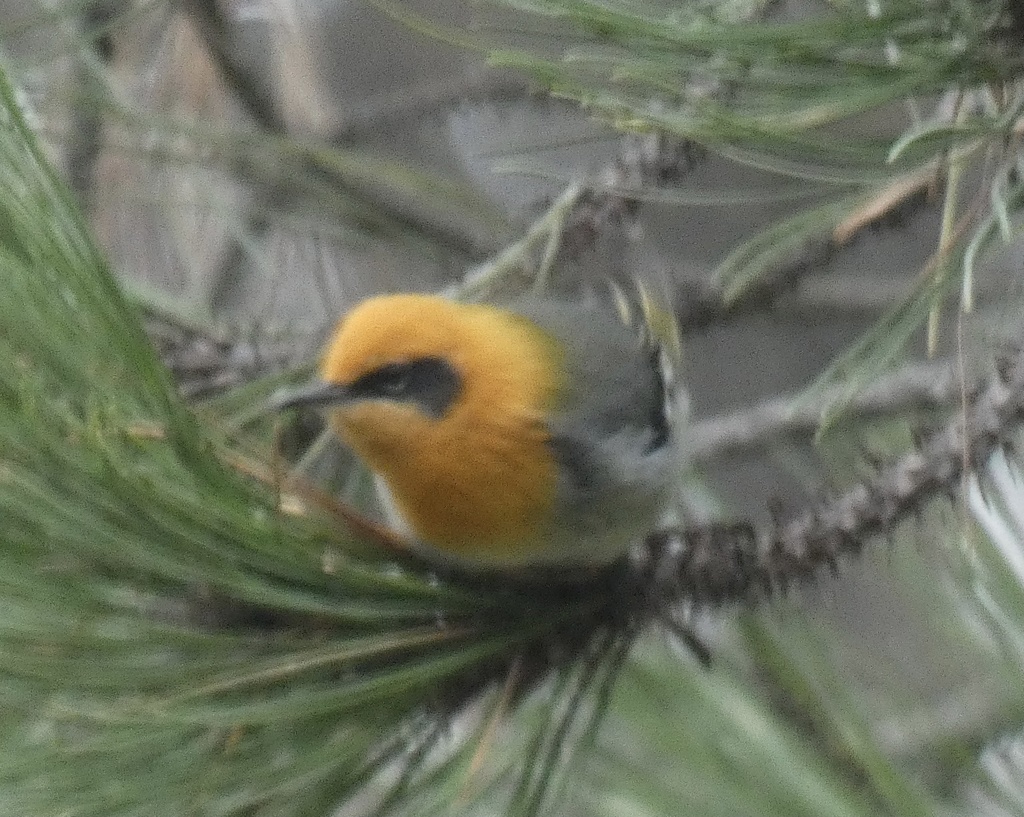
Olive Warbler
Photo © Jean-Paul Boerekamps
Photo © Jean-Paul Boerekamps — CC0 1.0 — Source: iNaturalist #66128133Identification
The Olive Warbler is a small passerine, measuring 13–14 cm in length and weighing 9.5–12 g. Males are distinctive with a grey body, olive-green wings bearing two white wing bars, and a striking tawny-orange head and breast with a bold black eye-stripe. Females and juveniles show yellow where males display orange, with a more diffuse mask. Northern populations are noticeably larger than southern birds. The species is long-winged and relatively slender. Males sing year-round with clear, whistled phrases—rendered as hirrJI hirrJI hirrJI or plida plida plida chir chir—delivered from the canopy, with song frequency peaking in early spring.
Range & Habitat
The Olive Warbler is endemic to North America, breeding from southern Arizona and New Mexico south through Mexico to Nicaragua. Its distribution is continuous in the northern portion of its range but becomes increasingly disjunct in central and southern areas. This is a highland specialist, typically occurring at 2,600 m or higher in the north, with some populations confined above 3,500 m, though southern birds range down to 1,000 m in Honduras and 1,070–1,370 m in Nicaragua. The species inhabits coniferous forests—particularly ponderosa and sugar pine, fir (Abies), and mixed pine-oak woodlands—in both humid and semi-arid settings.
Behaviour & Diet
An obligate insectivore, the Olive Warbler forages actively in the canopy and subcanopy, gleaning insects and arthropods from outer branches and twigs of pines and oaks. Documented prey includes Tortricidae moth larvae, though its full dietary spectrum remains poorly documented. Though traditionally described as non-migratory, evidence suggests northern populations are partial migrants, with most New Mexican birds departing from November through late February. Some individuals may move downslope or disperse widely, with records appearing as far north as Texas. Breeding birds lay 3–4 eggs in tree nests.
Best Time & Places to See It
To locate Olive Warblers, focus on montane pine and mixed conifer forests in Arizona, New Mexico, and Mexico during breeding season (March–October), when males sing persistently, especially in mid-morning and late afternoon. In the northern United States, this is the only practical viewing window; southern populations may be more year-round. Elevation is key—seek out high-elevation coniferous forests above 2,600 m in the north, or the specified elevation bands in Guatemala, Honduras, and Nicaragua. Listening for the diagnostic clear whistles will often lead to sightings before visual contact.
Photography Tips
Patient observers scanning high canopies will be rewarded with this striking warbler. Males' tawny-orange and grey plumage contrasts sharply with the eye-stripe, making them relatively conspicuous when perched. Early morning or late afternoon during spring offers the best chance of encounters, as singing males are most vocal and active then. Use the calls and songs as a guide—locate singing males and position yourself at a distance that allows unobstructed canopy views. The bird's preference for outer twigs means it is often visible if you can track it; a spotting scope or telephoto lens is valuable for highland forest work at distance.
Saguaro National Park
Rincon Valley, United States
+354 birds+40 mammals
Where the Sonoran Desert meets sky-island mountains, two geographically separated districts of Saguaro National Park sprawl across nearly two thousand square kilometers of Arizona's most iconic…
VIEW NATIONAL PARKLagunas de Montebello National Park
Laguna de Montebello, Mexico
+360 birds+2 mammals
Where turquoise lagoons pierce the limestone plateau of southeastern Chiapas, the Lagunas de Montebello National Park unfolds across roughly 174 square kilometers of spectral water and…
VIEW NATIONAL PARKParque Nacional Cerro de la Estrella
Mexico
+126 birds+4 mammals
Where volcanic peaks rise sharply above Mexico City's sprawling metropolis, Parque Nacional Cerro de la Estrella offers a rare glimpse of high-altitude terrain within one of…
VIEW NATIONAL PARKParque Nacional Benito Juárez
San Andrés Huayápam, Mexico
+128 birds+4 mammals
High in the Sierra Madre del Sur of Oaxaca, where cloud forest mingles with pine woodland and the terrain climbs steeply through ravines carved by mountain…
VIEW NATIONAL PARKTutuaca
Tosanachi, Mexico
+147 birds+13 mammals
Where copper canyons plunge deeper than the Grand Canyon itself, Mexico's remote Sierra Madre Occidental unfolds in dramatic vertical relief. Tutuaca anchors this wilderness realm, a…
VIEW PROTECTED LANDSCAPEGrand Canyon National Park
United States
+277 birds+35 mammals
A mile-deep chasm of rust-red rock and purple shadow cuts through the high desert plateau of northern Arizona, revealing nearly two billion years of geological history…
VIEW NATIONAL PARKNo community photos yet. Log in to add the first one.
No community observations of this species yet.