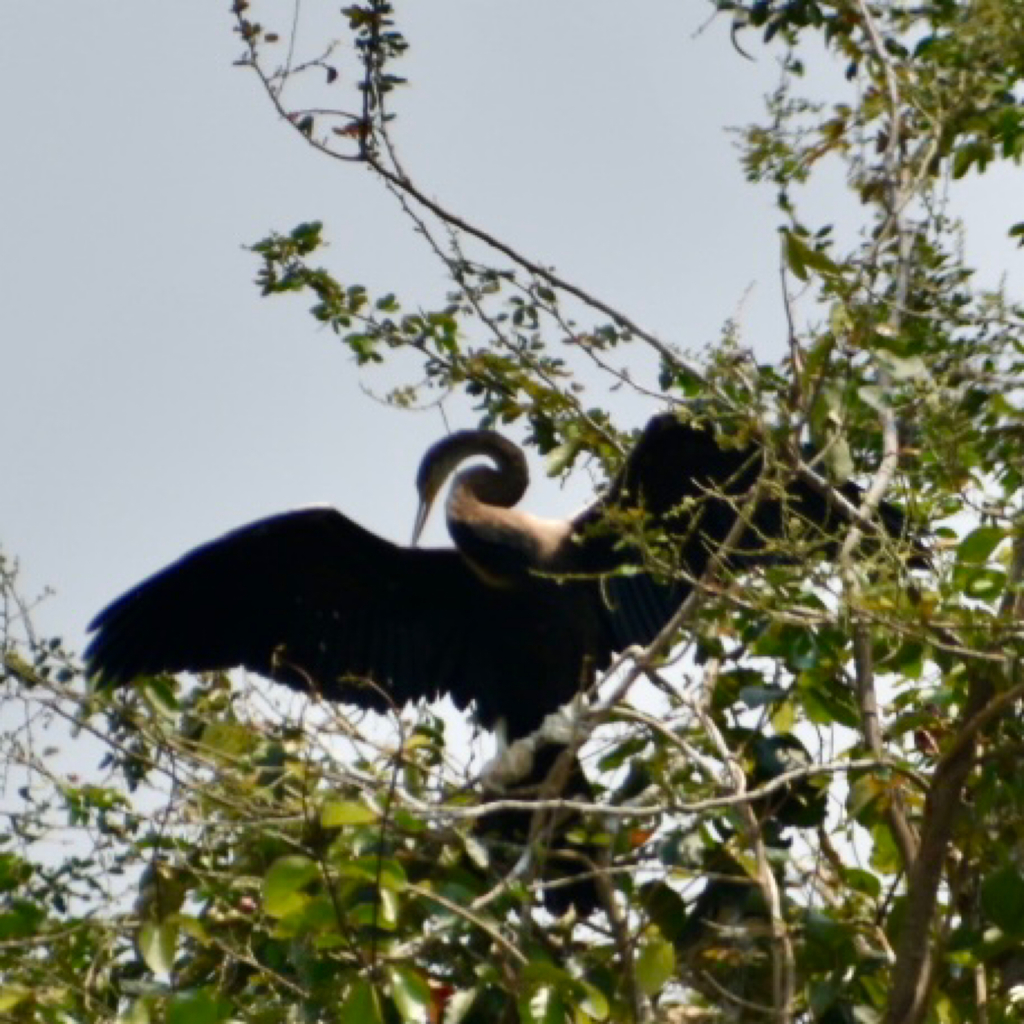
Oriental Darter
Photo © stli_
Photo © stli_ — CC BY 4.0 — Source: iNaturalist #110426178Identification
The Oriental darter is a slender, cormorant-like water bird distinguished by its exceptionally long neck, straight pointed bill, and characteristic hunting posture. Adults display black plumage above with silvery streaks on the wing coverts and tertials, while the crown and neck are brown shading to black. The underparts are blackish brown. A pale line runs over the eye and along the throat, with another stripe down each side of the neck, creating a distinctive striped appearance. The white iris is ringed with yellow, more brightly yellow in breeding birds. The bill is dark at the tip and pale brown at the base, with the lower mandible yellowish. Legs and foot webbing are yellow in immatures and non-breeding birds, but darker grey in breeding adults (with yellow webbing retained). Females have shorter bills and a wide buff band separating black on the chest from the hind neck. Young birds have pale brown necks, appear whitish below, and lack the adult's white neck stripe. In flight, the long slender neck, wide wings, and wedge-shaped tail are distinctive. The tail comprises twelve stiff feathers, which are dragged along the ground when the bird attempts to walk on land.
Range & Habitat
The Oriental darter inhabits tropical South Asia and Southeast Asia, occurring mainly in freshwater lakes and streams. It is found in freshwater environments throughout the region, often near water bodies suitable for hunting and nesting.
Behaviour & Diet
Like cormorants, Oriental darters hunt fish while almost completely submerged, earning them the colloquial name "snakebird" due to the slender neck visible above water. The bird forages singly, swimming slowly forward with webbed feet while jerking its head and neck above water. It uses a highly specialized technique: darting its long, muscular neck forward with rapid force to spear fish underwater, then bringing them to the surface. The bird tosses and juggles its catch before swallowing it head first. The neck's structure features strongly developed muscles around a kink at the 8th and 9th vertebrae, enabling this striking motion. Minute inward-pointing serrations on the mandible edges help hold impaled fish. Like cormorants, Oriental darters have wettable feathers and are frequently seen perched on rocks or branches with wings held open to dry. They sometimes soar on thermals during warm daylight hours but typically alternate flapping and gliding in normal flight.
These birds nest in mixed-species heronries, building stick platforms in nest trees usually surrounded by water. Breeding seasons vary by region: June to August in northern India, April to May in southwestern India, and winter in southeastern India. Typical clutches consist of three to six bluish-green spindle-shaped eggs with white chalky covering. Both parents incubate eggs beginning after the first is laid, causing asynchronous hatching. Chicks are initially bare with down on the head, later becoming covered in white down. Adults undergo synchronous molt of flight feathers after breeding, temporarily losing flying ability. They are largely silent except at the nest, where they produce grunts, croaks, and disyllabic "chigi-chigi-chigi" calls. Chicks are noisy when begging for food. Adults roost communally in waterside trees.
Best Time & Places to See It
Oriental darters are found throughout tropical South Asia and Southeast Asia in freshwater habitats. The breeding season varies regionally and offers opportunities to observe nesting behavior and hear vocalizations at heronries: June to August in northern India, April to May in southwestern India, and winter months in southeastern India. Look for birds hunting singly in freshwater lakes and streams, where they may sometimes be encountered alongside cormorants. Early morning and midday hours, when birds may soar on thermals, offer good viewing opportunities.
Photography Tips
Photograph Oriental darters perched on waterside rocks and trees with wings spread open to dry, a characteristic behavior that provides excellent opportunities for wing detail shots. When hunting, the distinctive silhouette of the submerged body with only the slender neck and head visible above water is highly photogenic and illustrates the "snakebird" moniker well. Capture the bird in its diving and spearing behavior if possible, and photograph the pale eye and colorful bill markings in good light. Breeding birds display brighter yellow eye-rings, so visit heronries during the breeding season for enhanced plumage detail. The long tail, which drags along the ground on land, and the bird's jerky neck movements during foraging make for dynamic action shots. Early morning light is ideal for capturing the silvery streaks on wing coverts and tertials.
Lunugamvehera National Park
Sri Lanka
+204 birds+14 mammals
Dry scrubland and shallow wetlands converge in Sri Lanka's southeastern lowlands, where Lunugamvehera National Park anchors one of the island's most ecologically vital landscapes. The park's…
VIEW NATIONAL PARKMinneriya National Park
Sri Lanka
+158 birds+9 mammals
Across the dry zone of Sri Lanka's North Central Province spreads a landscape of shallow tanks, grassland margins, and scattered dry forest—a mosaic of water and…
VIEW NATIONAL PARKWasgamuwa National Park
Sri Lanka
+156 birds+8 mammals
Dry deciduous forest and open grassland sweep across the North Central lowlands where Wasgamuwa National Park protects one of Sri Lanka's largest remaining tracts of this…
VIEW NATIONAL PARKOrang National Park
Rangagarapathar, India
+298 birds+1 mammals
Where the Brahmaputra's floodplains meet the foothills of Assam, Orang National Park unfolds across a mosaic of riverine grasslands, forests and wetlands that pulse with the…
VIEW NATIONAL PARKRanthambhore National Park
Sawai Madhopur, India
+294 birds+20 mammals
Granite ridges and ravines carved through the Aravalli Range frame this protected landscape in eastern Rajasthan, where deciduous forest mingles with open scrubland and seasonal water…
VIEW NATIONAL PARKMu Ko Ang Thong National Park
Thailand
+47 birds+1 mammals
Forty-two limestone islands rise from the Gulf of Thailand, their weathered karst peaks piercing emerald waters in a landscape of stunning geological drama. Mu Ko Ang…
VIEW NATIONAL PARKHat Noppharat Thara-Mu Ko Phi Phi National Park
Ao Nang, Thailand
+253 birds+9 mammals
Where limestone karsts rise dramatically from turquoise waters, Hat Noppharat Thara-Mu Ko Phi Phi National Park unfolds across a mosaic of beach, mangrove forest, and island…
VIEW NATIONAL PARKKhao Yai National Park
Prachantakham District, Thailand
+377 birds+46 mammals
Evergreen dipterocarp forest blankets the rolling terrain of this national park in eastern Thailand, where limestone hills rise abruptly from the forest floor and seasonal streams…
VIEW NATIONAL PARKKanha Tiger Reserve
Kanha Kisli F.V., India
+321 birds+23 mammals
Where sal forests give way to emerald meadows and crystalline streams carve through ancient valleys, one of India's finest wilderness reserves unfolds across the Maikal Range.…
VIEW NATIONAL PARKTadoba National Park
Palasgaon Singru, India
+270 birds+20 mammals
Where sal forests meet open grasslands and rocky outcrops rise from red laterite soil, central India's landscape unfolds in raw, untamed beauty. Ancient teak woodlands and…
VIEW NATIONAL PARKBandhavgarh National Park
Garhpuri, India
+285 birds+17 mammals
Where granite ridges rise dramatically above sal and bamboo forests, one of India's most pristine tiger reserves unfolds across the Vindhyan plateau. Ancient rock formations tower…
VIEW NATIONAL PARKPanna National Park
Badgadi Kalan, India
+271 birds+17 mammals
Where granite gorges slice through central India's Vindhyan plateau, a landscape of stark beauty unfolds across nearly six hundred square kilometers. The Ken River carves through…
VIEW NATIONAL PARKKaziranga National Park
Kohora, India
+422 birds+26 mammals
Dawn breaks over the floodplains of the Brahmaputra, where tall grasslands stretch endlessly beneath monsoon-heavy skies. This sprawling wilderness of northeastern Assam is a mosaic of…
VIEW NATIONAL PARKKeoladeo National Park
Shreenagar Rural, India
+326 birds+14 mammals
Where shallow wetlands shimmer beneath vast Rajasthani skies, one of Asia's finest bird sanctuaries pulses with extraordinary life. This former maharaja's hunting reserve, now spanning 29…
VIEW NATIONAL PARKPeriyar National Park
Mlappara, India
+232 birds+4 mammals
Dawn breaks over mist-shrouded ridges where the Western Ghats tumble toward Kerala's spice-scented lowlands. Here, ancient tropical forests envelope a glittering artificial lake, creating a mosaic…
VIEW NATIONAL PARKPampadum Shola National Park
Vattavada, India
+258 birds+14 mammals
Where misty shola forests cling to the high plateaus of the Nilgiri Mountains, ancient evergreen remnants create a world apart. This 2,316-hectare reserve protects one of…
VIEW NATIONAL PARKBandipur National Park
Hirehalli, India
+302 birds+19 mammals
Where the Western Ghats descend into the Deccan plateau, ancient deciduous forests blanket a landscape carved by the Nugu River. Bandipur unfolds across 880 square kilometres…
VIEW NATIONAL PARKNagarahole Tiger Reserve
Nalkeri Forest, India
+323 birds+23 mammals
Where granite escarpments rise above dense deciduous forests and the Kabini River carves through pristine wilderness, one of India's most biodiverse landscapes unfolds across the Western…
VIEW NATIONAL PARKBako National Park
Kuching, Malaysia
+210 birds+17 mammals
Weathered sandstone cliffs rise dramatically from the South China Sea, their ochre faces sculpted by millennia of wind and tide into a landscape of extraordinary geological…
VIEW NATIONAL PARKKuching Wetlands National Park
Kuching, Malaysia
+103 birds+4 mammals
Where brackish waters meet mangrove stilts and freshwater swamps blend into coastal mudflats, one of Southeast Asia's most dynamic wetland ecosystems unfolds across Sarawak's northwestern coast.…
VIEW NATIONAL PARKTaman Negara Bukit Lambir National Park
Miri, Malaysia
+153 birds+7 mammals
Rainforest cascades down sandstone ridges where crystal streams carve through ancient geology, creating a landscape of profound biological richness in Sarawak's interior. This 68-square-kilometre sanctuary protects…
VIEW NATIONAL PARKGunung Mulu National Park
Long Seridan, Malaysia
+280 birds+39 mammals
Where granite monoliths pierce the rainforest canopy of Sarawak, an ancient limestone karst landscape reveals one of Southeast Asia's most biodiverse strongholds. Soaring peaks cloaked in…
VIEW NATIONAL PARKBogani Nani Wartabone National Park
Bolaang Mongondow, Indonesia
+154 birds+4 mammals
Across North Sulawesi's rugged interior, where tectonic uplift has carved steep ridges and deep valleys through ancient volcanic terrain, Bogani Nani Wartabone National Park sprawls across…
VIEW NATIONAL PARKLore Lindu National Park
Indonesia
+177 birds+4 mammals
Across the mountainous spine of Central Sulawesi spreads a wilderness of montane forest, rolling ridges, and deep valleys that rises from the island's volcanic bedrock to…
VIEW NATIONAL PARKWay Kambas National Park
Lampung Timur, Indonesia
+237 birds+20 mammals
Across the low swamplands of eastern Lampung, where freshwater wetlands merge into tidal mangrove forests along the Sunda Strait, sprawls one of Sumatra's most vital sanctuaries.…
VIEW NATIONAL PARKGir National Park
Asundrali, India
+258 birds+13 mammals
Dry deciduous forests cloak the rolling hills of western Gujarat where the Gir landscape rises as a final sanctuary for one of the world's rarest felids:…
VIEW NATIONAL PARKNo community photos yet. Log in to add the first one.
No community observations of this species yet.