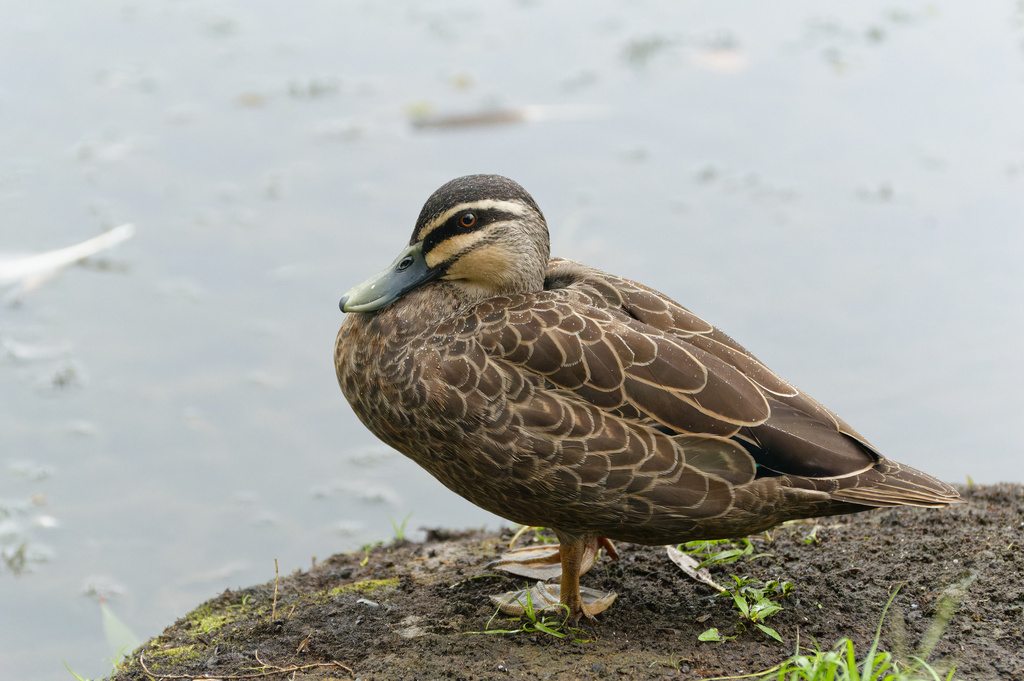
Pacific Black Duck
Photo © Donald Davesne
Photo © Donald Davesne — CC BY 4.0 — Source: iNaturalist photo #314883018Identification
The Pacific black duck is a dabbling duck of medium size, measuring 54–61 cm in length, with males typically larger than females. The most distinctive features are its dark body contrasted by a paler head marked with a dark crown and prominent facial stripes—characteristics reflected in its scientific name superciliosa, meaning "eye-browed." In flight, the species displays a green speculum and pale underwing coverts. All plumages are similar across sexes and seasons, though some island forms appear smaller and darker than mainland populations.
Like the mallard and American black duck, the Pacific black duck is capable of quacking, with females producing a distinctive sequence of raucous, rapid calls that decrease in volume. This vocal ability helps distinguish it from silent dabbling ducks in its range.
Range & Habitat
The Pacific black duck inhabits much of Indonesia, New Guinea, Australia, New Zealand, and numerous islands throughout the southwestern Pacific, extending as far north as the Caroline Islands and east to French Polynesia. In New Zealand, where it is commonly known as the grey duck or by its Māori name pārera, the species has become increasingly hybridized with introduced mallards. Two subspecies are recognized: the island black duck of the southwest Pacific islands and northern New Guinea, and the Australasian duck of Indonesia, southern New Guinea, Australia, and New Zealand.
Behaviour & Diet
This sociable duck frequents a variety of wetland habitats and employs dabbling techniques to feed, plunging its head and neck underwater and upending with its rear end raised vertically above the surface. The Pacific black duck is mainly vegetarian, feeding primarily on seeds of aquatic plants, though its diet is supplemented with small crustaceans, molluscs, and aquatic insects. Food is occasionally sought on land in damp grassy areas.
Breeding habits resemble those of the mallard. Nests are typically placed in tree holes, though old corvid nests or ground sites are sometimes used. Females lay clutches of 8–10 pale cream eggs and incubate them alone for 26–32 days. The precocial downy ducklings fledge at approximately 58 days of age.
Best Time & Places to See It
The Pacific black duck is distributed across Indonesia, New Guinea, Australia, New Zealand, and the Pacific islands, making it accessible to travellers throughout this vast region. It is not resident on the Marianas islands but may appear there during migration periods. The species' sociable nature and preference for accessible wetland habitats make it a fairly reliable sighting for wildlife enthusiasts exploring freshwater environments across its range.
Photography Tips
Photographers should focus on capturing the duck's distinctive head markings and facial stripes, which are key identification features. The green speculum is best photographed during flight, so patience will be rewarded when the bird takes wing. Early morning and late afternoon typically offer the best light for wetland photography. Since the species dabbles in shallow water, positioning yourself low to water level can create dynamic compositions that showcase the bird's characteristic upending posture and behaviour.
Alpine National Park
Annan River (Yuku Baja-Muliku) National Park
Aoraki / Mount Cook National Park
Arthur’s Pass National Park
Barrington Tops National Park
Belair National Park
Blue Mountains National Park
Boodjamulla National Park
Bouddi National Park
Nothing matches these filters.
No community photos yet. Log in to add the first one.
No community observations of this species yet.