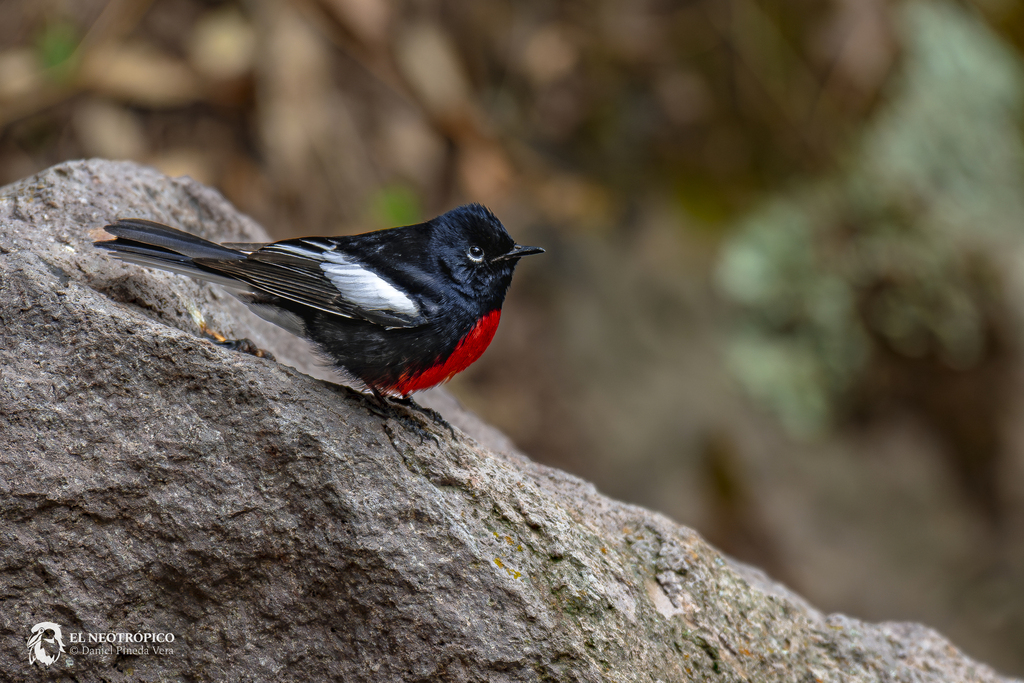
Painted Whitestart
Photo © Daniel Pineda Vera
Photo © Daniel Pineda Vera — CC BY 4.0 — Source: iNaturalist photo #364940803Identification
The Painted Whitestart is among the largest warblers, measuring 5.1–5.9 inches in length with a wingspan of 8.3 inches. Adults are unmistakable: predominantly glossy black plumage contrasts dramatically with a bright red lower breast and belly, large white wing patches, white outer tail feathers, and distinctive white crescents below the eyes. The bill and legs are blackish. Males average slightly larger than females, but the sexes are otherwise identical in plumage—a rarity among warblers.
Juveniles look quite different from adults, lacking the red belly and glossy black plumage. Young birds are brownish-gray overall with a paler belly and undertail coverts, and pale cream or buff-tinted wing patches. A deep yellow-orange mouth lining distinguishes nestlings and fledglings from other warbler species.
Range & Habitat
The Painted Whitestart inhabits mountainous regions across inland Central America and Mexico, reaching north to Arizona, New Mexico, and Big Bend National Park in Texas. The species occurs in two subspecies: the northern M. p. pictus ranges from the southwestern United States to Oaxaca and Veracruz in Mexico, while the southern M. p. guatemalae is found from Chiapas to northern Nicaragua. Northern populations migrate seasonally, while southern populations are non-migratory.
These birds favour open oak woodlands and canyons at elevations between 1,500–2,500 metres (4,900–8,200 feet). Rare vagrants have occasionally been recorded further north, with sightings documented in California in 2010 and 2013. The species is thought to be wholly insectivorous, foraging within its preferred woodland habitat.
Behaviour & Diet
The Painted Whitestart is remarkably unusual among warblers in that females are just as proficient singers as males. During spring courtship, pairs often bond by singing together—a behaviour that sets this species apart from most other warblers. The species is entirely insectivorous, gleaning prey from foliage and branches within its oak woodland habitat.
Breeding occurs on the ground, with birds constructing large, shallow nests hidden among rocks, roots, or tufts of grass on steeply sloping ground. Nests are built from strips of bark, plant fibres, leaves, and grass. Females lay 3 or 4 white to cream-coloured eggs speckled with fine brown and reddish spots; incubation lasts approximately 14 days, though other nesting details remain largely undocumented.
Best Time & Places to See It
The Painted Whitestart is common throughout its range in mountainous oak woodlands and canyons. Northern populations are present during breeding season and migrate south in winter, making the southwestern United States (Arizona, New Mexico, and Big Bend) productive destinations during the breeding months. The Madrean sky islands and Mogollon Rim offer reliable habitat.
For year-round encounters, central Mexico and Central America provide the best opportunities. The non-migratory southern subspecies inhabits the Chiapas region and ranges south to Nicaragua. Spring months are ideal for observing the distinctive singing behaviour and courtship interactions between pairs, offering naturalists and photographers excellent opportunities to appreciate this species' unique social dynamics.
Photography Tips
The Painted Whitestart's bold, contrasting plumage—glossy black with bright red underparts and white markings—photographs exceptionally well in mountain woodland light. The white crescents below the eyes and white wing patches provide excellent reference points for focus. Position yourself to capture the bird's profile to showcase the full extent of the red belly and white tail feathers.
Early morning light in oak woodland canyons will enhance the glossy quality of the black plumage and make the red colouration pop. Spring courtship offers unique photographic opportunities: capture pairs singing together, a behaviour uncommon among warblers. The bird's size—larger than most warblers—makes it relatively approachable, and its preference for open woodland habitat means less dense vegetation to obscure your shots compared to other warbler species.
Big Bend National Park
Brewster County, United States
+345 birds+34 mammals
Where the Chisos Mountains rise abruptly from the Sonoran Desert floor, Big Bend National Park spans over 7,300 square kilometers of one of North America's most…
VIEW NATIONAL PARKSaguaro National Park
Rincon Valley, United States
+354 birds+40 mammals
Where the Sonoran Desert meets sky-island mountains, two geographically separated districts of Saguaro National Park sprawl across nearly two thousand square kilometers of Arizona's most iconic…
VIEW NATIONAL PARKJoshua Tree National Park
Riverside County, United States
+221 birds+23 mammals
Across 5,610 square kilometers of Riverside County's high desert, a landscape of geological drama unfolds where granite monoliths pierce through bajadas of creosote scrub and Joshua…
VIEW NATIONAL PARKCarlsbad Caverns National Park
Eddy County, United States
+309 birds+18 mammals
Beneath the Chihuahuan Desert floor of southern New Mexico lies one of North America's most spectacular subterranean landscapes. Carlsbad Caverns National Park encompasses over 518 square…
VIEW NATIONAL PARKZion National Park
Washington County, United States
+244 birds+30 mammals
Towering sandstone cliffs in shades of crimson, rust, and cream rise abruptly from the Virgin River's winding canyon floor, their sculpted faces bearing witness to millions…
VIEW NATIONAL PARKDeath Valley National Park
Inyo County, United States
+339 birds+25 mammals
Across nearly 3.5 million acres of southeastern California's Inyo County, vast salt flats meet sculpted badlands and alluvial fans in a landscape so extreme it defines…
VIEW NATIONAL PARKLagunas de Montebello National Park
Laguna de Montebello, Mexico
+360 birds+2 mammals
Where turquoise lagoons pierce the limestone plateau of southeastern Chiapas, the Lagunas de Montebello National Park unfolds across roughly 174 square kilometers of spectral water and…
VIEW NATIONAL PARKParque Nacional Cerro de la Estrella
Mexico
+126 birds+4 mammals
Where volcanic peaks rise sharply above Mexico City's sprawling metropolis, Parque Nacional Cerro de la Estrella offers a rare glimpse of high-altitude terrain within one of…
VIEW NATIONAL PARKParque Nacional Benito Juárez
San Andrés Huayápam, Mexico
+128 birds+4 mammals
High in the Sierra Madre del Sur of Oaxaca, where cloud forest mingles with pine woodland and the terrain climbs steeply through ravines carved by mountain…
VIEW NATIONAL PARKTutuaca
Tosanachi, Mexico
+147 birds+13 mammals
Where copper canyons plunge deeper than the Grand Canyon itself, Mexico's remote Sierra Madre Occidental unfolds in dramatic vertical relief. Tutuaca anchors this wilderness realm, a…
VIEW PROTECTED LANDSCAPEChannel Islands National Park
Santa Barbara County, United States
+330 birds+15 mammals
A chain of eight volcanic islands rises from the cold Pacific waters off the California coast, their rugged sea cliffs and windswept terrain shaped by millions…
VIEW NATIONAL PARKGrand Canyon National Park
United States
+277 birds+35 mammals
A mile-deep chasm of rust-red rock and purple shadow cuts through the high desert plateau of northern Arizona, revealing nearly two billion years of geological history…
VIEW NATIONAL PARKGuadalupe Mountains National Park
Culberson County, United States
+262 birds+14 mammals
Where fossil-laden limestone ridges thrust skyward above the Chihuahuan Desert floor, Guadalupe Mountains National Park reveals a landscape sculpted by ancient seas and relentless aridity. These…
VIEW NATIONAL PARKBosque del Apache National Wildlife Refuge
Socorro County, United States
+345 birds+17 mammals
Where the Rio Grande emerges from its desert canyon in central New Mexico, a narrow ribbon of riparian woodland defies the arid landscape that surrounds it.…
VIEW WILDLIFE SANCTUARYSanta Ana National Wildlife Refuge
Hidalgo County, United States
+349 birds+12 mammals
Where the Rio Grande delta meets the semi-arid scrublands of South Texas, Santa Ana National Wildlife Sanctuary preserves a rare mosaic of wetland and thornforest habitat…
VIEW WILDLIFE SANCTUARYPea Island National Wildlife Refuge
Dare County, United States
+356 birds+15 mammals
Where the Outer Banks taper toward the Atlantic, a sliver of barrier island creates a microcosm of coastal ecology. Pea Island National Wildlife Sanctuary spans over…
VIEW WILDLIFE SANCTUARYNo community photos yet. Log in to add the first one.
No community observations of this species yet.