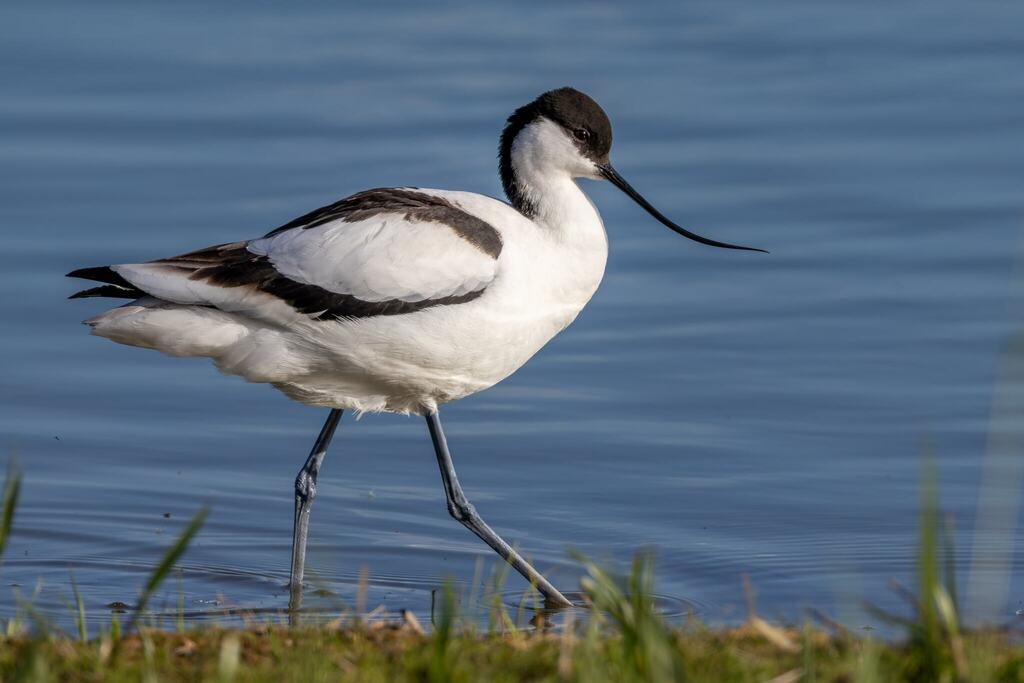
Pied Avocet
Photo © Alexis Lours
Photo © Alexis Lours — CC BY 4.0 — Source: iNaturalist photo #641029622Identification
The pied avocet is unmistakable among European waders, with its striking black-and-white plumage and distinctive upturned bill. Adults display a black cap extending to the back of the neck, black primaries with white bases on the inner feathers, and a white tail. The legs are bluish and notably long, extending beyond the tail in flight. Measuring 42 to 46 cm in length with a wingspan of 67 to 77 cm, this is a relatively large wader with an average weight of 325 g.
Sexual dimorphism is subtle: males have longer, straighter bills and are generally larger, with reddish-brown irises, while females have shorter, more distinctly curved bills and hazel-brown eyes. The black markings on females may occasionally appear browner. Juveniles resemble adults after their first complete moult by late September, though young birds show dingy grey wing coverts and worn, brownish primaries during their first summer.
Range & Habitat
The pied avocet has a wide distribution spanning western Europe, central Asia, the Indian subcontinent, and Africa. It is the only avocet species found in Europe, Africa, and Asia. In France, it occurs along the English Channel, Atlantic coast, and Mediterranean. The species exhibits both migratory and resident populations, with northern birds undertaking long journeys south to wintering grounds in Southern Europe or Africa.
This characteristic wader inhabits coastal lagoons, marshes, and shallow brackish lakes with exposed bare mud. It typically nests in colonies of 10 to 70 pairs on islets or dikes near water, preferring open ground often shared with other wader species.
Behaviour & Diet
The pied avocet employs a unique feeding technique among waders, scything its bill from side to side through shallow water and mud. It primarily feeds on small benthic invertebrates including annelids, crustaceans such as Corophium, oligochaete and polychaete worms, and bivalve molluscs. Small insects like midges and beetles measuring 4 to 15 mm are also consumed, with chironomid larvae particularly important during breeding and winter in salt marshes. It occasionally takes small fish, seeds, and roots, with daily food intake averaging 150 g per individual.
Highly territorial when breeding, avocets fiercely defend their chicks against conspecifics and predators including raptors, corvids, and mammals. They typically lay three to five eggs in a lined scrape or vegetation mound. The species produces distinctive fluty whistles—resembling plut-plut-plutt or klup-klup-klup—as contact and alarm calls, with variations including kvit-kvit-kvit when excited and kriyu near predators. Soft vocalizations accompany chick-rearing and pair bonding.
Best Time & Places to See It
The pied avocet is classified as Least Concern due to its extensive range and relatively large population. In France, search along the English Channel, Atlantic coast, and Mediterranean shores. Timing depends on local populations: northern birds arrive at southern wintering grounds between autumn and spring, while some populations remain year-round in Southern Europe and Africa. Spring and early summer are optimal for observing breeding colonies and parental behaviour on coastal marshes and brackish lagoons.
Look for avocets in shallow water and exposed mudflats where they feed in water depths of 4 to 10 cm. Colonial nesters often congregate on islets and dikes, making such locations reliable observation points during breeding season. With a lifespan of approximately 20 years, established breeding sites offer consistent opportunities for viewing across multiple seasons.
Photography Tips
The avocet's striking black-and-white pattern and elegant posture make it highly photogenic. Photograph birds feeding in shallow water to capture their characteristic sideways bill-sweeping technique—a behaviour unique among waders and visually distinctive. The extended legs and upturned bill are key identifying features worth emphasizing in composition.
During breeding season, capture territorial and parental behaviours as adults defend chicks against predators. In flight, the black wingtips and shoulders contrasting with white underparts create dramatic silhouettes. Early morning and late afternoon light enhances the contrast in their plumage. Colonial nesting sites on islets provide opportunities for capturing multiple birds and group feeding dynamics, where lateral pecks occur rapidly and nearly continuously.
Private Full-Day Birdwatching Tour from Lisbon to the Tagus Estuary
Private Full-Day Birdwatching Tour in Algarve
Week-long Birdwatching Programme in Northern & Central Portugal
Nothing matches these filters.
Murchison Falls National Park
Queen Elizabeth National Park
Abijata-Shalla Lakes National Park
Addo Elephant National Park
Agulhas National Park
Alpilles Regional Nature Park
Alta Murgia National Park
Altun Mountain National Nature Reserve
Amboseli National Park
Nothing matches these filters.
No community photos yet. Log in to add the first one.
No community observations of this species yet.