Identification
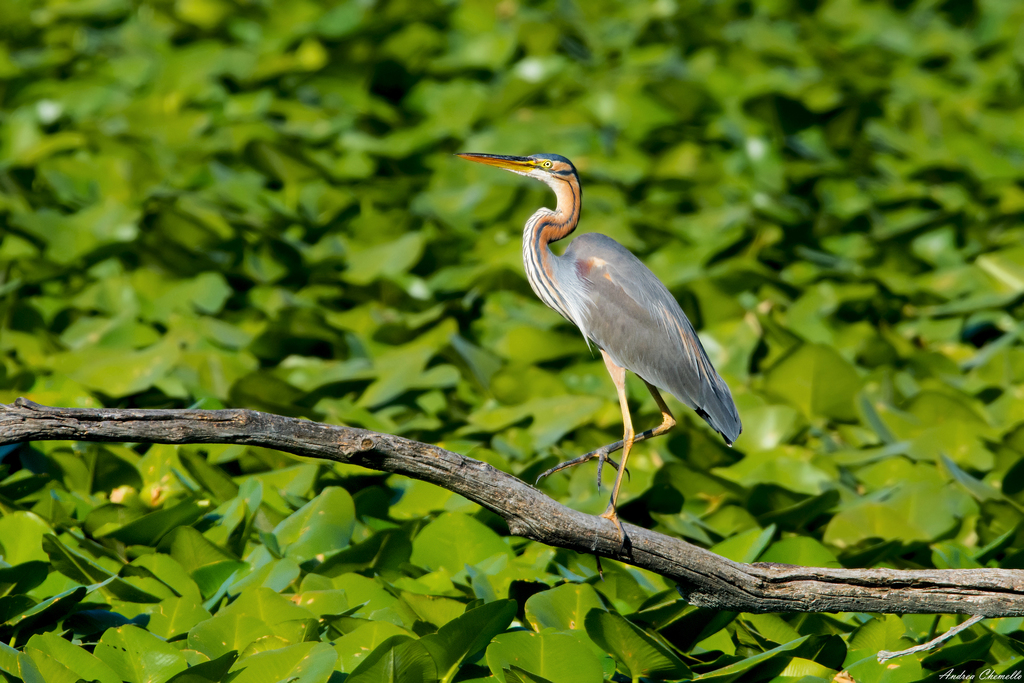
The purple heron is a large wading bird measuring 78–97 cm in length with a wingspan of 120–152 cm, yet it appears remarkably slender and lightweight for its size. It is somewhat smaller and more delicate than the closely related grey heron, from which it can be distinguished by its darker reddish-brown plumage and, in adults, darker grey back. Adults display a striking black forehead and crown with a dark stripe running down the back of the neck, terminating in a short, slender, dangling crest that does not exceed 140 mm. The sides of the head and neck are buffish chestnut with dark streaks, while the breast is chestnut brown. The belly and under-tail coverts are black, and the brownish-yellow beak is long, straight, and more brightly coloured in breeding birds. The iris is yellow and the legs are brown in front with yellowish colouring behind.
This heron's head and neck are notably more slender and snake-like than those of the grey heron, and its toes are much longer. A characteristic feature is its often oblique neck posture, which even nestlings tend to adopt. The call is a harsh "frarnk" that is quieter and more high-pitched than the grey heron's call, and the bird is generally less noisy overall. It appears somewhat hollow-chested and less robust than its grey counterpart.
Range & Habitat
The purple heron has a wide-ranging palaearctic and African distribution. The western race breeds across southern and central Europe from Portugal eastwards to Kazakhstan's Lake Balkhash region, and across parts of North Africa. In Africa, it breeds from Senegal down the east coast and in Madagascar. The eastern race ranges from the Indian subcontinent eastwards to eastern China and the Philippines, and northwards to the Amur River basin at approximately 49°N. A small population on the Cape Verde Islands is recognised as a distinct race by some authorities.
Western populations are migratory, moving southwards to tropical Africa between August and October and returning northwards in March. These birds frequently overshoot their normal range on return migration and appear as vagrants to northern Europe, including Britain. The eastern and African populations are primarily sedentary, though some northern birds undertake southward movements. The purple heron favours densely vegetated habitats near water, particularly reed beds, and is a notably more evasive bird than the grey heron.
Behaviour & Diet
The purple heron hunts a diverse range of prey including fish, rodents, frogs, and insects, employing two principal hunting strategies: stalking through vegetation or standing waiting in ambush. This adaptability to different hunting techniques reflects its preference for densely vegetated wetlands where cover is abundant.
Purple herons are colonial breeders, constructing bulky nests from dead reeds or sticks positioned close to the water's edge among reeds or in dense vegetation. Typically, about five bluish-green eggs are laid and incubated by both parents. The young hatch approximately four weeks after incubation begins and fledge six weeks later. Despite the global population trend being downwards due largely to wetland drainage, the International Union for Conservation of Nature assesses the species' conservation status as of "least concern."
Best Time & Places to See It
The best time to observe purple herons depends on their population status in your region. Western European breeders are present during the breeding season, with birds returning from African wintering grounds in March and departing again between August and October. Spring and autumn migration periods offer opportunities to see vagrants in northern Europe, including Britain, though sightings here are irregular. For more reliable viewing, target their core breeding range in southern and central Europe, particularly areas with extensive reed beds and other densely vegetated wetland habitats. African populations are year-round residents and can be observed throughout the year in suitable wetland environments south of the Sahara and in Madagascar.
Photography Tips
Photographing purple herons requires patience and skill due to their evasive nature and preference for dense vegetation. Position yourself near reed beds and densely vegetated margins of wetlands during early morning or late evening hours when the birds are most active in feeding. Their characteristic oblique neck posture and slender profile make distinctive photographic subjects, so look for opportunities to capture this elegant stance. The darker plumage requires careful exposure management, particularly in low light conditions typical of reed bed habitats. Longer lenses (400mm or more) are essential for approaching these wary birds without disturbing them, and remain still to avoid startling them into flight.