Razor-billed Curassow
Photo © Dan Vickers
Photo © Dan Vickers — CC BY 4.0 — Source: iNaturalist #260867537Identification
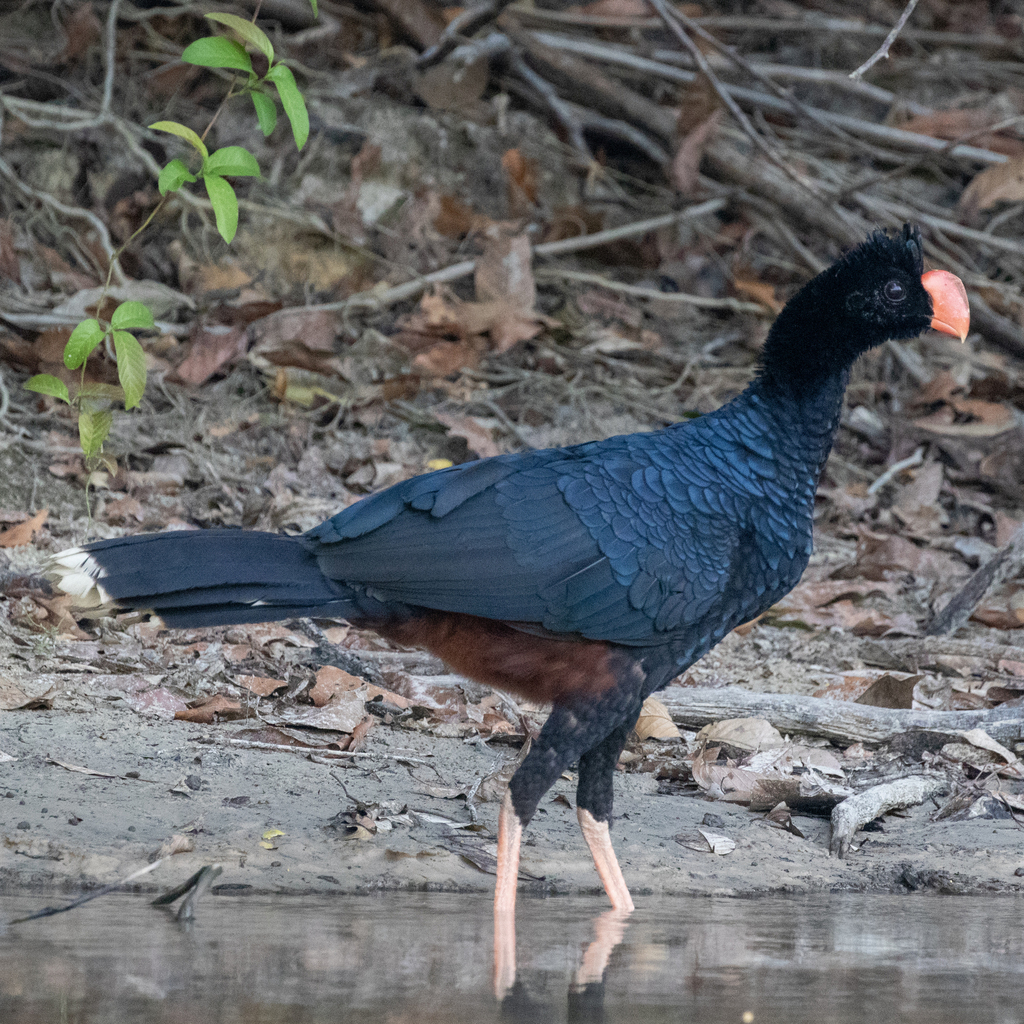
The razor-billed curassow is a large, striking galliforme measuring 83 to 89 centimetres in length, with males weighing around 3,860 grams. Its plumage is predominantly black with a striking purplish-blue gloss that catches the light beautifully. The lower belly and undertail coverts provide a warm chestnut contrast, while white tips on the tail feathers add subtle detail. Most distinctive is the bird's tall, ragged crest and its large, bright red bill that is laterally compressed—a feature that inspired its common name.
Range & Habitat
This species inhabits much of the Amazon Basin across four South American countries: Bolivia, Brazil, Colombia, and Peru. It is mostly found south of the Amazon River in eastern Peru, northern Bolivia, and northern Brazil extending to the Atlantic coast, with populations also occurring north of the Amazon in southeastern Colombia and along the Rio Negro in Brazil. The razor-billed curassow prefers lowland evergreen forests, particularly terra firme (upland forest), but also frequents gallery forests along waterways and várzea forests. The species' elevation range extends from sea level to 1,350 metres, though it typically remains below 1,000 metres.
Behaviour & Diet
This curassow typically forages alone or in pairs directly on the forest floor, where it searches for fallen fruits that comprise the bulk of its diet. It also consumes leaves, insects, fungi, and small vertebrates as dietary supplements. The species is occasionally polygynous and may breed regularly in this system. In northern Peru, the nesting season runs from November through February, with females constructing distinctive cup-shaped nests from branches, lianas, and leaves. Clutch sizes are typically two or three eggs.
Best Time & Places to See It
The razor-billed curassow is vocal during the breeding season from November to February in northern Peru, when deep booming calls resonate through the forest. The bird sings from a perch at any time of day but most frequently at dawn and before dawn. Its large range across Amazonian lowland forests and protected areas in Peru, Bolivia, Brazil, and Colombia offers multiple opportunities for encounters, though its preference for the forest floor and gallery forests along streams and lakes may make locating it challenging. Early morning visits to terra firme and várzea forests offer the best prospects.
Photography Tips
The razor-billed curassow's striking plumage—glossy black with chestnut underparts and that distinctive red bill—photographs beautifully in dappled forest light. Its large size and ground-feeding behaviour offer advantages for photographers, though the dense forest habitat demands patience and a fast-focusing telephoto lens. Dawn visits when the bird sings from a perch provide the best opportunities to locate and photograph it before it descends to forage. The bird's tall crest and bright colouration make it visually dramatic; position yourself to capture the purplish-blue gloss on its plumage and the intensity of its red bill.
Where to stay to see the Razor-billed Curassow
Amazônia National Park
Brazil
+439 birds+6 mammals
Where the Rio Amazonas and its tributaries weave through the heart of Pará state, a vast tapestry of rainforest stretches across 23,611 square kilometers of unbroken…
VIEW NATIONAL PARKMapinguari National Park
Brazil
+354 birds
Vast tracts of western Amazonian rainforest blanket the remote terrain of this 56,827 square kilometre national park in Amazonas state, where seasonal rivers wind through dense…
VIEW NATIONAL PARKPacaás Novos National Park
Brazil
+279 birds+1 mammals
Across the border between Rondônia and Amazonas, vast tracts of humid tropical forest rise and fall in gentle undulations, carved by clear-flowing rivers that feed into…
VIEW NATIONAL PARKCampos Amazónicos National Park
Amazonas, Brazil
+434 birds+7 mammals
Sprawling across the southwestern Amazon basin in Amazonas state, this 27,263-square-kilometre national park encompasses some of the region's most pristine lowland rainforest, where terra firme forest…
VIEW NATIONAL PARKSerra do Divisor National Park
Brazil
+448 birds+10 mammals
Where the western Amazon meets the Andes foothills, Serra do Divisor National Park sprawls across one of South America's most biodiverse and least accessible frontiers. Spanning…
VIEW NATIONAL PARKOtishi National Park
Río Tambo, Peru
+108 birds
Where the Andes descend toward the Amazon basin, vast cloud forests cloak the ridges and valleys of Peru's Río Tambo watershed, and this is where Otishi…
VIEW NATIONAL PARKYanachaga–chemillén National Park
Palcazu, Peru
+639 birds+6 mammals
Where the eastern slopes of Peru's central cordillera plunge into cloud forest, Yanachaga–Chemillén National Park protects nearly three thousand square kilometres of montane wilderness that few…
VIEW NATIONAL PARKManu National Park
Manu, Peru
+892 birds+26 mammals
Across the eastern slopes of the Peruvian Andes, tropical rainforest descends into the Amazon basin with a complexity that few terrestrial ecosystems match. Manu National Park…
VIEW NATIONAL PARKSierra del Divisor National Park
Alto Tapiche, Peru
+298 birds+2 mammals
Where the western Amazon meets the Andes foothills, nearly 41,000 square kilometres of pristine rainforest rise across Peru's Alto Tapiche region in a landscape of extraordinary…
VIEW NATIONAL PARKBahuaja Sonene National Park
San Pedro de Putina Punco, Peru
+602 birds+8 mammals
Where the Madre de Dios and Heath rivers converge in southeastern Peru rises one of South America's most biodiverse wilderness regions: a vast protected realm of…
VIEW NATIONAL PARKCordillera Azul National Park
Pampa Hermosa, Peru
+322 birds+1 mammals
Where the eastern Andes descend into the western Amazon basin, Cordillera Azul National Park sprawls across nearly 38,000 square kilometres of some of Peru's most pristine…
VIEW NATIONAL PARKNo community photos yet. Log in to add the first one.
No community observations of this species yet.