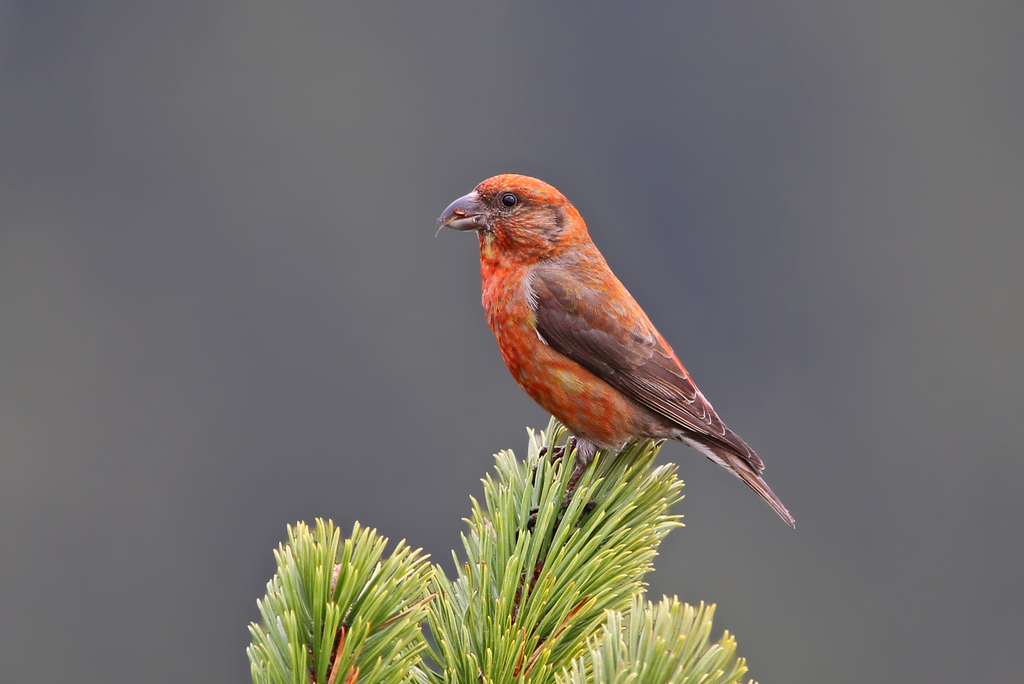
Red Crossbill
Photo © Christoph Moning
Photo © Christoph Moning — CC BY 4.0 — Source: iNaturalist photo #92108347Identification
The red crossbill is instantly recognizable by its distinctive crossed mandibles—the tips of its upper and lower bills cross over each other, a unique adaptation that gives the species its common name. Adult males are typically red or orange in colour, while females are green or yellow, though considerable variation exists across individuals and populations. The bird measures approximately 20 cm in length, weighs 40–53 g, and has a wingspan of 27–29 cm.
To distinguish red crossbills from similar species, look for entirely brownish-black wings, which separate them from the two-barred crossbill, which displays two bright white wing bars. In most of its range, the red crossbill is the only dark-winged crossbill species. Where it overlaps with the parrot, Scottish, and Cassia crossbills—three species formerly classified as subspecies—visual identification becomes challenging, as plumage differences are negligible and there is often more variation between individual birds than between species. These similar species are generally best distinguished by their distinctive call types.
Range & Habitat
Red crossbills breed across a variety of coniferous forests throughout North America and Eurasia. Their distribution and movements are closely tied to conifer seed availability, their primary food source. They typically nest in late summer, from June to September, when conifer seeds mature, though they may breed at any time of year if they discover an area with an abundant cone crop.
The species is highly nomadic and irruptive, with populations dispersing widely when local cone production fails. In many areas they are considered irregular visitors, present in some years but absent in others. A notable exception is the Newfoundland population, which is resident and does not undertake significant movements. Red crossbill irruptions in the British Isles are particularly rare, historically remarked upon since the 13th century, yet have recently led to the establishment of permanent breeding colonies in England and Ireland.
Behaviour & Diet
The red crossbill's crossed mandibles are perfectly engineered for its specialized diet. Using the crossing tips as leverage, these birds efficiently separate the scales of conifer cones and extract seeds with remarkable precision. Their nomadic lifestyle reflects an evolutionary adaptation to the unpredictable availability of seed crops across different conifer species.
Different types of red crossbill show preferences for particular conifer species, and each has optimal breeding success only in specific conifer forest types. This dietary specialization has driven an adaptive radiation, with approximately 10 North American and 18 Eurasian types identified, many affiliated with particular conifer species or suites of similar species. When not breeding, various types may flock together and also associate with other crossbill species.
Best Time & Places to See It
Timing is crucial for encountering red crossbills, as their presence depends entirely on conifer seed availability. In areas with resident or regular populations, breeding season (June–September) offers the best viewing opportunities. However, in regions where the species is irregular or irruptive, sighting success is unpredictable and may vary dramatically from year to year.
Search coniferous forests where seed-bearing cones are abundant. In regions experiencing cone crop failures, crossbills may appear unexpectedly in atypical locations. Local birding groups and naturalist networks can provide current information about crossbill movements and irruptions in your area, significantly improving your chances of encounters.
Photography Tips
The red crossbill's striking plumage—brilliant red or orange in males, soft green or yellow in females—makes for compelling photography when light is favourable. The distinctive crossed mandibles are the species' most diagnostic feature and should be a priority in your composition, particularly in close-up shots that showcase this remarkable adaptation.
Position yourself in coniferous forests where crossbills are actively feeding on cone crops. Early morning light works well for capturing the warm tones of males, while overcast conditions can be effective for photographing the more subtle hues of females and immature birds. Be patient and observant, as these nomadic birds may move quickly through an area. Capturing feeding behaviour at the cone tips demonstrates their unique bills in action and creates more engaging and informative images for wildlife documentation.
Abruzzo, Lazio and Molise National Park
Acadia National Park
Aggtelek National Park
Alaska Maritime National Wildlife Refuge
Algonquin Provincial Park
Alligator River National Wildlife Refuge
Alpilles Regional Nature Park
Altai Tavan Bogd National Park
Appennino Tosco-Emiliano National Park
Nothing matches these filters.
No community photos yet. Log in to add the first one.
No community observations of this species yet.