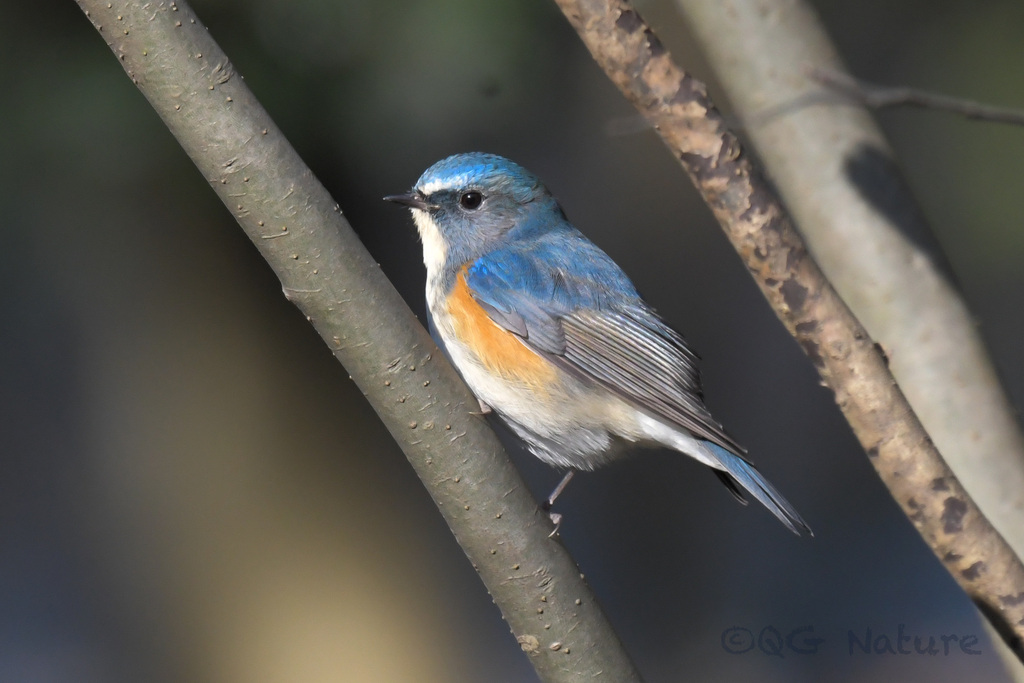
Red-flanked Bluetail
Photo © Wang.QG
Photo © Wang.QG — CC BY 4.0 — Source: iNaturalist photo #243648144Identification
The red-flanked bluetail is a small passerine measuring 13–14 cm long and weighing 10–18 g, making it comparable in size to a common redstart and slightly smaller than a European robin. Both sexes share distinctive features: a bright blue tail and rump, orange-red flanks, white throat, and greyish-white underparts, along with a small thin black bill and slender black legs. Adult males are notably darker, displaying deep blue upperparts, while females and immature males have plain brown plumage above except for the blue rump and tail, and dusky breasts that distinguish them from males.
Range & Habitat
This migratory species breeds in mixed coniferous forests with undergrowth across a vast range spanning northeastern Europe, from northern Sweden eastward through Siberia to Kamchatka and south to Japan. It winters primarily in southeastern Asia, including the Indian subcontinent, the Himalayas, Taiwan, and northern Indochina. The breeding range has been slowly expanding westwards, particularly through Finland where up to 500 pairs now breed, and the species is an increasingly rare vagrant to Western Europe, especially Great Britain. Occasional records have appeared in North America, mostly in western Alaska.
Behaviour & Diet
The red-flanked bluetail is an insectivorous bird belonging to the chat group within the Old World flycatcher family. In behaviour, it closely resembles the common redstart, frequently flicking its distinctive blue tail in an identical manner. The bird is an active forager, regularly flying from a perch to catch insects either in the air or on the ground. Males sing a melancholy trill from treetops during breeding season, while both sexes produce a typical chat "tacc" call. Breeding pairs construct nests on or near the ground, with females incubating clutches of 3–5 eggs.
Best Time & Places to See It
Travellers and photographers seeking this species should target its breeding grounds in northern coniferous forests during the breeding season, particularly in Siberia, Japan, and increasingly in Finland. Winter observers might encounter the bird in southeast Asian wintering grounds, including the Himalayas, Taiwan, and northern Indochina. Western European birdwatchers have increasing opportunities to spot this expanding vagrant, particularly in Great Britain. The species' range expansion makes it worth watching for in previously uncommon areas, especially during migration periods.
Photography Tips
Photographers should take advantage of the male's conspicuous behaviour of singing from exposed treetops, which provides opportunities for clean, well-lit shots. The bird's frequent tail-flicking habit offers chances to capture the distinctive blue tail and rump in flight or perched positions. The orange-red flanks and blue plumage create striking colour contrasts that photograph well in natural light. Look for the bird in undergrowth and lower branches of coniferous forests, where its smaller size and active foraging behaviour require patience and quick reflexes to capture in-flight feeding moments.
Muddus / Muttos National Park
Norrbottens län, Sweden
+128 birds+7 mammals
Where boreal forest meets wetland across the high plateaus of Swedish Lapland, Muddus National Park unfolds as one of northern Europe's most pristine wilderness sanctuaries. Vast…
VIEW NATIONAL PARKHamburgisches Wattenmeer National Park
Hamburg, Germany
+206 birds+6 mammals
Where the North Sea exhales across the Elbe estuary, the tidal mudflats of Hamburgisches Wattenmeer National Park emerge twice daily in a landscape of extraordinary ecological…
VIEW NATIONAL PARKSchleswig-Holsteinisches Wattenmeer National Park
Germany
+378 birds+49 mammals
Where the North Sea ebbs and flows across a vast expanse of exposed mud and sand, the Schleswig-Holsteinisches Wattenmeer National Park reveals one of Europe's most…
VIEW NATIONAL PARKDanube Delta Biosphere Reserve
Tulcea, Romania
+277 birds+27 mammals
Where the Danube surrenders to the Black Sea, a vast labyrinth of channels, reed beds, and freshwater lakes sprawls across nearly 13,400 square kilometers of eastern…
VIEW NATIONAL PARKPyhä-Luosto National Park
Pelkosenniemi, Finland
+113 birds+6 mammals
Where boreal forest meets fell landscape in Finnish Lapland, Pyhä-Luosto National Park sprawls across 616 square kilometres of terrain that embodies the raw essence of the…
VIEW NATIONAL PARKPallas-Yllästunturi National Park
Muonio, Finland
+137 birds+19 mammals
Where boreal forest meets fell, across the Finnish Arctic frontier, nearly 3,650 square kilometres of pristine subarctic wilderness unfold in a landscape sculpted by glacial epochs…
VIEW NATIONAL PARKPatvinsuo National Park
Lieksa, Finland
+134 birds+1 mammals
Across eastern Finland's borderlands, where boreal forest meets waterlogged terrain, Patvinsuo National Park sprawls across roughly 185 square kilometers of one of northern Europe's most intact…
VIEW NATIONAL PARKIsojärvi National Park
Kuhmoinen, Finland
+81 birds+2 mammals
Across the forested landscape of central Finland, where the Pirkanmaa region rolls gently beneath boreal skies, lies a landscape of water and woodland that defines the…
VIEW NATIONAL PARKSyöte National Park
Taivalkoski, Finland
+80 birds+1 mammals
Across nearly two thousand square kilometres of North Ostrobothnian wilderness, Syöte National Park unfolds a landscape where boreal forest meets open fell, where swift rivers carve…
VIEW NATIONAL PARKUrho Kekkonen National Park
Sodankylä, Finland
+122 birds+11 mammals
Across nearly 2,700 square miles of boreal wilderness in Lapland, where the Arctic Circle's influence shapes every ecosystem, lies a landscape dominated by dense spruce and…
VIEW NATIONAL PARKStora Sjöfallet
Norrbotten County, Sweden
+150 birds+10 mammals
Where granite plateaus rise above boreal forest and ice-carved valleys plunge toward rushing rivers, Stora Sjöfallet unfolds across nearly 3,300 square kilometres of pristine subarctic wilderness…
VIEW NATIONAL PARKEspacio Natural Remolar-Filipinas
El Prat del Llobregat, Spain
+297 birds+7 mammals
Where the Llobregat River delta meets the Mediterranean, a patchwork of salt marshes, reed beds, and shallow lagoons creates one of Catalonia's most dynamic wetland ecosystems.…
VIEW NATURE RESERVECamargue Regional Nature Park
Saintes-Maries-de-la-Mer, France
+378 birds+48 mammals
Where the Rhône Delta sprawls into the Mediterranean, a landscape of stark and haunting beauty emerges—vast salt marshes punctuated by shallow lagoons, reed beds, and scrubland…
VIEW NATURAL PARKSt. Paul Island
Saint Paul, United States
+255 birds+8 mammals
Windswept tundra rolls across this remote Pribilof island, where volcanic basalt cliffs plunge into the Bering Sea and fog rolls in thick enough to erase the…
VIEW PROTECTED LANDSCAPEBaikal National Park
Ольхонский район, Russia
+184 birds+11 mammals
Where the world's deepest freshwater lake meets ancient Siberian taiga, Baikal National Park sprawls across 66,203 square kilometers of one of Earth's most singular ecosystems. The…
VIEW NATIONAL PARKTransbaikal National Park
Barguzinsky Rayon, Russia
+83 birds+7 mammals
Where the eastern shore of Lake Baikal meets the Barguzinsky Range, a vast wilderness of boreal forest, alpine tundra, and rocky shoreline unfolds across more than…
VIEW NATIONAL PARKNalychevo National Park
Nalychevo, Russia
+30 birds+5 mammals
Where volcanic peaks pierce the mist of Russia's far northeast, a primordial landscape of steaming geothermal springs and pristine river valleys unfolds across the Kamchatka Peninsula.…
VIEW NATIONAL PARKWulingyuan
Jundiping, China
+97 birds+3 mammals
Sandstone peaks erupting from forested valleys define this sprawling 993-square-kilometre national park in Hunan Province, where vertical cliffs rise dramatically above lush subtropical woodland. The landscape—a…
VIEW NATURAL MONUMENTGiant Panda National Park
Mianyang, China
+447 birds+47 mammals
Where the eastern slopes of China's Sichuan plateau descend into cloud-wrapped valleys, one of Asia's most biodiverse landscapes unfolds across more than 350,000 square kilometres. This…
VIEW NATIONAL PARKMount Nanling Forest Park
Ruyang Forest Farm, China
+179 birds+3 mammals
Granite ridges and weathered peaks rise through a canopy of subtropical montane forest where Ruyang Forest Farm anchors one of southern China's most biodiverse landscapes. Across…
VIEW FOREST & JUNGLEJiuzhai Valley
Jiuzhaigou County, China
+226 birds+7 mammals
Where crystalline alpine streams cascade through limestone gorges and karst terrain rises in dramatic vertical walls, Jiuzhai Valley unfolds across nearly 1,300 square kilometers of southwestern…
VIEW NATURAL MONUMENTHuanglong Scenic and Historic Interest Area
Ngawa Tibetan and Qiang Autonomous Prefecture, China
+194 birds+7 mammals
Across the high plateau of northwestern Sichuan, a geological wonder unfolds where limestone terraces and mineral-rich springs have sculpted one of China's most distinctive natural monuments.…
VIEW NATURAL MONUMENTLemmenjoki National Park
Inari, Finland
+87 birds+1 mammals
Where granite gorges cut through pristine boreal forest and the Lemmenjoki River winds through one of Europe's last great wilderness corridors, Finland's Arctic heart reveals itself…
VIEW NATIONAL PARKKhangai Nuruu National Park
Erdenetsogt, Mongolia
+136 birds+7 mammals
Where granite ridges pierce Mongolia's central steppe, alpine meadows give way to dense coniferous forests that climb toward windswept summits. Khangai Nuruu sweeps across 1.2 million…
VIEW NATIONAL PARKGorkhi-Terelj National Park
Ulaanbaatar, Mongolia
+137 birds+5 mammals
Where granite monoliths rise abruptly from rolling steppe grasslands, Gorkhi-Terelj National Park unfolds across the landscape north of Ulaanbaatar, a sanctuary where forest and alpine meadow…
VIEW NATIONAL PARKAltai Tavan Bogd National Park
Tsengel, Mongolia
+146 birds+3 mammals
Where the Altai Mountains rise in jagged defiance along Mongolia's western frontier, the terrain transforms into a realm of alpine tundra, rocky plateaus, and glacier-carved valleys…
VIEW NATIONAL PARKHustai National Park
Altanbulag, Mongolia
+198 birds+16 mammals
Where the steppe rolls endlessly beneath vast Mongolian skies, Hustai National Park preserves one of Central Asia's most dynamic grassland ecosystems. Rolling hills and open prairie…
VIEW NATIONAL PARKKhoridol Saridag National Park
Khatgal, Mongolia
+164 birds+6 mammals
Where granite peaks thrust skyward across Mongolia's remote southeastern reaches, a landscape of raw geological drama unfolds. Deep river gorges carved through ancient stone create a…
VIEW NATIONAL PARKNortheast China Tiger and Leopard National Park
Mu Dan Jiang Shi, China
+202 birds+19 mammals
Across the temperate forests of northeastern China, where winters grip the landscape in subzero silence and summers remain cool and brief, the Mudanjiang region supports a…
VIEW NATIONAL PARKWuyishan National Park
Yanshan County, China
+141 birds+2 mammals
Where subtropical monsoon rains sustain a perpetually humid landscape, Wuyishan National Park rises from Fujian's eastern plateau as a realm of forested ridges, cascading streams, and…
VIEW NATIONAL PARKWolong National Nature Reserve
Wenchuan County, China
+333 birds+17 mammals
Where the Qingyi River cuts through the eastern flanks of the Minshan Range, a temperate montane forest cloaks steep valleys in dense canopy that thins dramatically…
VIEW NATURE RESERVEYancheng National Nature Reserve
Yancheng, China
+208 birds+4 mammals
Where the East China Sea's tidal rhythms sculpt the Jiangsu coast, Yancheng National Nature Reserve sprawls across one of Asia's most dynamic wetland complexes. This vast…
VIEW NATURE RESERVEZhalong National Nature Reserve
Qiqihar, China
+78 birds
Across the wetlands of northeastern China, where the Heilongjiang climate swings between brutal winters and warm summers, lies one of East Asia's most vital refuges for…
VIEW NATURE RESERVEPoyang Lake National Nature Reserve
Shangrao, China
+270 birds+7 mammals
Where the Yangtze River's massive floodplain spreads across central China, Poyang Lake National Nature Reserve encompasses one of the continent's most dynamic and water-rich wetland systems.…
VIEW NATURE RESERVECaohai National Nature Reserve
Bijie, China
+93 birds
At roughly 1,900 metres elevation on Guizhou's high plateau, Caohai sprawls across a temperate landscape shaped by pronounced seasonal extremes. Winters here are dry and cool,…
VIEW NATURE RESERVEGaoligong Mountain National Nature Reserve
Nujiang Lisu Autonomous Prefecture, China
+443 birds+13 mammals
VIEW NATURE RESERVEAlaska Maritime National Wildlife Refuge
Alaska, United States
+391 birds+58 mammals
Where the North Pacific collides with Alaska's rugged coastline, a sprawling archipelago of islands, rocky outcrops, and coastal headlands forms one of North America's most remote…
VIEW WILDLIFE SANCTUARYFarallon National Wildlife Refuge
San Francisco, United States
+384 birds+16 mammals
Windswept granite peaks rising abruptly from the Pacific, the Farallon Islands form a wildlife sanctuary of extraordinary seabird abundance and ecological significance just twenty-seven miles west…
VIEW WILDLIFE SANCTUARYLindisfarne National Nature Reserve
Holy Island, United Kingdom
+240 birds+13 mammals
Windswept tidal flats and rocky outcrops define this reserve on Holy Island, where the North Sea's relentless rhythm shapes both landscape and wildlife. The terrain shifts…
VIEW NATURE RESERVEHolkham National Nature Reserve
North Norfolk, United Kingdom
+235 birds+11 mammals
Where Norfolk's coastal flatlands meet the North Sea, Holkham National Nature Reserve unfolds across nearly 4,000 hectares of some of England's most dynamic and least predictable…
VIEW NATURE RESERVENo community photos yet. Log in to add the first one.
No community observations of this species yet.