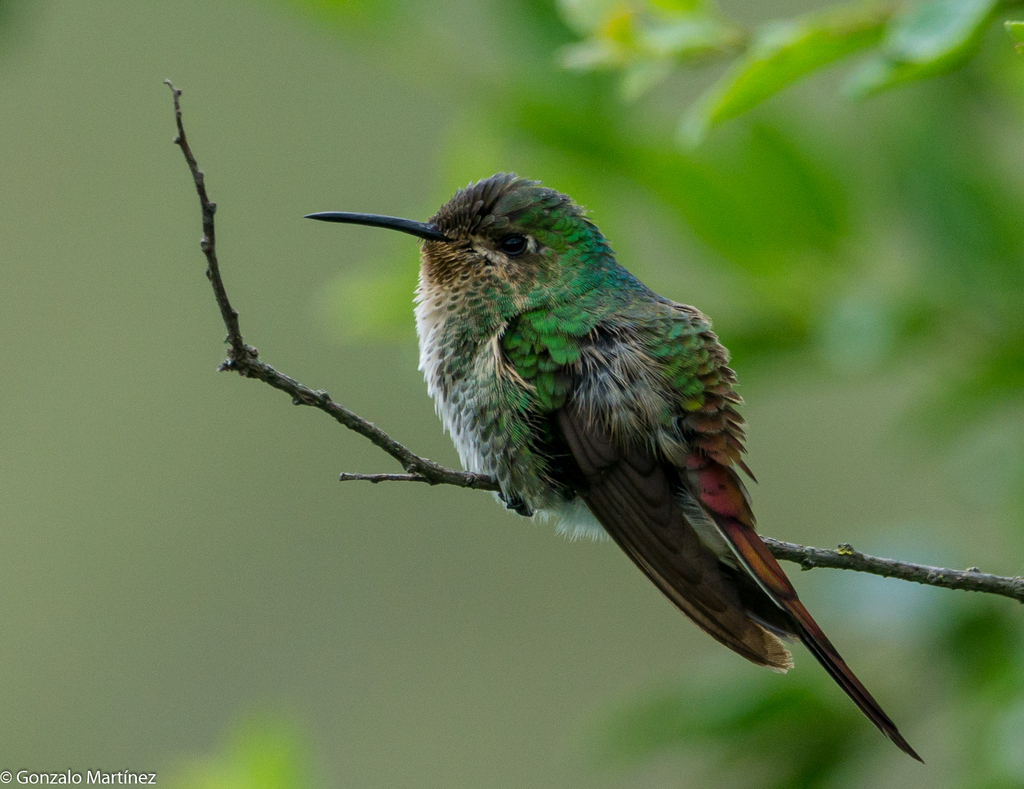
Red-tailed Comet
Photo © Gonzalo Martinez
Photo © Gonzalo Martinez — CC BY 4.0 — Source: iNaturalist photo #226326808Identification
The red-tailed comet is a medium-sized hummingbird with one of the most striking features in its family: a dramatically forked tail. Males are notably larger, measuring 19 to 20 cm in length with tails extending 7 to 10 cm, while females are considerably smaller at 12 to 14 cm overall. Both sexes are remarkably lightweight, weighing only 4 to 6.5 grams. Males display brilliant plumage with a shining green head, golden-green or emerald gorget, reddish-purple back and rump, and mostly green underparts. Their most distinctive feature is the long, deeply forked tail, which appears iridescent reddish-purple to green depending on light angle, with wide velvety black to dusky purple tips on the tail feathers. Females are considerably duller, with shining green head and back, reddish-purple rump, and pale buff underparts speckled with green on the throat and breast. Both sexes have a reddish-brown iris, black bill, and black legs. The subspecies S. s. sapho is paler overall, with golden-orange coloring replacing the reddish-purple of the nominate form.
Range & Habitat
The red-tailed comet is found in the Andes mountains, with populations confirmed in Argentina and Bolivia, and possibly occurring in Chile and Peru. The species inhabits arid montane scrublands on the eastern Andean slopes and within mountain valleys, preferring landscapes characterized by scattered trees, bushy understory, and dense tangles in ravines. It also occurs in Polylepis woodlands. Elevations range mostly between 1,500 and 4,200 meters, though the species has been recorded as low as 400 meters.
Behaviour & Diet
The red-tailed comet is primarily a year-round resident, though it makes elevational movements within its range, particularly in Bolivia. It feeds mainly on nectar, which it collects both while hovering and while perched, supplementing its diet with small arthropods captured in flight or gleaned from vegetation. Males actively defend flower patches as feeding territories. The species produces a distinctive "short, rapid, jumbled chatter" thought to be its song, along with harsher vocalizations including "unmelodic tjrrrt" calls and "rather harsh tsha or zack notes."
Best Time & Places to See It
The red-tailed comet is considered fairly common throughout its main range in Argentina and Bolivia. Breeding seasons vary by location: October to December in Argentina and April to June in Bolivia, with activity potentially year-round at lower elevations. The species is most readily observed in arid montane scrublands and Polylepis woodlands between 1,500 and 4,200 meters elevation, where it can be found defending flowering patches. Early morning hours typically offer the best viewing opportunities.
Photography Tips
Photographers should focus on the male's dramatically forked tail and iridescent gorget, which change color dramatically with light angle—positioning yourself to capture the interplay of green and reddish-purple tones will yield striking images. The bird's preference for hovering and perching while feeding offers opportunities for both action and portrait shots. Look for males defending flower patches, where they may remain relatively stationary. High shutter speeds are essential to freeze wing movements, while careful attention to backlighting will reveal the metallic sheen of the head and gorget. The contrast between the brilliant male plumage and the subtle coloring of females offers diverse photographic subjects within a single species.
Los Cardones National Park
Argentina
+193 birds+6 mammals
Where the Andes descend into northwestern Argentina, Los Cardones National Park sprawls across nearly 1,200 square kilometres of one of South America's most distinctive high-altitude desert…
VIEW NATIONAL PARKEl Rey National Park
Municipio de Las Lajitas, Argentina
+317 birds+4 mammals
Where the eastern slopes of the Andes descend into northwestern Argentina's subtropical transition zone, El Rey National Park unfolds across 841 square kilometers of dramatically varied…
VIEW NATIONAL PARKCalilegua National Park
Municipio de Calilegua, Argentina
+288 birds+8 mammals
Where the eastern Andean slopes plunge into northwestern Argentina's humid subtropics, nearly 2,645 square kilometers of steep terrain and luxuriant forest compose one of South America's…
VIEW NATIONAL PARKSierra de las Quijadas National Park
Argentina
+168 birds+5 mammals
Sandstone cliffs and deeply incised canyons define this 1,137-square-kilometre expanse in San Luis Province, where the dry Chacoan landscape of central Argentina reveals an unexpected ecological…
VIEW NATIONAL PARKNo community photos yet. Log in to add the first one.
No community observations of this species yet.