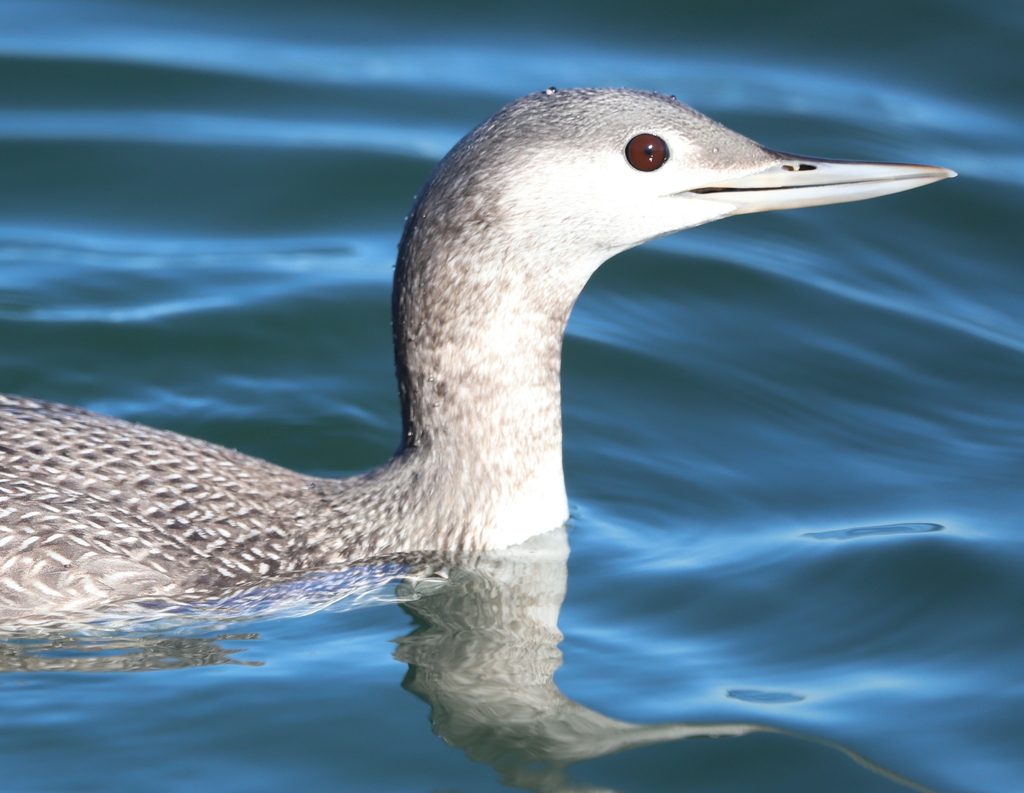
Red-throated Loon
Photo © Steven Bodzin
Photo © Steven Bodzin — CC BY 4.0 — Source: iNaturalist photo #106051502Identification
The red-throated loon is the smallest and lightest of the world's loons, ranging from 55 to 67 centimetres in length with a wingspan of 91–120 centimetres. In breeding plumage, adults display a distinctive dark grey head and neck with narrow black and white stripes, paired with a striking triangular red throat patch—the feature that gives the species its name. The underparts are white, and the back is dark grey-brown, making it the only loon with an all-dark back in breeding plumage. In winter, the bird becomes far more subdued: greyish above and fading to white below, with white on the chin, foreneck, and much of the face. The species has a thin, sharp, straight bill often held at an uptilted angle, dark legs on the outer half with pale inner halves, and carmine-red to burgundy irises.
Range & Habitat
The red-throated loon is a migratory aquatic bird found throughout the Northern Hemisphere and is the most widely distributed member of the loon family. It breeds primarily in Arctic regions and winters in northern coastal waters. The species is monotypic with no distinctive subspecies despite its large Holarctic range, though some populations are currently declining due to oil spills, habitat degradation, pollution, and fishing nets.
Behaviour & Diet
Fish form the bulk of the red-throated loon's diet, though amphibians, invertebrates, and plant material are sometimes eaten as well. The species is monogamous and forms long-term pair bonds. Both members of a pair help to build the nest, incubate the eggs (generally two per clutch), and feed the hatched young. Like all loons, it is superbly adapted to aquatic life, with dense bones that aid submersion, legs set far back on its body that provide excellent propulsion, and a streamlined form. Natural predators—including various gull species and both red and Arctic foxes—will take eggs and young.
Best Time & Places to See It
The red-throated loon's migratory nature means that timing and location are key to observing this species. During breeding season, look for it in Arctic regions where it nests near freshwater lakes and ponds. In winter, seek the species in northern coastal waters where it congregates in larger numbers. The bird's large global population and significant global range offer multiple opportunities for encounter, though the species is protected by international treaties.
Photography Tips
Photographers should note the dramatic seasonal plumage change: the striking red throat patch and contrasting head markings of breeding birds make for compelling images, while the subtle winter plumage requires different photographic approaches. The bird's set-back legs and streamlined aquatic form are best captured when the loon is in water. The sharply pointed bill and distinctive irises provide excellent detail for close-up shots. Early morning light on northern coastal waters during winter months, or the extended daylight of Arctic breeding grounds in summer, will offer optimal lighting conditions for photography.
Tombstone Territorial Park
Acadia National Park
Alaska Maritime National Wildlife Refuge
Algonquin Provincial Park
Alligator River National Wildlife Refuge
Arctic National Wildlife Refuge
Auyuittuq National Park
Banff National Park
Becharof National Wildlife Refuge
Nothing matches these filters.
No community photos yet. Log in to add the first one.
No community observations of this species yet.