Redpoll
Photo © Jyrki Salmi from Finland
Photo © Jyrki Salmi from Finland — CC BY-SA 4.0 — Source: Wikimedia CommonsIdentification
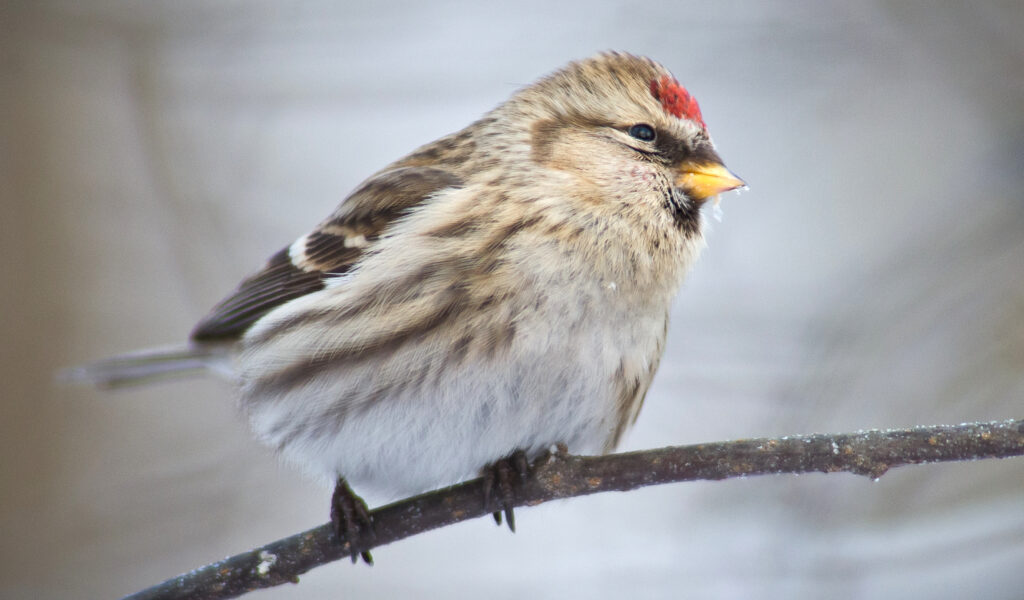
The redpoll is a small finch, measuring between 11.5 and 14 centimetres in length with a wingspan of 19–22 cm. Despite their diminutive size, these birds are distinctive and relatively easy to identify. The most striking feature is a bright red patch on the forehead, combined with a black bib that contrasts sharply against the bird's predominantly brownish-grey plumage with dark streaks. Two pale stripes run across the wings, and the rump is noticeably streaked with a broad dark brown streak across the vent. Males often display red suffusion on their breasts, making them particularly colourful during breeding season. The bill is dark-tipped and yellowish, and the legs are brown.
Range & Habitat
The redpoll is a northern hemisphere species with a circumpolar distribution extending through northern Europe, Asia, northern North America, Greenland, and Iceland. As a partial migrant, redpolls move southward in late autumn and return northward in March and April, making them seasonal visitors to temperate regions. The species is typically found in boreal forests dominated by pines, spruces, and larches, though some subspecies favour birch and willow in Arctic tundra habitats. Interestingly, the subspecies A. f. cabaret has also been established in New Zealand, where redpolls were introduced between 1862 and 1875 and now inhabit both the North and South Islands and many outlying islands.
Behaviour & Diet
Redpolls are seed specialists, feeding primarily on very small seeds, particularly from birch trees. During breeding season, they supplement their diet with small invertebrates. They forage mainly in trees but will occasionally descend to ground level to feed. Breeding occurs when birds reach just one year old. The female constructs a carefully layered nest—typically placed low in a tree or bush—with an outer layer of twigs, middle layer of root fibres and lichen, and inner lining of down and hair. Clutches consist of three to seven speckled eggs that incubate for about 11 days. Both parents care for the chicks, though only the female broods them. Young fledge at around 13 days old, and redpolls typically raise two broods per breeding season.
Best Time & Places to See It
To observe redpolls in their breeding habitat, visit Arctic and subarctic regions during the breeding season. For temperate-region birders, redpolls are best seen during their southward migration in late autumn and winter, when they move into more accessible areas. Look for them in birch and alder woods, particularly during seed-bearing seasons when food is abundant. Their small size and preference for foraging in trees means scanning the canopy and middle story of boreal forests is essential.
Photography Tips
The redpoll's small size and active nature present challenges for photographers. Use a telephoto lens to capture detail without disturbing the birds. The bright red forecrown and males' red-suffused breasts are key features to highlight, so position yourself to catch good light on the bird's head. Early morning or late afternoon light will render the red markings most vividly. Patience is essential—wait for birds to settle in trees rather than attempting to photograph them in flight. Their preference for feeding high in the canopy often means photographing against a bright sky, so expose carefully to retain detail in the plumage.
Manitoba Owls
Nothing matches these filters.
Tombstone Territorial Park
Acadia National Park
Alaska Maritime National Wildlife Refuge
Algonquin Provincial Park
Alligator River National Wildlife Refuge
Altai Tavan Bogd National Park
Aoraki / Mount Cook National Park
Arctic National Wildlife Refuge
Arthur’s Pass National Park
Nothing matches these filters.
No community photos yet. Log in to add the first one.
No community observations of this species yet.