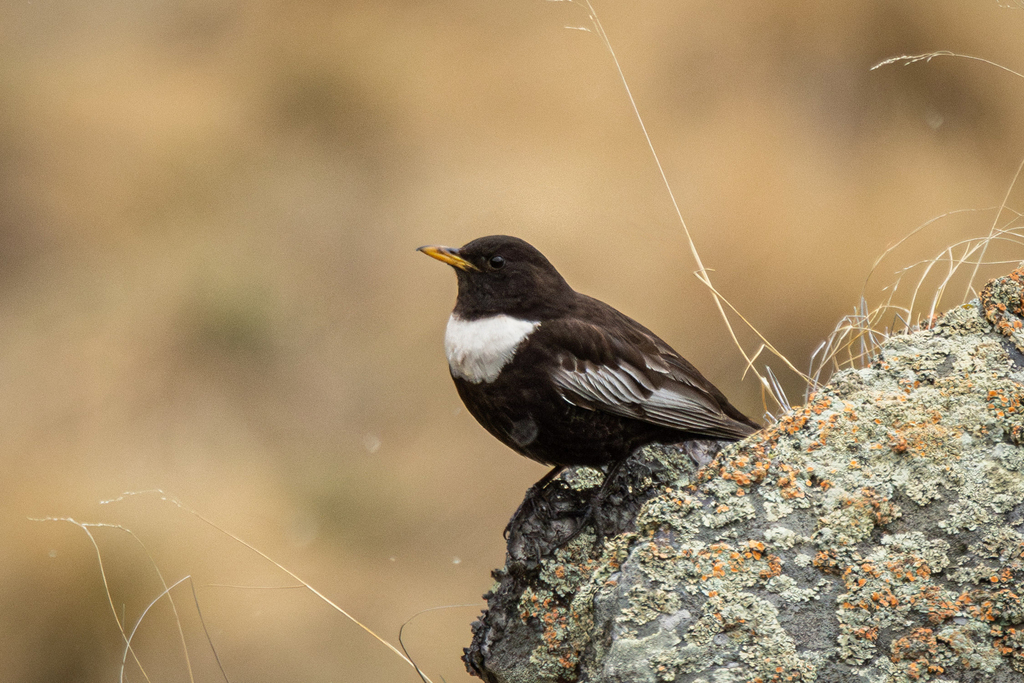
Ring Ouzel
Photo © Антон Лабачоў
Photo © Антон Лабачоў — CC BY 4.0 — Source: iNaturalist photo #384833594Identification
The ring ouzel is a medium-sized thrush, measuring 23–24 centimetres in length and weighing 90–138 grams. The most distinctive feature of this species is the conspicuous white crescent across the breast of males, which makes adults unmistakeable. Males are predominantly black with narrow greyish scaling on the upperparts and belly, pale edges to the wing feathers, a yellow bill, and greyish-brown legs.
Females are browner and duller than males, with a duller breast band. Young birds may lack the pale chest markings altogether or show only a faint crescent. First-winter males sometimes display a pale crescent. When identifying juveniles, note that they always show a paler wing panel than the superficially similar common blackbird. Subspecific variation exists: T. t. alpestris males display broader white scalloping on their underparts, while T. t. amicorum males have the largest and whitest breast band of the three subspecies.
Range & Habitat
The ring ouzel is a mainly European member of the thrush family with three subspecies breeding in mountains from Ireland east to Iran. In all but the northernmost part of its range, this is a high-altitude species, preferring open mountain areas with some trees or shrubs. Typical breeding habitats include juniper and other treeline conifers, rowan, bilberry, heather, and hairy alpenrose.
This is a migratory bird, leaving its breeding areas to winter in southern Europe, North Africa, and Turkey, typically in mountains with junipers. Analysis of mitochondrial DNA suggests the species had a much broader distribution after the Last Glacial Period ended approximately 11,700 years ago than it does now.
Behaviour & Diet
The ring ouzel is omnivorous, feeding on invertebrates—particularly insects and earthworms—small vertebrates, and a wide range of fruit. Most animal prey is caught on the ground. During spring migration and the breeding season, invertebrates dominate the adult's diet and are also fed to the chicks. Later in the year, fruit becomes increasingly important, particularly from the common juniper.
The male sings from a low perch or occasionally in flight, producing a distinctive song consisting of 2–4 plaintive fluty notes with pauses between repeats. The call is a loud tac-tac-tac, becoming harsher if the bird is alarmed. Ring ouzels typically produce a clutch of 3–6 brown-flecked pale blue or greenish-blue eggs, incubated almost entirely by the female. Hatching normally occurs after 13 days, and the altricial, downy chicks fledge in another 14 days, remaining dependent on their parents for approximately 12 days after fledging.
Best Time & Places to See It
Ring ouzels are best encountered during the breeding season in mountainous regions from Ireland to Iran, particularly in open upland areas with scattered trees and shrubs. Their migratory nature means they are present in breeding areas during spring and summer, departing to southern Europe, North Africa, and Turkey for winter. Look for them in habitats featuring juniper, rowan, and other mountain vegetation.
Although the ring ouzel has an extensive range and large population, evaluated as least concern by the IUCN, there are significant declines in several countries. Suspected causes include climate change, human disturbance, hunting, outdoor leisure activities, and loss of junipers. Natural hazards include predation by mammalian carnivores and birds of prey, as well as potential competition from other large thrushes such as the common blackbird, mistle thrush, and fieldfare.
Photography Tips
The ring ouzel's striking black plumage and brilliant white breast crescent make it visually distinctive and rewarding to photograph. Males are particularly photogenic, especially during breeding season when they sing from low perches or in flight. The contrast between their dark plumage and pale breast markings photographs well in strong mountain light.
Since this species typically forages on the ground, watch for feeding activity in open areas with sparse vegetation. Early morning and late afternoon often provide the best light in mountainous terrain. Be mindful that ring ouzels breed in remote upland habitats and can be sensitive to human disturbance, so use appropriate distance and concealment when photographing these birds during their vulnerable breeding season.
Abruzzo, Lazio and Molise National Park
Alpilles Regional Nature Park
Avesnois Regional Nature Park
Bannau Brycheiniog National Park
Bardenas Reales
Baronnies Provençales Regional Nature Park
Bavarian Forest National Park
Beinn Eighe National Nature Reserve
Belluno Dolomites National Park
Nothing matches these filters.
No community photos yet. Log in to add the first one.
No community observations of this species yet.