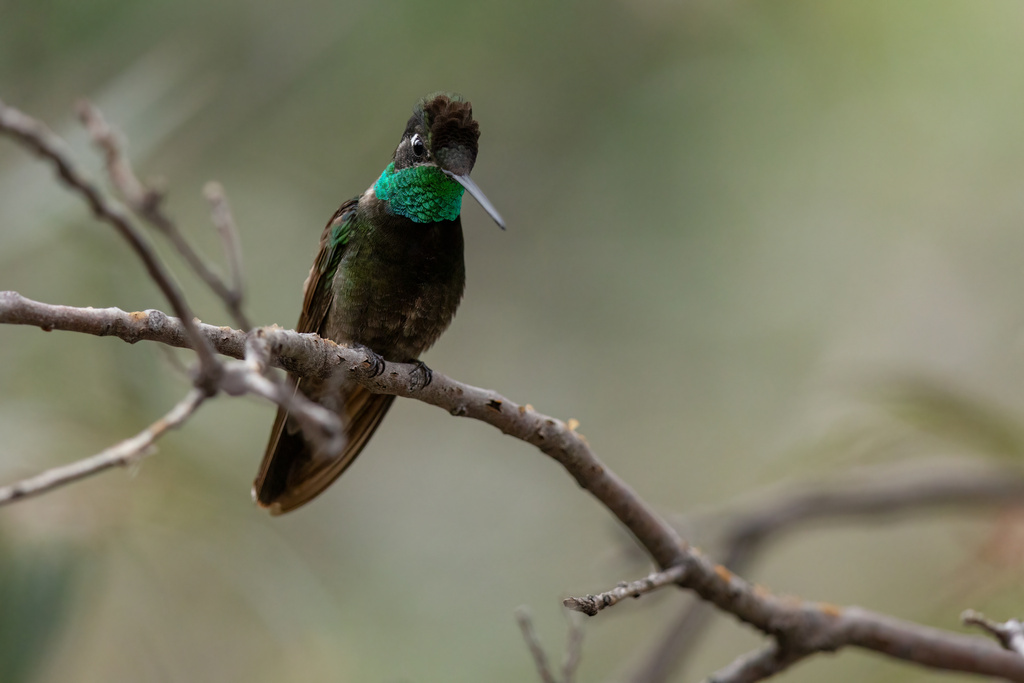
Rivoli’s Hummingbird
Photo © Matt Felperin
Photo © Matt Felperin — CC BY 4.0 — Source: iNaturalist photo #598573865Identification
Rivoli's hummingbird, also known as the magnificent hummingbird, is one of the two largest hummingbirds found in the United States, measuring 11 to 14 cm long with a wingspan of 18 centimetres and weighing about 6 to 10 grams. It has a long, straight to slightly decurved black bill. Both sexes appear very dark in most light, but when the sun catches their plumage, brilliant colors flash spectacularly.
Adult males are green-bronze on the back and tail, with a distinctive violet crown, bright blue-green throat gorget, and black head marked by a white spot behind the eye. The chest is green-bronze and the belly grayish. Females are bronze-green above with dull gray underparts and a white eye-stripe. Immature birds resemble females but are darker and browner. The species undergoes a protracted molt between breeding and non-breeding plumage.
Range & Habitat
Rivoli's hummingbird is found in El Salvador, Guatemala, Honduras, Mexico, Nicaragua, and the United States, where it breeds in mountains from the southwestern states southward. The species inhabits the interior, edges, and clearings of pine-oak forest and cloudforest from about 1,500 metres up to the timberline, as well as more open secondary forest and grasslands. It regularly visits bird feeders throughout its range.
The species is migratory in parts of its range and a year-round resident from north-central Mexico south to northern Nicaragua. It nests in southeastern Arizona, possibly in southwestern New Mexico, and in Mexican states including Chihuahua and Sonora, though it does not overwinter in these northern breeding areas. Summer records exist from the Chisos Mountains of Texas, though breeding there has not been confirmed.
Behaviour & Diet
Rivoli's hummingbird feeds on nectar from a wide variety of flowering plants whose composition varies by season, elevation, and latitude. In parts of Mexico, males defend feeding territories. Notably, this species feeds on small insects more frequently than other North American hummingbirds, capturing them in mid-air or by gleaning from vegetation while hovering. Throughout its range, Rivoli's is subordinate to the larger blue-throated hummingbird but tends to dominate smaller species such as amethyst-throated, berylline, and bumblebee hummingbirds. It coexists peacefully with black-chinned and broad-tailed hummingbirds.
The breeding season spans from May to July in the U.S. and is possibly year-round in El Salvador. Females build delicate open cup nests from soft feathers and moss bound with spider silk and covered with lichen, typically placing them on horizontal branches or in forks—often in maples and sycamores and frequently over streams—at least 6 metres above ground. Females incubate a clutch of two white eggs, with fledging occurring in about 25 days. The species produces a loud, high-pitched "tchik" or "tcheep" call, along with sharp chattering notes that rise and fall; males also give rapid sequences of chip notes during aggressive or alarm situations.
Best Time & Places to See It
In the United States, Rivoli's hummingbird is best sought during the breeding season from May to July in southeastern Arizona and possibly southwestern New Mexico. The species is a year-round resident throughout much of Mexico and Central America, making these regions accessible for viewing in any season. Higher mountain elevations—particularly pine-oak forests and cloudforests above 1,500 metres—offer the best chances of encountering this striking species.
Visiting bird feeders is a reliable method for locating Rivoli's hummingbirds, as they regularly come to feeders throughout their range. In mountainous regions within its distribution, watching flowering plants in clearings and forest edges during peak blooming times increases sighting opportunities.
Photography Tips
The spectacular iridescent plumage of Rivoli's hummingbird demands careful attention to lighting. The male's violet crown and brilliant blue-green gorget only flash vividly when sunlight catches the feathers at the right angle; position yourself so that the sun illuminates the bird from the side or front rather than from behind. In overcast conditions or shade, the bird appears uniformly dark, making good light essential for capturing its true colors.
The species' large size compared to other North American hummingbirds makes it slightly easier to photograph than smaller species, though standard hummingbird photography techniques still apply. Watch for males defending feeding territories, as these birds tend to return to the same perches and feeding sites, offering repeated opportunities for photography. High-speed flash or fast shutter speeds are necessary to freeze the rapid wing beats and capture the intricate details of this magnificent species.
Big Bend National Park
Brewster County, United States
+345 birds+34 mammals
Where the Chisos Mountains rise abruptly from the Sonoran Desert floor, Big Bend National Park spans over 7,300 square kilometers of one of North America's most…
VIEW NATIONAL PARKSaguaro National Park
Rincon Valley, United States
+354 birds+40 mammals
Where the Sonoran Desert meets sky-island mountains, two geographically separated districts of Saguaro National Park sprawl across nearly two thousand square kilometers of Arizona's most iconic…
VIEW NATIONAL PARKLagunas de Montebello National Park
Laguna de Montebello, Mexico
+360 birds+2 mammals
Where turquoise lagoons pierce the limestone plateau of southeastern Chiapas, the Lagunas de Montebello National Park unfolds across roughly 174 square kilometers of spectral water and…
VIEW NATIONAL PARKParque Nacional Cerro de la Estrella
Mexico
+126 birds+4 mammals
Where volcanic peaks rise sharply above Mexico City's sprawling metropolis, Parque Nacional Cerro de la Estrella offers a rare glimpse of high-altitude terrain within one of…
VIEW NATIONAL PARKParque Nacional Benito Juárez
San Andrés Huayápam, Mexico
+128 birds+4 mammals
High in the Sierra Madre del Sur of Oaxaca, where cloud forest mingles with pine woodland and the terrain climbs steeply through ravines carved by mountain…
VIEW NATIONAL PARKTutuaca
Tosanachi, Mexico
+147 birds+13 mammals
Where copper canyons plunge deeper than the Grand Canyon itself, Mexico's remote Sierra Madre Occidental unfolds in dramatic vertical relief. Tutuaca anchors this wilderness realm, a…
VIEW PROTECTED LANDSCAPEGrand Canyon National Park
United States
+277 birds+35 mammals
A mile-deep chasm of rust-red rock and purple shadow cuts through the high desert plateau of northern Arizona, revealing nearly two billion years of geological history…
VIEW NATIONAL PARKGuadalupe Mountains National Park
Culberson County, United States
+262 birds+14 mammals
Where fossil-laden limestone ridges thrust skyward above the Chihuahuan Desert floor, Guadalupe Mountains National Park reveals a landscape sculpted by ancient seas and relentless aridity. These…
VIEW NATIONAL PARKNo community photos yet. Log in to add the first one.
No community observations of this species yet.