Ross’s Gull
Photo © Christoph Moning
Photo © Christoph Moning — CC BY 4.0 — Source: iNaturalist photo #174805564Identification
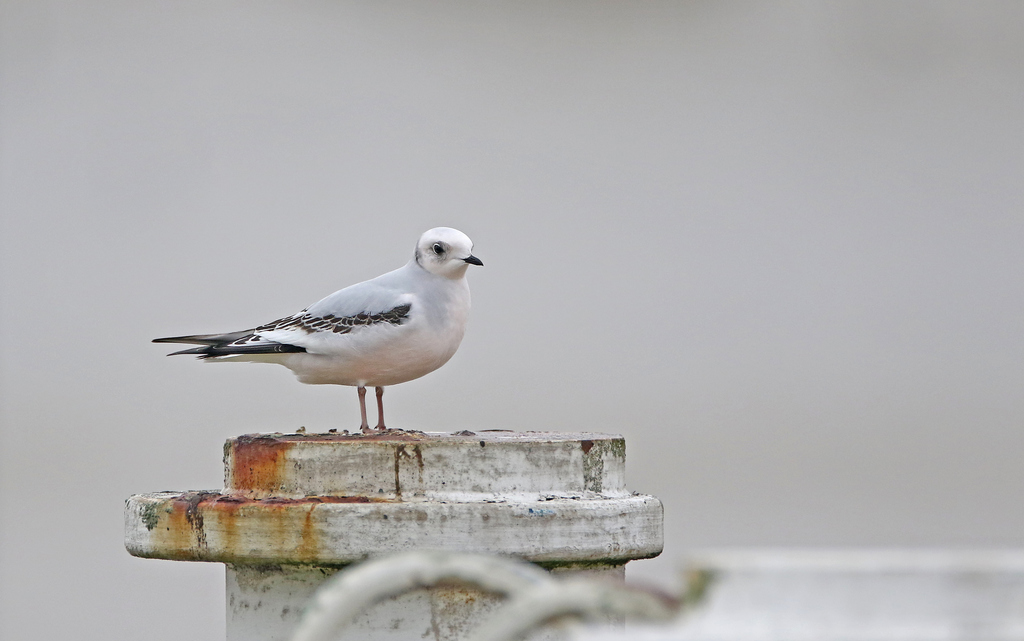
Ross's gull is a small, delicate gull slightly larger than the little gull, with notably pointed wings and a distinctive wedge-shaped tail. Summer adults display pale grey upperparts and white underparts with a characteristic pink flush across the body plumage and a neat black neck ring. The red legs are a helpful identifying feature. In winter, the neck collar disappears and a small dark crescent develops behind the eye; the pink coloration, which is diet-dependent, fades in some individuals but persists in others.
Young birds resemble winter adults but show a dark "W" pattern on the wings in flight and lack pink tones entirely. Juveniles require two years to acquire full adult plumage. Adult measurements range from 29–31 cm in length with a wingspan of 90–100 cm and weight between 140–250 g.
Range & Habitat
Ross's gull breeds across the high Arctic of northernmost North America and northeast Siberia. The species is highly migratory but only travels short distances south in autumn, with most birds wintering at high northern latitudes along the pack ice edge in the northern Bering Sea and Sea of Okhotsk. Vagrants occasionally reach temperate regions, including northwest Europe; recent sightings have occurred in Cornwall, Ireland, Belgium, and exceptionally far south as California's Salton Sea, though such occurrences are extremely rare.
Breeding habitat consists of tundra characterized by sedges, grass tussocks, dwarf willows, bushes, lichens, and shallow pools. The species typically nests in small colonies on tundras and swampy Arctic estuaries, often alongside other seabirds such as Arctic terns, frequently on islands within small lakes.
Behaviour & Diet
Ross's gull is strongly colonial, breeding in small groups and laying two to three eggs in ground nests lined with seaweed, grass, or moss. The olive-green eggs are marked with small reddish-brown spots. Incubation lasts approximately three weeks, with chicks fledging after another three weeks. Not all breeding pairs successfully raise young, as predators and harsh Arctic weather frequently impact breeding success.
The species is opportunistic in its feeding, consuming small fish and crustaceans year-round. During the breeding season, it becomes largely insectivorous, focusing on beetles and flies. In winter, it often forages on mudflats in wader-like fashion, adapting its feeding behavior to available resources in its high-latitude environment.
Best Time & Places to See It
The best opportunities to observe Ross's gull occur during the winter months when birds congregate along the pack ice edges of the Bering Sea and Sea of Okhotsk. Breeding birds can be found in the high Arctic regions of northern North America and northeast Siberia during summer, though accessing these remote areas requires significant effort and specialized Arctic travel. Birdwatchers in northwest Europe should watch for vagrant individuals during winter months, particularly in coastal regions.
Photography Tips
Photographing Ross's gull presents considerable challenges due to its remote Arctic habitat and preference for ice-edge environments. During breeding season in the Arctic, work from a distance to avoid disturbing nesting colonies; the bird's small size and subtle plumage require careful exposure metering to capture the delicate pink flush and pale grey tones accurately. Use a longer lens (500mm or greater) to fill the frame from typical viewing distances.
Winter sightings in more accessible locations offer better photography opportunities. Overcast Arctic and subarctic conditions are typical, so fast film speeds or high ISO settings may be necessary. The distinctive neck ring and red legs of summer birds are key identification features worth highlighting in images. Patient observation of mudflat feeding behavior during winter can yield unique action photographs.
Kosterhavets National Park
Västra Götalands län, Sweden
+211 birds+9 mammals
Where the west coast of Sweden dissolves into an archipelago of granite skerries and pine-clad islands, Kosterhavets National Park emerges as one of northern Europe's most…
VIEW NATIONAL PARKNorthwest Spitsbergen National Park
Norway
+58 birds+17 mammals
Where the High Arctic converges with the Norwegian mainland, Northwest Spitsbergen National Park sprawls across one of Earth's most extreme and pristine wildernesses. Crowned by jagged…
VIEW NATIONAL PARKSchleswig-Holsteinisches Wattenmeer National Park
Germany
+378 birds+49 mammals
Where the North Sea ebbs and flows across a vast expanse of exposed mud and sand, the Schleswig-Holsteinisches Wattenmeer National Park reveals one of Europe's most…
VIEW NATIONAL PARKSt. Paul Island
Saint Paul, United States
+255 birds+8 mammals
Windswept tundra rolls across this remote Pribilof island, where volcanic basalt cliffs plunge into the Bering Sea and fog rolls in thick enough to erase the…
VIEW PROTECTED LANDSCAPEDisko Bay
Kitsissuarsuit, Greenland
+46 birds+9 mammals
Where Arctic fjords carve deep into Greenland's western coast, Disko Bay creates a protected landscape of extraordinary ecological complexity. The waters here merge temperate Atlantic currents…
VIEW PROTECTED LANDSCAPEAlaska Maritime National Wildlife Refuge
Alaska, United States
+391 birds+58 mammals
Where the North Pacific collides with Alaska's rugged coastline, a sprawling archipelago of islands, rocky outcrops, and coastal headlands forms one of North America's most remote…
VIEW WILDLIFE SANCTUARYYukon Delta National Wildlife Refuge
Bethel, United States
+156 birds+12 mammals
Across the Yukon Delta sprawls one of North America's most expansive coastal wetland sanctuaries, where the boreal subarctic climate strips down existence to essentials. This vast…
VIEW WILDLIFE SANCTUARYNo community photos yet. Log in to add the first one.
No community observations of this species yet.