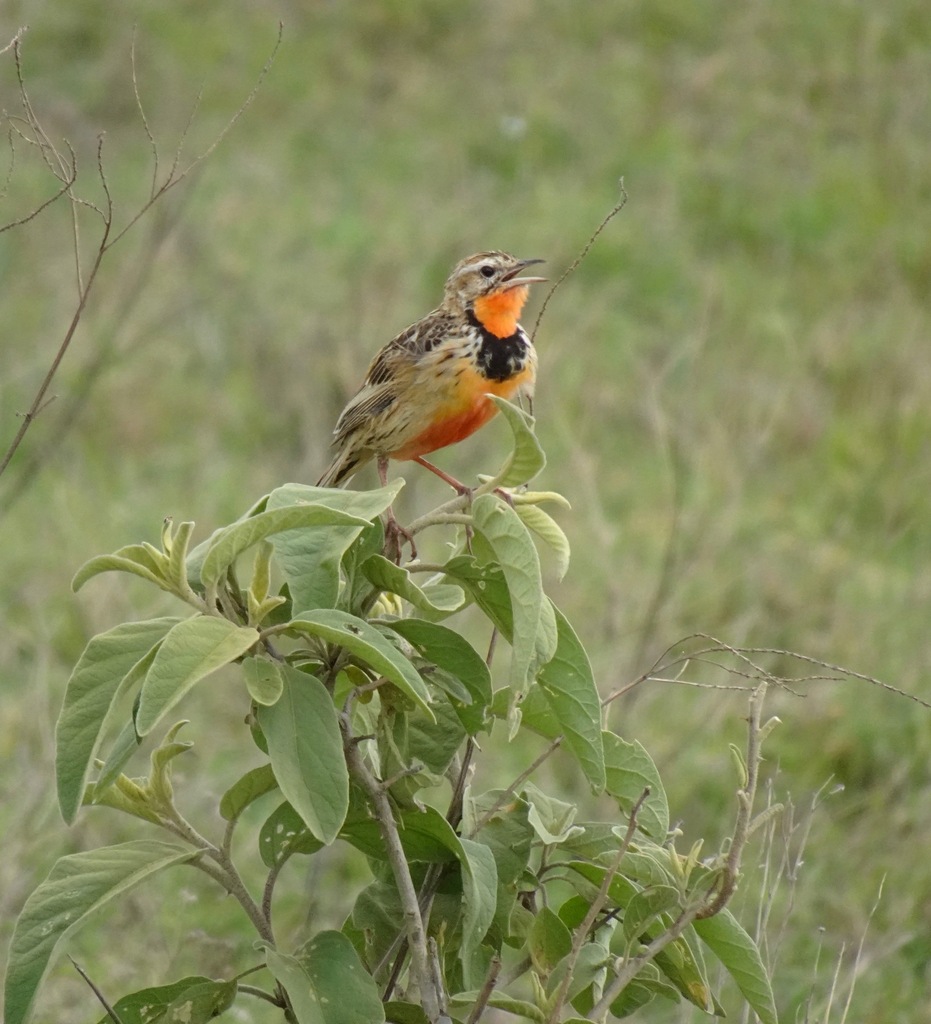
Rosy-throated Longclaw
Photo © Laura Gaudette
Photo © Laura Gaudette — CC BY 4.0 — Source: iNaturalist #148559122Identification
The Rosy-throated Longclaw is a small passerine measuring 19–20 centimetres in length, making it a compact but distinctive bird of African grasslands. Both sexes share greyish-brown, finely scalloped upper parts that blend well with their grassland habitat. Males are particularly striking during breeding season, displaying a soft pink throat and breast adorned with a bold black band across the chest—a feature that vanishes outside the breeding period. Females lack this dramatic chest band but retain pink underparts, appearing more subtly marked. Immature birds are duller still, showing mainly black-streaked pale brown underparts with touches of pink-red colouration in the centre. In the field, listen for its distinctive chiteet call, a sharp, pipit-like sound that often reveals the bird's presence before you spot it visually.
Range & Habitat
This species is widely distributed across central and eastern Africa, with a patchier presence in southern regions. Its range spans Angola, Botswana, Democratic Republic of the Congo, Kenya, Malawi, Mozambique, Namibia, South Africa, Tanzania, Zambia, and Zimbabwe. Three subspecies are recognized, each occupying distinct portions of this range: M. a. ameliae in Mozambique, Eswatini and eastern South Africa; M. a. wintoni in southwestern Kenya and northern Tanzania; and M. a. altanus across a broad swath of Botswana, Angola, Malawi, southwestern Tanzania, Zimbabwe and Zambia.
The Rosy-throated Longclaw is a specialist of wet grasslands and flood plains, preferring areas with lower grass cover that allow it to forage and move more easily. Key strongholds include the Okavango Delta, Linyanti Marshes and Chobe floodplains in Botswana and Namibia, the Zimbabwe highveld, and coastal wetland areas in KwaZulu-Natal, South Africa. However, coastal populations in KwaZulu-Natal face mounting pressure from development, making conservation awareness crucial in that region.
Behaviour & Diet
Like other longclaws, this species is a ground-dwelling bird adapted to life in open grasslands and marshes. The bird breeds during the wet season, which runs from September through April—a period when grasslands are lush and invertebrate prey is abundant. While specific dietary details are limited in current literature, longclaws are known primarily to forage on insects and other small invertebrates found in their grassland habitats, gleaning food from vegetation and the ground.
Best Time & Places to See It
For the best chance of encountering Rosy-throated Longclaws, visit during the breeding season from September to April, when birds are more active and vocal. The Okavango Delta and associated wetlands in Botswana and Namibia are prime locations, as are the floodplain ecosystems of the Linyanti Marshes and Chobe region. In Zimbabwe, check the highveld grasslands, while in South Africa, the coastal wetlands of KwaZulu-Natal offer opportunities, though populations there are increasingly localized. Early morning visits to wet grassland habitats yield the best results, as birds are most vocal and active at this time.
Photography Tips
Photographing this species requires patience and stealth, as it is a bird of open grasslands where cover is limited. Use a telephoto lens (at least 400mm) to maintain distance and avoid flushing birds. Males in breeding plumage are your most photogenic subjects, with their pink and black breast pattern providing striking contrast. Overcast days or early morning light are ideal for capturing detail without harsh shadows. Focus on wetland habitats during the wet season for the greatest density of birds and the most cooperative subjects. The bird's small size and tendency to remain low in grass mean you may need to position yourself carefully or wait for it to perch briefly on a grass stem or low shrub.
Serengeti National Park
Tanzania
+558 birds+57 mammals
Across Tanzania's northern plateau, where volcanic soils meet acacia woodland and open grassland, unfolds one of Earth's most dynamic ecosystems. The Serengeti National Park sprawls across…
VIEW NATIONAL PARKArusha National Park
Tanzania
+555 birds+16 mammals
Where the slopes of Mount Mawenzi rise above the Arusha region, a compact yet ecologically rich national park unfolds across montane forest, moorland, and alpine zones.…
VIEW NATIONAL PARKChobe National Park
Botswana
+446 birds+45 mammals
Where the Chobe River cuts a sinuous path through northern Botswana, the landscape transforms into one of Africa's most dynamic wetland-savanna mosaics. This national park encompasses…
VIEW NATIONAL PARKAmboseli National Park
Etonet/Lenkism ward, Kenya
+501 birds+43 mammals
Where the Amboseli basin opens toward the Tanzanian frontier, a shallow alkaline lake mirrors vast skies across one of East Africa's most iconic savanna landscapes. The…
VIEW NATIONAL PARKTarangire National Park
Tanzania
+527 birds+50 mammals
Acacia woodland and grassland sweep across the Manyara Region where the Tarangire River carves through low hills and volcanic soils, creating one of East Africa's most…
VIEW NATIONAL PARKNgorongoro Conservation Area
Tanzania
+626 birds+55 mammals
Volcanic calderas and open grassland dominate this high plateau in northern Tanzania, where the landscape rises above 2,000 metres and ancient geological forces have shaped both…
VIEW WILDLIFE MANAGEMENT AREANkasa Rupara National Park
Namibia
+283 birds+17 mammals
Where the Zambezi's floodplains spill across the border between Namibia and Botswana, Nkasa Rupara National Park unfolds across 518 square kilometers of wetland and woodland mosaic.…
VIEW NATIONAL PARKNairobi National Park
Nairobi, Kenya
+515 birds+35 mammals
Just minutes from Kenya's capital, where the Nairobi River winds through acacia woodland and open grassland, lies one of Africa's most paradoxical wildlife sanctuaries. The park's…
VIEW NATIONAL PARKLake Nakuru National Park
Nakuru West, Kenya
+494 birds+32 mammals
Alkaline waters ringed by acacia woodland and grassland create one of East Africa's most distinctive wetland ecosystems, where the interplay of geology and climate sustains a…
VIEW NATIONAL PARKRuma National Park
Suba, Kenya
+250 birds+8 mammals
Where the Winam Gulf narrows toward the Kenyan mainland, Ruma National Park rises as a sanctuary of evergreen woodland set within the humid tropics of Homa…
VIEW NATIONAL PARKNo community photos yet. Log in to add the first one.
No community observations of this species yet.