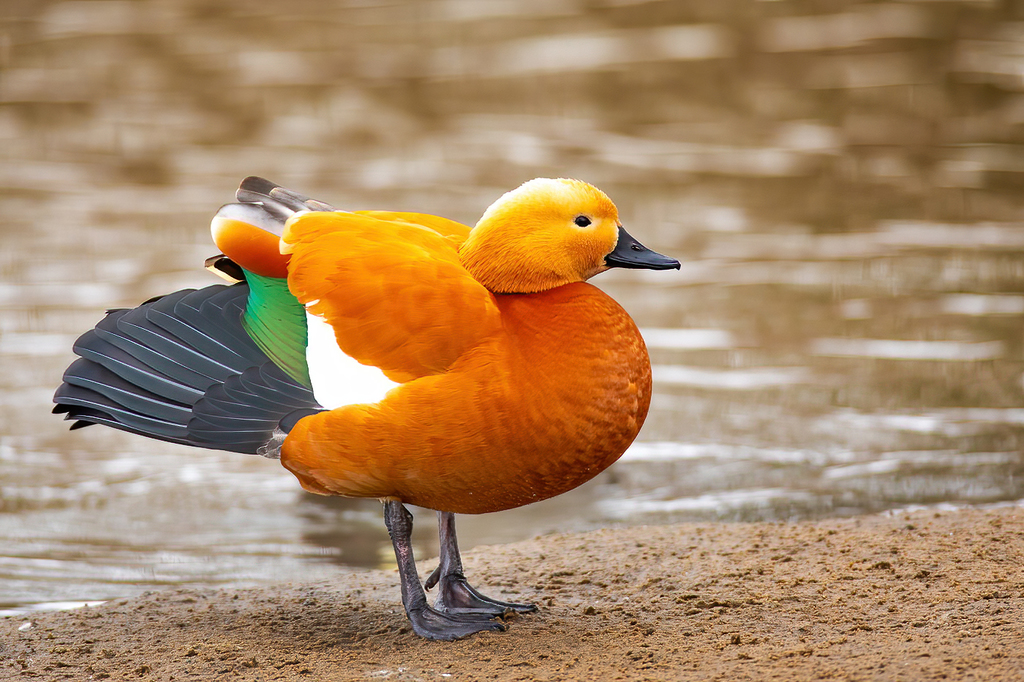
Ruddy Shelduck
Photo © egorbirder
Photo © egorbirder — CC BY 4.0 — Source: iNaturalist photo #118676181Identification
The Ruddy Shelduck is a striking and unmistakable waterfowl, measuring 58 to 70 cm in length with a wingspan of 110 to 135 cm. Males display vibrant orange-brown body plumage with a paler head and neck, distinguished by a distinctive narrow black collar separating the head from the body. The rump, flight feathers, and tail are black, contrasting sharply with white upper and lower wing-coverts that are particularly noticeable in flight. Females are similar but possess a pale, whitish head and neck without the black collar. Both sexes have black bills and dark grey legs, with iridescent green speculum feathers visible on the inner wing surfaces. The species has a loud, nasal honking call that differs distinctly between males and females, making it highly vocal and easy to locate.
Range & Habitat
The Ruddy Shelduck is a migratory species with breeding grounds spanning from southeastern Europe across the Palearctic to Lake Baikal, Mongolia, and western China. Eastern populations winter in the Indian subcontinent, arriving by October and departing by April. Small resident populations persist in Northwest Africa and Ethiopia, while the species has recently colonised Fuerteventura in the Canary Islands. This duck favours open inland water-bodies including lakes, reservoirs, and rivers with mud flats and shingle banks. Though typically lowland birds, they are remarkably adaptable and in central Asia are among the few waterbirds found on high-altitude lakes at 5,000 metres. They seldom occur in forested areas but readily use brackish water and saline lagoons.
Behaviour & Diet
Ruddy Shelducks form lasting pair bonds, with males and females remaining together. They demonstrate unusual nesting behaviour, often building nests well away from water in crevices or holes in cliffs, trees, or similar sheltered sites. Females lay a clutch of about eight eggs, which they incubate solely for approximately four weeks. Both parents care for the young, who fledge about eight weeks after hatching. The birds are highly vocal, producing loud honking calls both on the ground and in flight, with the sounds varying according to circumstances and readily distinguishing individual birds.
Best Time & Places to See It
In the Indian subcontinent, Ruddy Shelducks are common winter visitors between October and April, making this an excellent period for observation. Central and eastern Asian populations remain steady or rising, offering reliable sightings throughout much year in these regions. The species is still common across much of its Asian range, particularly on large lakes and reservoirs. In Europe, the species has become increasingly rare in southeastern regions and southern Spain, though feral populations have established in several European countries, particularly Switzerland where numbers have dramatically increased in recent decades.
Photography Tips
The Ruddy Shelduck's bold colouration and distinctive markings make it highly photogenic. The contrast between orange-brown body plumage and black flight feathers is most striking in flight, when the white wing-coverts become particularly prominent. Early morning and late afternoon light will enhance the warm tones of the plumage. Since these ducks favour open water-bodies with minimal vegetation, photography opportunities are often unobstructed. Their vocal nature means they are relatively easy to locate, and their tendency to congregate on lakes and reservoirs in good numbers provides ample opportunities for compelling group compositions.
Sarus Crane Jeep Safari
Nothing matches these filters.
Nothing matches these filters.
Kanha Tiger Reserve
Altai Tavan Bogd National Park
Altun Mountain National Nature Reserve
Avesnois Regional Nature Park
Baikal National Park
Bale Mountains National Park
Bandhavgarh National Park
Banke National Park
Bardiya National Park
Nothing matches these filters.
No community photos yet. Log in to add the first one.
No community observations of this species yet.