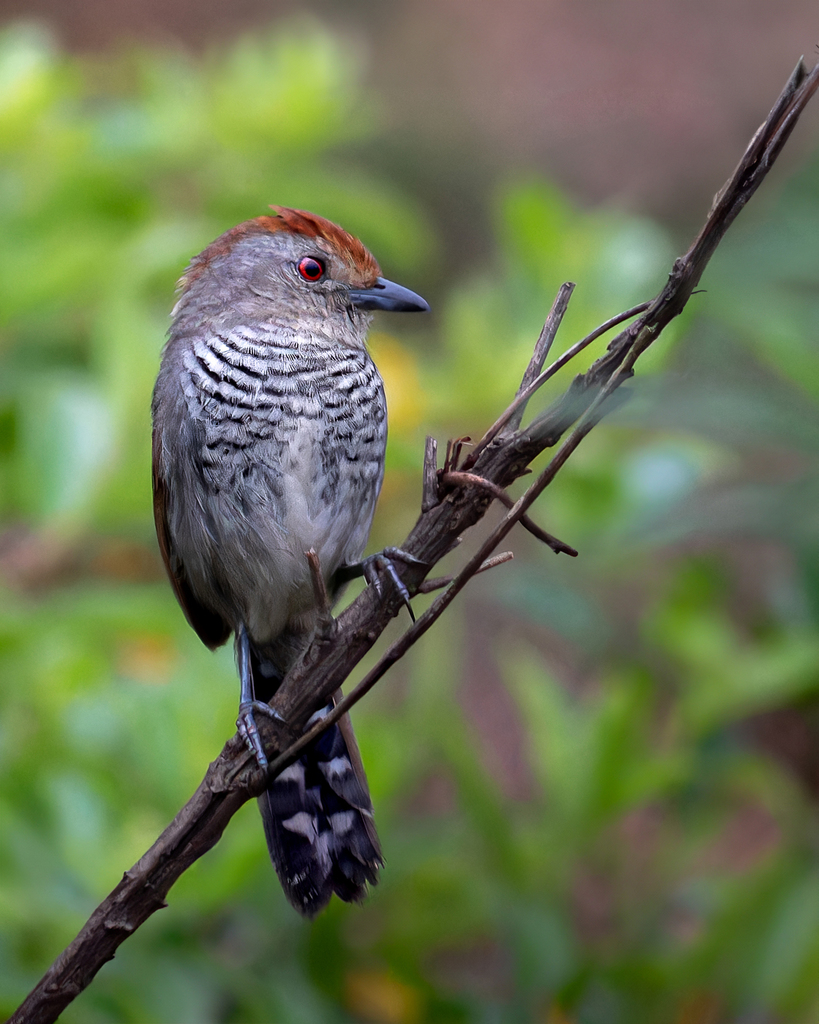
Rufous-capped Antshrike
Photo © Enéas V. Gouvêa Junior
Photo © Enéas V. Gouvêa Junior — CC BY-SA 4.0 — Source: iNaturalist photo #441678865Identification
The rufous-capped antshrike is a small member of the antbird family, measuring 15–17 cm in length. Like other members of genus Thamnophilus, it has a characteristic stout bill with a hooked tip. The species shows marked sexual dimorphism. Males of the widespread southern subspecies have a chestnut crown, buffy-gray face and throat, dark brown upperparts, and rufous-brown wings. Their tail is brownish-black with white tips and inner barring. The underparts are mostly buff-white with bold black barring on the breast and sides. Females are similar but duller, with a cinnamon-brown crown, rufous-brown tail lacking white markings, and little to no breast barring. Other subspecies show regional variation in cap shade, face coloration, and underpart patterning.
The five recognized subspecies are distributed across the species' range and show subtle but consistent plumage differences that field observers may notice when traveling between regions.
Range & Habitat
The rufous-capped antshrike has a disjunct distribution across South America, found in Peru, Bolivia, Brazil, Paraguay, Argentina, and Uruguay. In the Andes of Peru and northern Bolivia, it inhabits semi-humid montane forest, secondary forest, and scrublands, favoring forest edges though also occurring in forest interior in northern Peru. From southern Bolivia into Argentina, it continues in these habitats while also using scrub and riparian corridors in more open country. In the lowlands of Brazil, Uruguay, Paraguay, and Argentina, it avoids dense forest interior, preferring isolated shrub patches, small woodlots, scrublands, hedgerows, and brushy margins around settlements.
Elevation varies considerably by region: from sea level to 2,400 m in Brazil, 1,800–3,000 m in Peru, and 600–2,700 m in Bolivia, with lower elevations in Argentina. This adaptability to varied woodland and scrubland habitats makes it a relatively accessible species for travelers across much of lowland and middle-elevation South America.
Behaviour & Diet
The rufous-capped antshrike is presumed to be a year-round resident throughout most of its range, though some individuals at the southern edge of its distribution may migrate northward during the austral winter. Like other antshrikes, it is an active forager, though detailed information on its specific diet and foraging techniques remains limited in published literature.
Best Time & Places to See It
As a presumed year-round resident across most of its range, the rufous-capped antshrike can be encountered in suitable habitat throughout the year. In the Andes, visiting montane forest edges and secondary growth in Peru and Bolivia offers good chances. In lowland regions of Brazil, Paraguay, Argentina, and Uruguay, focus on shrubby habitats, woodland edges, and riparian scrub rather than dense forest interiors. The species' preference for forest edges and open scrubland makes it more accessible than many forest antbirds, particularly in the lowland portions of its range.
Photography Tips
The rufous-capped antshrike's small size and preference for dense scrubland and brushy habitats require patience and fieldcraft. Males are more visually distinctive than females due to their brighter chestnut cap and bold breast barring; position yourself with light favorable to capture these field marks. The hooked bill profile is a useful identifying feature to include in frame. Photograph birds at the edges of thickets and shrublands where better light penetration occurs. Early morning activity in scrubby areas increases encounter rates. Be aware that subspecific variation exists across the range; recording the geographic location of your shots will help document regional plumage differences for reference libraries.
Araucárias National Park
Calilegua National Park
Campos Gerais National Park
Carlos Botelho State Park
El Palmar National Park
El Rey National Park
Ibitipoca State Park
Iguaçu National Park
Iguazú National Park
Nothing matches these filters.
No community photos yet. Log in to add the first one.
No community observations of this species yet.