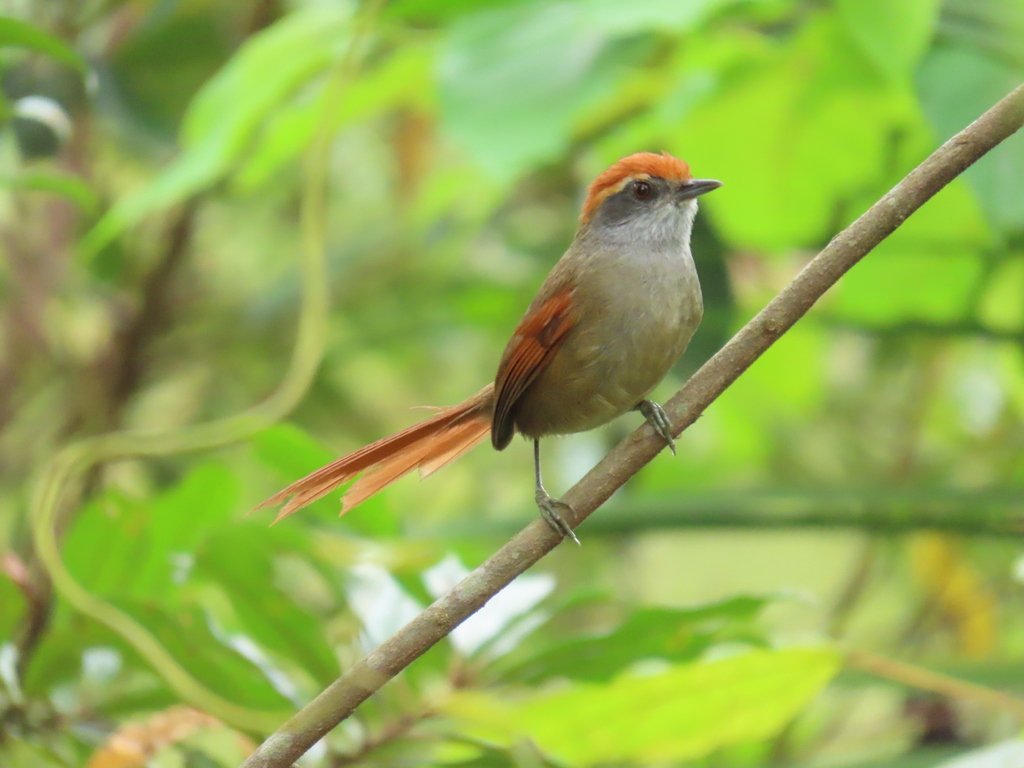
Rufous-capped Spinetail
Photo © Jonathan Lorencetti Ehlert
Photo © Jonathan Lorencetti Ehlert — CC BY-SA 4.0 — Source: iNaturalist photo #581649184Identification
The rufous-capped spinetail is a small bird, measuring 13 to 17 cm in length and weighing just 12 to 16 grams. Its most distinctive feature is its bright orange-rufous crown and nape, which contrasts sharply with its dark brownish-gray lores and ear coverts. A wide buff supercilium runs above the eye, giving the bird an alert expression. The back, rump, and upper tail coverts are rufescent brown, while the wings and tail are chestnut-brown. The tail is notably graduated with pointed feather tips—a characteristic spinetail trait. The throat and chin are whitish with faint streaking, and the underparts are paler buff-brown overall. Males and females share identical plumage, though juveniles have a duller crown with little or no chin spot and a more ochraceous wash below.
Range & Habitat
This species inhabits a broad swath of southeastern South America, found in Brazil from southern Goiás eastward to Espírito Santo and southward into northern Rio Grande do Sul, as well as far eastern Paraguay and the Misiones and Corrientes provinces of northern Argentina. The rufous-capped spinetail favors the undergrowth and edges of various forest types, including both primary and secondary montane and lowland evergreen forests. It is strongly associated with stands of Chusquea bamboo, which appear to be important habitat features. Elevations range from near sea level to 1,400 meters.
Behaviour & Diet
This is a year-round resident throughout its range with no seasonal migrations. The rufous-capped spinetail forages primarily in pairs and frequently joins mixed-species feeding flocks, typically working through the forest understorey but occasionally dropping to the ground or into the mid-storey. It is thought to feed chiefly on arthropods, gleaning prey from foliage and small branches, though detailed dietary information remains limited. During the austral spring and summer, breeding pairs construct bulky nests of thorny sticks, placing them in dense vegetation 1 to 2.5 meters above ground. The nest features a distinctive downward-slanting entrance tube, and clutches typically contain two to three eggs.
Best Time & Places to See It
The rufous-capped spinetail is a year-round resident, making it potentially observable at any season, though breeding activity intensifies during austral spring and summer. Although considered uncommon to common and rather poorly known, it can be found in several protected areas throughout its range in southern Brazil, Paraguay, and northern Argentina. Bamboo-dominated understory habitat offers the best chances for encounters. Listen for its distinctive vocalizations: a rapid nasal song described as "di-di-di-réét," and a characteristic low-pitched trill or dry rattle call.
Photography Tips
The rufous-capped spinetail's preference for dense understory vegetation and bamboo thickets makes photography challenging but rewarding. Early morning is often best for activity and light penetration through the canopy. Focus on areas with Chusquea bamboo, where the bird regularly forages. A patient approach and attention to vocalizations will help locate birds; mixed-species flocks also increase your chances. The bird's bright rufous crown and contrasting plumage provide excellent subject matter once located. A telephoto lens and fast film speed or high ISO will help compensate for the typically dim understorey lighting conditions.
Tijuca National Park
Brazil
+317 birds+13 mammals
Where the Atlantic forest rises steeply from Rio de Janeiro's urban edge, Tijuca National Park encompasses a landscape of dramatic granite peaks, cascading waterfalls, and closed-canopy…
VIEW NATIONAL PARKSerra do Cipó National Park
Brazil
+379 birds+5 mammals
Where granite escarpments rise above the Atlantic Forest transition zone in southeastern Brazil, Serra do Cipó National Park unfolds across a landscape of dramatic ridges, cascading…
VIEW NATIONAL PARKItatiaia National Park
Brazil
+519 birds+12 mammals
Where granite peaks pierce the Atlantic rainforest canopy in southeastern Brazil, Itatiaia National Park rises as one of the country's oldest and most ecologically vital protected…
VIEW NATIONAL PARKPeixe National Park Lagoon
Brazil
+293 birds+4 mammals
Where the coastal plains of Rio Grande do Sul meet the Atlantic, Peixe National Park Lagoon sprawls across nearly 2,200 square kilometres of shallow waters, reed…
VIEW NATIONAL PARKSuperagui National Park
Brazil
+246 birds+2 mammals
Where the Atlantic rainforest meets the subtropical coast of Paraná, Superagui National Park sprawls across more than 1,000 square kilometres of one of Brazil's most biodiverse…
VIEW NATIONAL PARKSaint-Hilaire/Lange National Park
Brazil
+225 birds
Subtropical Atlantic forests rise and fall across the plateaus of inland Paraná, where Saint-Hilaire/Lange National Park protects nearly 578 square kilometres of Brazil's most biodiverse woodland…
VIEW NATIONAL PARKSerra do Itajaí National Park
Brazil
+227 birds+2 mammals
Where the Atlantic rainforest rises steeply from the coastal plains of Santa Catarina, Serra do Itajaí National Park spreads across 1,136 square kilometres of montane wilderness…
VIEW NATIONAL PARKSerra da Bocaina National Park
Brazil
+441 birds+5 mammals
Where the escarpment of the Serra da Bocaina rises sharply from the Atlantic coastal plain, tropical rainforest cloaks steep mountainsides that climb toward peaks exceeding 2,000…
VIEW NATIONAL PARKIguaçu National Park
Brazil
+387 birds+17 mammals
Where the Paraná Plateau plunges toward the Atlantic watershed, six thousand square kilometers of subtropical rainforest cling to steep gorges and river valleys in this corner…
VIEW NATIONAL PARKSão Joaquim National Park
Brazil
+222 birds+9 mammals
Where the southern Brazilian highlands rise above the Atlantic Forest, São Joaquim National Park protects nearly 1,000 square kilometers of montane terrain that shifts between temperate…
VIEW NATIONAL PARKSerra dos Órgãos National Park
Brazil
+446 birds+13 mammals
Granite peaks thrust skyward through the Atlantic Forest canopy in the mountains immediately north of Rio de Janeiro, their bare rock faces rising above a landscape…
VIEW NATIONAL PARKSerra do Gandarela National Park
Brazil
+333 birds+3 mammals
Where granite massifs rise through Atlantic Forest in southeastern Brazil's highlands, Serra do Gandarela National Park protects nearly 1,000 square kilometres of montane terrain that few…
VIEW NATIONAL PARKAraucárias National Park
Brazil
+231 birds+3 mammals
Where the southern Brazilian highlands rise into cool temperate forest, Araucárias National Park protects one of the Atlantic Forest's most distinctive ecosystems across 506 square kilometres…
VIEW NATIONAL PARKSerra Geral National Park
Brazil
+211 birds+2 mammals
Where basalt cliffs and sandstone escarpments rise above the subtropical forests of southern Brazil, Serra Geral National Park preserves one of the Atlantic region's most dramatic…
VIEW NATIONAL PARKCampos Gerais National Park
Brazil
+143 birds
Where rolling plateaus rise above the Atlantic forest escarpment in Paraná's interior, Campos Gerais National Park unfolds across 539 square kilometers of highland grassland and forest…
VIEW NATIONAL PARKIguazú National Park
Puerto Iguazú, Argentina
+346 birds+15 mammals
Where the Paraná Plateau plunges toward the Atlantic watershed, nearly 800 square kilometers of subtropical rainforest drape across Misiones Province in a landscape carved by millennia…
VIEW NATIONAL PARKNo community photos yet. Log in to add the first one.
No community observations of this species yet.