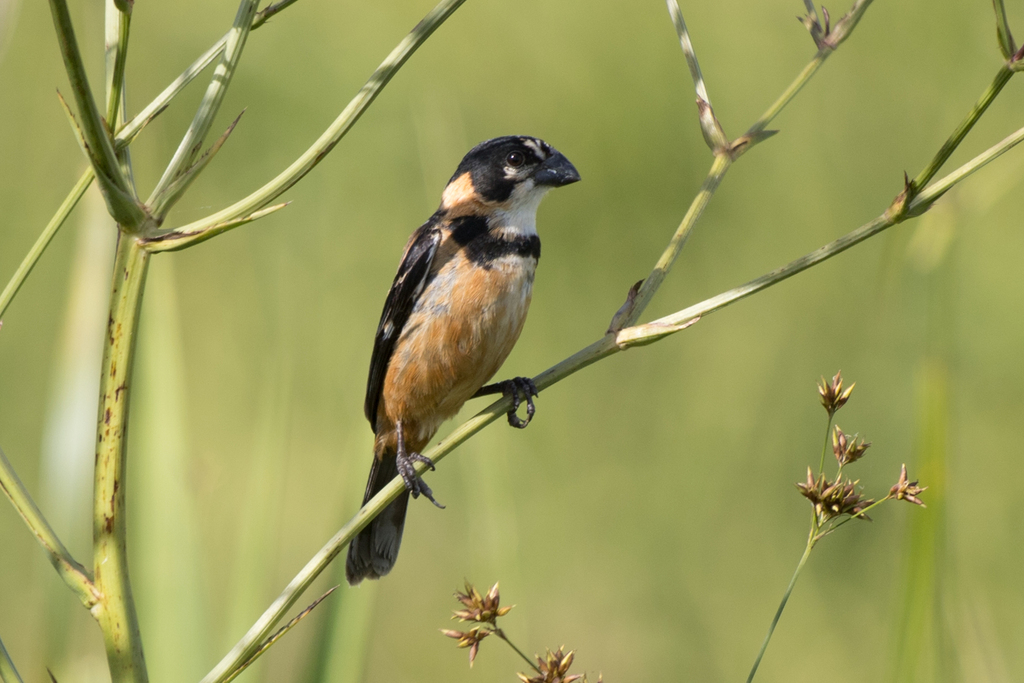
Rusty-collared Seedeater
Photo © Frank Thomas Sautter
Photo © Frank Thomas Sautter — CC0 1.0 — Source: iNaturalist photo #259222757Identification
The rusty-collared seedeater is a small passerine in the tanager family. Males are distinctive with their characteristic rusty or ochre collar, which gives the species its common name. The plumage is otherwise subdued, allowing the neck marking to stand out as a key field mark. Females and immatures are less conspicuous, requiring careful observation to distinguish from related seedeater species.
Range & Habitat
This species is found across southern South America, with populations in Argentina, Bolivia, Brazil, Paraguay, and Uruguay. It inhabits subtropical and tropical seasonally wet or flooded lowland grasslands, swamps, and degraded former forest areas. The bird favours open and semi-open habitats where seed-bearing plants are abundant, typically at low elevations in wetland regions.
Behaviour & Diet
As its scientific name Sporophila (seed-loving) suggests, the rusty-collared seedeater is primarily granivorous, feeding on seeds from grasses and weeds. Like other seedeaters, it often forages on the ground or in low vegetation, sometimes joining mixed feeding flocks. The species is relatively quiet and unobtrusive, though males may give simple vocalizations during breeding season.
Best Time & Places to See It
Look for this seedeater in open grassland and wetland habitats across its range, particularly where seasonal flooding creates productive seed-bearing vegetation. The species is resident throughout much of its range, though local movements may occur with seasonal changes in habitat conditions. Early morning visits to suitable wetland grasslands offer the best opportunities for observation.
Photography Tips
The rusty collar is the primary photographic feature to capture, so aim for side or three-quarter views of males to showcase this marking. Patient stalking through open grassland habitats may be necessary, as the species often forages on the ground where vegetation can obscure views. Use a telephoto lens to maintain distance and avoid flushing birds. Overcast conditions or early morning light work well for capturing detail without harsh shadows on the subtle plumage.
Emas National Park
Brazil
+333 birds+23 mammals
Across the high plateaux of central Brazil, where the cerrado grasslands roll toward distant horizons under an immense sky, Emas National Park anchors one of South…
VIEW NATIONAL PARKSerra do Cipó National Park
Brazil
+379 birds+5 mammals
Where granite escarpments rise above the Atlantic Forest transition zone in southeastern Brazil, Serra do Cipó National Park unfolds across a landscape of dramatic ridges, cascading…
VIEW NATIONAL PARKItatiaia National Park
Brazil
+519 birds+12 mammals
Where granite peaks pierce the Atlantic rainforest canopy in southeastern Brazil, Itatiaia National Park rises as one of the country's oldest and most ecologically vital protected…
VIEW NATIONAL PARKSerra da Bocaina National Park
Brazil
+441 birds+5 mammals
Where the escarpment of the Serra da Bocaina rises sharply from the Atlantic coastal plain, tropical rainforest cloaks steep mountainsides that climb toward peaks exceeding 2,000…
VIEW NATIONAL PARKIlha Grande National Park
Brazil
+233 birds
Across the subtropical plateaus and Atlantic forest remnants of southern Brazil, a vast protected landscape spanning nearly 4,600 square kilometers safeguards one of the continent's most…
VIEW NATIONAL PARKSerra dos Órgãos National Park
Brazil
+446 birds+13 mammals
Granite peaks thrust skyward through the Atlantic Forest canopy in the mountains immediately north of Rio de Janeiro, their bare rock faces rising above a landscape…
VIEW NATIONAL PARKChapada dos Guimarães National Park
Brazil
+450 birds+1 mammals
Where weathered sandstone plateaus rise above the cerrado grasslands of central Brazil, Chapada dos Guimarães National Park protects 624 square kilometres of ecological transition zone that…
VIEW NATIONAL PARKPantanal Matogrossense National Park
Brazil
+322 birds+17 mammals
Where the flooded forests of central Brazil meet vast seasonally inundated grasslands, Pantanal Matogrossense National Park sprawls across nearly 2,900 square kilometers of one of the…
VIEW NATIONAL PARKEl Palmar National Park
Distrito Sexto, Argentina
+244 birds+14 mammals
Across the Paraná River floodplain in northeastern Argentina, palms rise from wetland and grassland in a landscape shaped by water and time. El Palmar National Park…
VIEW NATIONAL PARKRío Pilcomayo National Park
Argentina
+271 birds+13 mammals
Where the Río Pilcomayo cuts through northeastern Argentina's subtropical lowlands, a sprawling mosaic of wetlands, grasslands, and seasonally flooded forests creates one of South America's most…
VIEW NATIONAL PARKParque Provincial Pampa del Indio
Laguna Limpia, Argentina
+231 birds+4 mammals
Across the flat horizons of Chaco Province, where the Paraná River system spills into vast wetlands and grasslands, Parque Provincial Pampa del Indio protects one of…
VIEW NATURE RESERVEChaco National Park
Municipio de Presidencia de la Plaza, Argentina
+258 birds+7 mammals
Across the humid subtropical lowlands of northeastern Argentina, where the Paraná River basin feeds vast seasonal wetlands and gallery forests, Chaco National Park protects one of…
VIEW NATIONAL PARKNo community photos yet. Log in to add the first one.
No community observations of this species yet.