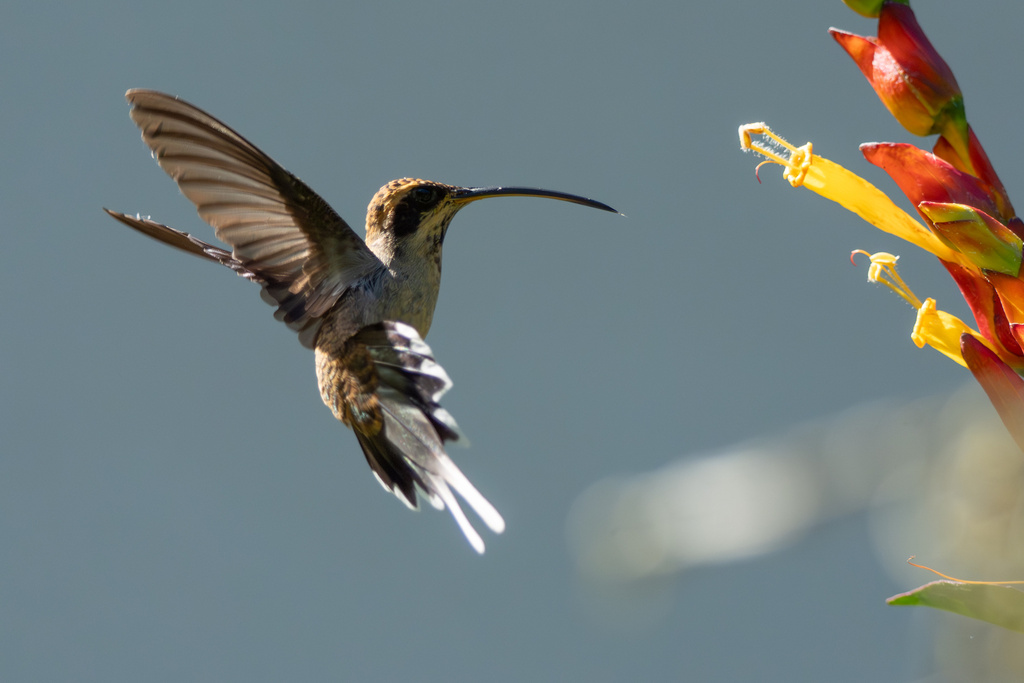
Scale-throated Hermit
Photo © Joao Quental
Photo © Joao Quental — CC BY 4.0 — Source: iNaturalist photo #658182038Identification
The scale-throated hermit is a medium-sized hummingbird measuring 14 to 14.5 cm in length, with males weighing 4.5 to 6 g and females 4 to 5 g. Its most distinctive feature is its dark throat, whose feathers have lighter edges creating the characteristic scaly appearance that gives the species its common name. The bird is olive green above with grayish underparts, and displays a striking black "mask" across the face framed by a pale supercilium and gular stripe. The tail feathers are tipped with white, with the middle pair noticeably elongated. Females can be distinguished from males by their shorter wings and less strongly curved bill. The two subspecies are identical in plumage, though P. e. paraguayensis is significantly smaller than the nominate form.
Range & Habitat
This species is found across three South American countries: Argentina, Brazil, and Paraguay. The nominate subspecies inhabits southeastern Brazil from southeastern Bahia south to Rio Grande do Sul, while P. e. paraguayensis occurs in eastern Paraguay and northeastern Argentina's Misiones Province. The scale-throated hermit favours the understory of diverse forest types within the Atlantic Forest biome, including lowland and montane rainforest, semi-deciduous forest, and mature secondary forest. It has been recorded at elevations ranging from 100 to 2,250 m, demonstrating considerable adaptability across different altitudinal zones.
Behaviour & Diet
Like other hermit hummingbirds, the scale-throated hermit is a "trap-line" feeder, visiting a regular circuit of flowering plants to feed on nectar. In addition to nectar, it supplements its diet with small arthropods. The species is assumed to be sedentary, though data on its movement patterns remain limited. The breeding season in Brazil runs from September to March, with the female constructing a distinctive long cone-shaped cup nest made of plant fibres and spider web, suspended beneath a drooping leaf. These nests are often decorated with the lichen Spiloma roseum, which can stain both the eggs and incubating female red. The female incubates a clutch of two eggs alone. The bird's vocalizations are variable but typically consist of 2–4 notes, such as "tsi-tseee....tsi-tseee" repeated in pattern, with calls including a plaintive "tsew" and an upslurred "tsee."
Best Time & Places to See It
The scale-throated hermit is common throughout its range and occurs in several protected areas, making it a reasonably reliable species to encounter. In Brazil, the breeding season from September to March offers the best opportunity for observation when birds are most active. The species' preference for forest understory means visitors should focus their attention on the lower vegetation levels within Atlantic Forest reserves and protected areas across southeastern Brazil, eastern Paraguay, and northeastern Argentina.
Photography Tips
Photographers should look for this species in shaded understory habitats where it feeds on flowering plants along its regular feeding routes. The scaly throat pattern and facial mask provide excellent identifying features for close-up photography. The bird's small size and forest habitat mean fast shutter speeds and patience are essential. During the breeding season, photographers may locate nests suspended beneath drooping leaves, though care should be taken not to disturb nesting females.
Tijuca National Park
Brazil
+317 birds+13 mammals
Where the Atlantic forest rises steeply from Rio de Janeiro's urban edge, Tijuca National Park encompasses a landscape of dramatic granite peaks, cascading waterfalls, and closed-canopy…
VIEW NATIONAL PARKItatiaia National Park
Brazil
+519 birds+12 mammals
Where granite peaks pierce the Atlantic rainforest canopy in southeastern Brazil, Itatiaia National Park rises as one of the country's oldest and most ecologically vital protected…
VIEW NATIONAL PARKSerra do Itajaí National Park
Brazil
+227 birds+2 mammals
Where the Atlantic rainforest rises steeply from the coastal plains of Santa Catarina, Serra do Itajaí National Park spreads across 1,136 square kilometres of montane wilderness…
VIEW NATIONAL PARKSerra da Bocaina National Park
Brazil
+441 birds+5 mammals
Where the escarpment of the Serra da Bocaina rises sharply from the Atlantic coastal plain, tropical rainforest cloaks steep mountainsides that climb toward peaks exceeding 2,000…
VIEW NATIONAL PARKIguaçu National Park
Brazil
+387 birds+17 mammals
Where the Paraná Plateau plunges toward the Atlantic watershed, six thousand square kilometers of subtropical rainforest cling to steep gorges and river valleys in this corner…
VIEW NATIONAL PARKSão Joaquim National Park
Brazil
+222 birds+9 mammals
Where the southern Brazilian highlands rise above the Atlantic Forest, São Joaquim National Park protects nearly 1,000 square kilometers of montane terrain that shifts between temperate…
VIEW NATIONAL PARKSerra dos Órgãos National Park
Brazil
+446 birds+13 mammals
Granite peaks thrust skyward through the Atlantic Forest canopy in the mountains immediately north of Rio de Janeiro, their bare rock faces rising above a landscape…
VIEW NATIONAL PARKChapada Diamantina National Park
Brazil
+346 birds+5 mammals
Where granite peaks and sandstone cliffs rise abruptly from the Brazilian interior, Chapada Diamantina National Park sprawls across 4,215 square kilometers of some of Brazil's most…
VIEW NATIONAL PARKSerra do Gandarela National Park
Brazil
+333 birds+3 mammals
Where granite massifs rise through Atlantic Forest in southeastern Brazil's highlands, Serra do Gandarela National Park protects nearly 1,000 square kilometres of montane terrain that few…
VIEW NATIONAL PARKAraucárias National Park
Brazil
+231 birds+3 mammals
Where the southern Brazilian highlands rise into cool temperate forest, Araucárias National Park protects one of the Atlantic Forest's most distinctive ecosystems across 506 square kilometres…
VIEW NATIONAL PARKSerra Geral National Park
Brazil
+211 birds+2 mammals
Where basalt cliffs and sandstone escarpments rise above the subtropical forests of southern Brazil, Serra Geral National Park preserves one of the Atlantic region's most dramatic…
VIEW NATIONAL PARKIguazú National Park
Puerto Iguazú, Argentina
+346 birds+15 mammals
Where the Paraná Plateau plunges toward the Atlantic watershed, nearly 800 square kilometers of subtropical rainforest drape across Misiones Province in a landscape carved by millennia…
VIEW NATIONAL PARKNo community photos yet. Log in to add the first one.
No community observations of this species yet.