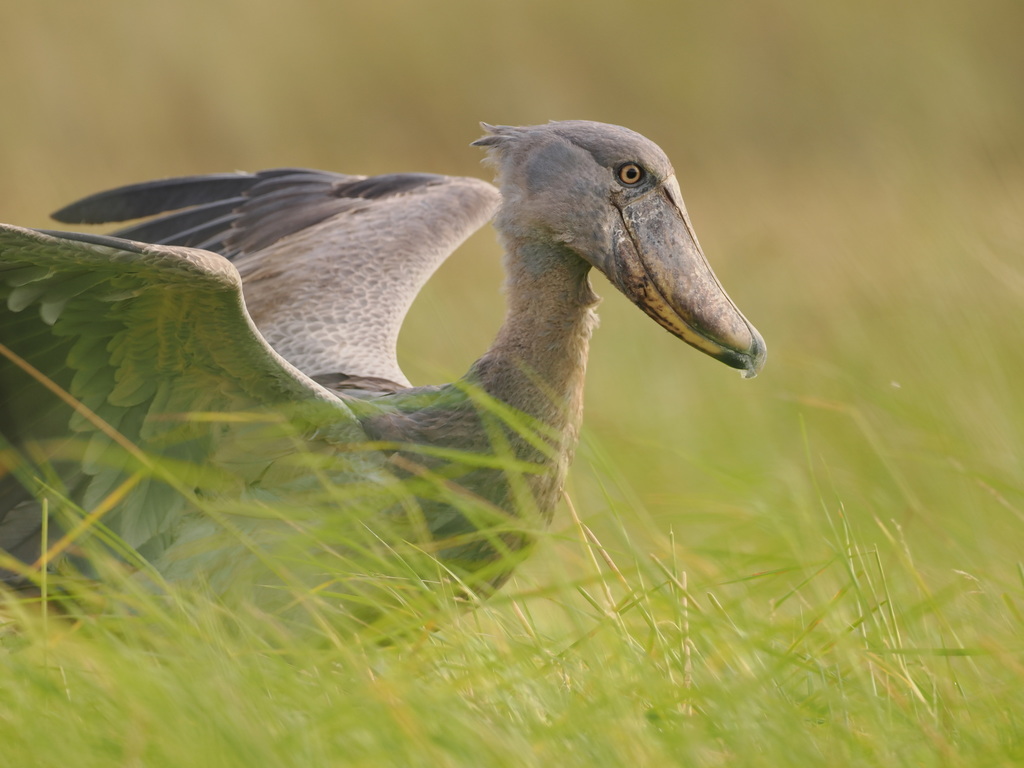
Shoebill
Photo © Peter Archdale
Photo © Peter Archdale — CC BY 4.0 — Source: iNaturalist photo #205553855Identification
The shoebill is an unmistakable wading bird, instantly recognizable by its enormous, shoe-shaped bill—the third-longest of any living bird species. Standing 110 to 140 centimetres tall (with some individuals reaching 152 centimetres), it is a massive, imposing presence in its wetland habitat. Adults display blue-grey plumage with darker slaty-grey flight feathers, while juveniles are browner with a darker grey tinge. The bill itself is pinkish with erratic greyish markings, strongly keeled like a pelican's, and can be as impressive in circumference as a pelican's despite being narrower in length.
Beyond the bill, several features distinguish the shoebill from other wading birds. It has a relatively short, thick neck compared to herons and cranes, exceptionally large feet with a middle toe reaching up to 18.5 centimetres—an adaptation for walking on aquatic vegetation—and broad wings with a wingspan of 230 to 260 centimetres. Males are noticeably larger than females, typically weighing around 5.6 kilograms compared to females at 4.9 kilograms.
Range & Habitat
The shoebill is found exclusively in the freshwater swamps of central tropical Africa, distributed from South Sudan through parts of eastern Congo, Rwanda, Uganda, western Tanzania, and northern Zambia. The species is most numerous in the West Nile sub-region and South Sudan, particularly in the Sudd, which represents a major stronghold for the population. Significant numbers also inhabit the wetlands of Uganda and western Tanzania.
These birds are specialist swamp dwellers, requiring the vast, shallow freshwater marshes that characterize their African range. The extensive wetlands of their distribution provide the ideal conditions for their aquatic lifestyle and feeding behaviour.
Behaviour & Diet
Shoebills are normally silent birds, but during nesting season they perform distinctive bill-clattering displays at the nest, sometimes accompanied by cattle-like moos and high-pitched whines. Nestlings produce uncanny hiccup-like calls when begging for food. Both adults and young use bill-clattering as a primary means of communication during the breeding season. When threatened, flying adults have been recorded uttering hoarse croaks as a sign of aggression.
In flight, shoebills display a characteristically slow flapping rate of approximately 150 flaps per minute—among the slowest of any bird species. They fly with their necks retracted, holding their wings flat while soaring, and alternate between flapping and gliding in cycles of around 7 seconds. When disturbed, they typically fly only 100 to 500 metres; long-distance flights are rare, with most foraging movements occurring within 20 metres of their starting point.
Best Time & Places to See It
South Sudan, particularly the Sudd wetland, offers the best opportunity to encounter shoebills in their stronghold population. Uganda and western Tanzania also host significant numbers. The species' preference for remote, expansive freshwater swamps makes it a challenging but rewarding sighting for dedicated birdwatchers and wildlife travellers willing to venture into pristine wetland wilderness.
Photography Tips
The shoebill's enormous bill and striking silhouette make it a remarkable photographic subject. Its slow, deliberate flight pattern and habit of remaining within a limited foraging range offer opportunities for flight photography, though you should be prepared for the bird's tendency to fly only short distances. The dramatic profile—particularly the massive, shoe-shaped bill—is best captured from angles that emphasize the bird's impressive proportions and unique morphology. Patience is essential, as shoebills are not highly active birds and much time will be spent observing them in their wetland habitat.
11 Days Safari to Uganda Including Gorilla Trekking.
Virunga National Park
Uganda
+418 birds+13 mammals
Where the Western Rift Valley fractures the landscape of North Kivu, Virunga National Park sprawls across terrain as geologically dramatic as it is ecologically vital. Volcanic…
VIEW NATIONAL PARKBwindi Impenetrable National Park
Kanyashogi, Uganda
+603 birds+26 mammals
Steep ridges cloaked in montane forest rise from Uganda's southwestern borderlands, where the landscape grows so dense and tangled that early explorers named it impenetrable. At…
VIEW NATIONAL PARKMurchison Falls National Park
Uganda
+608 birds+33 mammals
Where the Victoria Nile compresses through a narrow gorge and explodes across a 45-meter precipice, the landscape speaks in thunder. Murchison Falls National Park sprawls across…
VIEW NATIONAL PARKLake Mburo National Park
Uganda
+505 birds+24 mammals
Rolling acacia woodland and scattered lakes define this intimate savanna preserve in southwestern Uganda, where the rift valley's geological drama shapes every water source and grassland.…
VIEW NATIONAL PARKToro-Semliki Proposed National Park
Uganda
+474 birds+5 mammals
Where the Albertine Rift's western escarpment rises above the Semliki River valley, a vast mosaic of forest, savanna and wetland converges to create one of East…
VIEW NATIONAL PARKQueen Elizabeth National Park
Uganda
+672 birds+30 mammals
Across the southwestern escarpment of Uganda, where the Western Rift Valley descends through ancient volcanic terrain, Queen Elizabeth National Park sprawls across more than 8,300 square…
VIEW NATIONAL PARKMabamba Swamp
Memere, Uganda
+464 birds+2 mammals
Across the Central Region of Uganda spreads one of Africa's most biodiverse freshwater wetlands, a sprawling nature reserve of roughly 283 square kilometres where papyrus swamps…
VIEW NATURE RESERVEZiwa Rhino and Wildlife Ranch
Nakasongola, Uganda
+359 birds+11 mammals
Where papyrus wetlands merge into sprawling savanna, Uganda's central landscape opens into one of East Africa's most vital rhino recovery zones. Ziwa Rhino and Wildlife Ranch…
VIEW WILDLIFE SANCTUARY