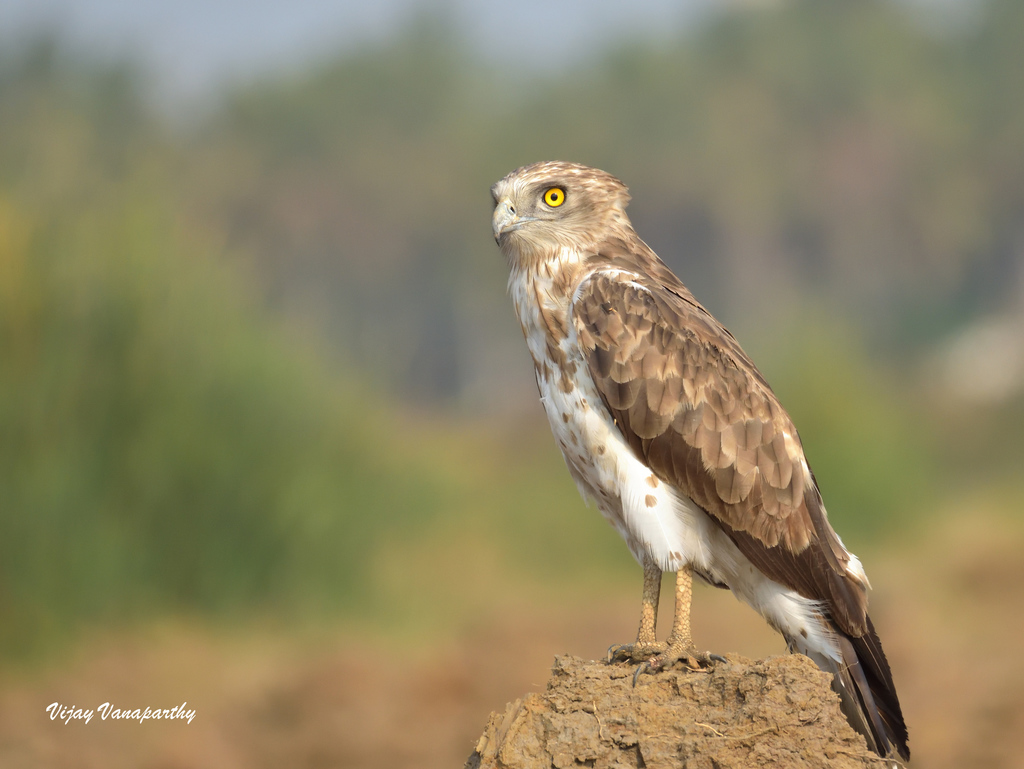
Short-toed Snake Eagle
Photo © Vijay Vanaparthy
Photo © Vijay Vanaparthy — CC BY 4.0 — Source: iNaturalist photo #40950147Identification
The short-toed snake eagle is a medium-sized raptor measuring 59 to 70 cm in length with a wingspan of 162 to 195 cm and weighing around 1.7 kg on average. In flight, look for its distinctive predominantly white underside contrasting with greyish-brown upper parts. The chin, throat and upper breast are pale, earthy brown, while the tail displays 3 or 4 dark bars. An owl-like rounded head, brightly yellow eyes, and lightly barred underwings are key field marks. When soaring, the bird characteristically holds its wings relatively flat.
Range & Habitat
This Old World species is found across the Mediterranean basin, into Russia and the Middle East, throughout Western Asia, the Indian subcontinent, and eastward into Indonesian islands including Java, Bali, Lombok and Timor. Two subspecies are recognised: the nominate gallicus ranges from southwest Europe to central Asia, northwest China and India, while sacerdotis occupies the Lesser Sunda Islands.
Short-toed snake eagles favour open cultivated plains, arid stony deciduous scrub, foothills and semi-desert areas. They require trees for nesting alongside open habitats such as cultivations and grasslands for hunting. European populations migrate mainly to sub-Saharan Africa north of the equator, departing in September/October and returning April/May, while Middle and Far Eastern populations are largely resident. Spain holds the largest European population, where the species is fairly common, though it remains rare across much of its European range.
Behaviour & Diet
The short-toed snake eagle is a specialised hunter, with snakes forming the bulk of its diet, supplemented by lizards and occasionally small mammals up to rabbit-size, with birds and large insects taken rarely. Notable for spending more time on the wing than most eagle species, it hunts primarily from soaring positions over hill slopes and hilltops on updraughts, reaching heights of up to 500 metres. It frequently hovers like a kestrel when quartering open country. Occasionally, these eagles become entangled in combat with larger snakes on the ground.
The species is generally very silent, though it occasionally emits musical whistling notes during breeding. Breeding pairs raise only one egg per season. These eagles can live up to 17 years. However, the species has suffered steep decline across Europe due to agricultural and land-use changes and remains rare and still decreasing in several countries, though populations in the Middle and Far East are not yet threatened.
Best Time & Places to See It
Spain offers the best opportunity to encounter this species in Europe, where it remains fairly common compared to other parts of its range. Travellers visiting Mediterranean regions, the Middle East, and Asia should focus on open habitats including cultivated plains and semi-desert areas during the breeding and migration seasons. European visitors should target April through September for resident or returning populations, while spring migration (April/May) and autumn migration (September/October) offer opportunities to observe passage birds.
Photography Tips
Photographing the short-toed snake eagle requires patience and positioning in open terrain where soaring birds can be observed against the sky. The species spends considerable time on the wing, often at considerable heights, so a telephoto lens is essential. Look for the characteristic flat-winged soaring posture and scan hillsides and hilltops where updraughts concentrate hunting birds. The pale underparts and dark barring make them relatively visible once located, though their height and speed demand fast shutter speeds and good tracking ability.
Private Full-Day Birdwatching Tour from Lisbon to the Tagus Estuary
Nothing matches these filters.
Nothing matches these filters.
Kanha Tiger Reserve
Murchison Falls National Park
Queen Elizabeth National Park
Abijata-Shalla Lakes National Park
Abruzzo, Lazio and Molise National Park
Alpilles Regional Nature Park
Alta Murgia National Park
Appennino Lucano Val d’Agri Lagonegrese National Park
Appennino Tosco-Emiliano National Park
Nothing matches these filters.