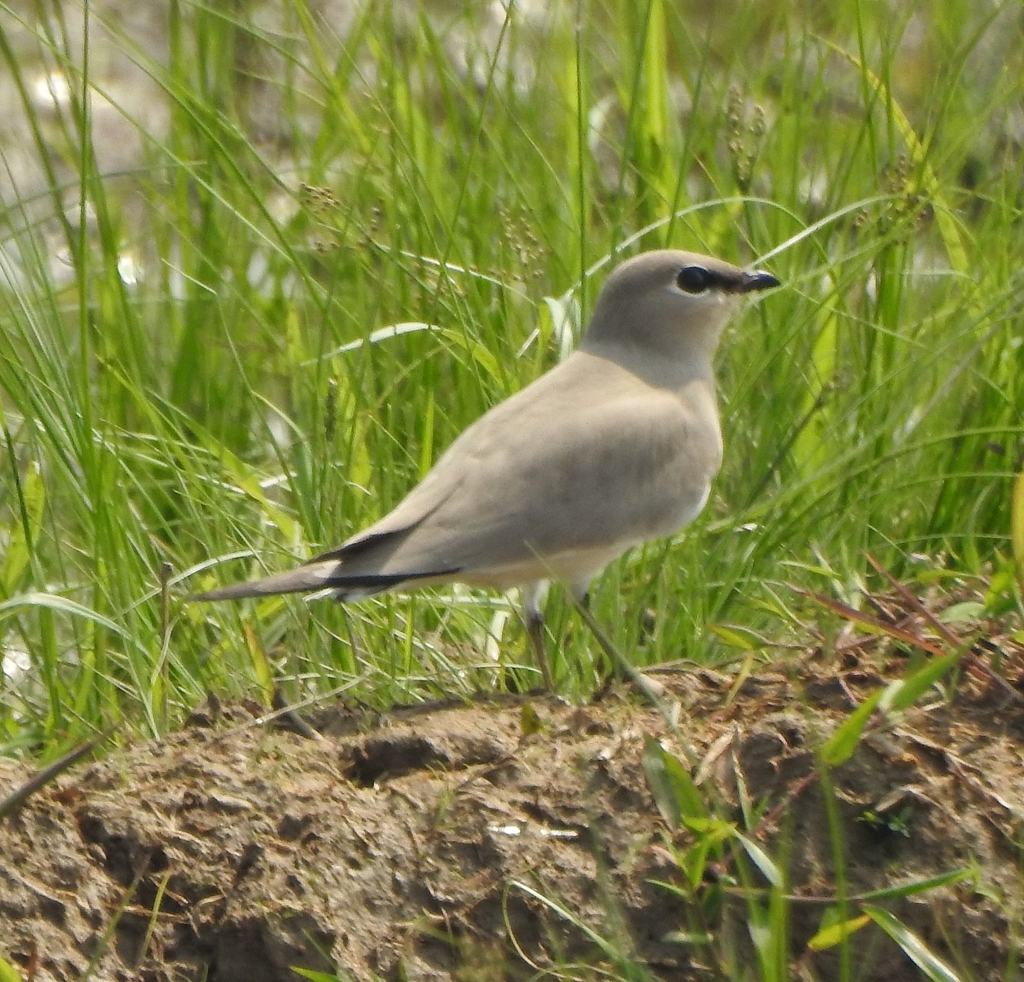
Small Pratincole
Photo © Afsar Nayakkan
Photo © Afsar Nayakkan — CC BY 4.0 — Source: iNaturalist #144349010Identification
The Small Pratincole is a diminutive wader, measuring just 16.5–18.5 cm in length with a wingspan of 42–48 cm. Its compact size can lead to brief confusion with swifts or swallows in flight, though closer inspection reveals its distinctive wader characteristics. The bird sports short legs, long pointed wings, and a short tail—adaptations reflecting its unusual lifestyle. Its short bill is specifically evolved for aerial feeding, a trait unusual among waders.
Plumage-wise, the Small Pratincole is predominantly pale grey when perched on the ground, earning its scientific name lactea, meaning "milky." The crown is distinctly brown, contrasting with the pale underparts. The wings are grey above with striking black primaries and black-and-white barred patterns along the rear edge of the inner flight feathers. The underwings are notably dark, predominantly black, while the white tail features a distinctive black terminal triangle. The white belly completes a subtle but elegant overall appearance.
Range & Habitat
The Small Pratincole is a resident breeder across the Indian subcontinent and Southeast Asia, with populations found in India, Western Pakistan, Bangladesh, Burma, Laos, Cambodia, Sri Lanka, and Thailand. Within India, breeding areas include the northern parts of Karnataka—particularly the Manvi and Raichur districts and along the Hemavathi River—and northern Kerala near Kannur. This species favors open country, particularly areas near water bodies where it can pursue its insect prey.
The species breeds during the period from December to March, selecting gravel or sand banks adjacent to rivers and lakes for nesting. Pairs typically lay 2–4 eggs in simple ground scrapes, relying on camouflage and the exposed habitats they choose for breeding success.
Behaviour & Diet
The Small Pratincole exhibits one of the most remarkable ecological behaviors among waders: despite being classified within the wader family, it hunts like a swallow, pursuing insect prey on the wing rather than foraging along shorelines or mudflats. This aerial feeding strategy is the defining characteristic of pratincoles, distinguishing them from their wading relatives. However, the species retains flexibility and can also feed on the ground when circumstances permit.
The bird is often observed near water during evening hours, actively hawking for insects in flight. This crepuscular behavior makes evening outings particularly rewarding for those seeking to observe this species in its natural habitat.
Best Time & Places to See It
The breeding season from December to March offers the best opportunity to locate Small Pratincoles, as birds are territorial and more predictable during this period. Target open country habitats near rivers and lakes across the species' range, with particular attention to the breeding areas in northern Karnataka and northern Kerala. The species' presence is not restricted to breeding season alone, as it is a resident breeder throughout its range, though populations may be more concentrated during the breeding months.
Photography Tips
Capturing images of Small Pratincoles requires patience and timing, as the birds are most active during evening hours when they hawk for insects over open water. A telephoto lens is essential given the species' small size and its tendency to remain airborne while feeding. Position yourself near suitable habitat—gravel or sand banks adjacent to rivers and lakes—during late afternoon and early evening for the best light and activity levels. The distinctive black underwings and white tail with black terminal triangle are particularly striking in flight photography and should be priority subjects for the camera.
Lunugamvehera National Park
Sri Lanka
+204 birds+14 mammals
Dry scrubland and shallow wetlands converge in Sri Lanka's southeastern lowlands, where Lunugamvehera National Park anchors one of the island's most ecologically vital landscapes. The park's…
VIEW NATIONAL PARKOrang National Park
Rangagarapathar, India
+298 birds+1 mammals
Where the Brahmaputra's floodplains meet the foothills of Assam, Orang National Park unfolds across a mosaic of riverine grasslands, forests and wetlands that pulse with the…
VIEW NATIONAL PARKRanthambhore National Park
Sawai Madhopur, India
+294 birds+20 mammals
Granite ridges and ravines carved through the Aravalli Range frame this protected landscape in eastern Rajasthan, where deciduous forest mingles with open scrubland and seasonal water…
VIEW NATIONAL PARKKanha Tiger Reserve
Kanha Kisli F.V., India
+321 birds+23 mammals
Where sal forests give way to emerald meadows and crystalline streams carve through ancient valleys, one of India's finest wilderness reserves unfolds across the Maikal Range.…
VIEW NATIONAL PARKTadoba National Park
Palasgaon Singru, India
+270 birds+20 mammals
Where sal forests meet open grasslands and rocky outcrops rise from red laterite soil, central India's landscape unfolds in raw, untamed beauty. Ancient teak woodlands and…
VIEW NATIONAL PARKPanna National Park
Badgadi Kalan, India
+271 birds+17 mammals
Where granite gorges slice through central India's Vindhyan plateau, a landscape of stark beauty unfolds across nearly six hundred square kilometers. The Ken River carves through…
VIEW NATIONAL PARKKaziranga National Park
Kohora, India
+422 birds+26 mammals
Dawn breaks over the floodplains of the Brahmaputra, where tall grasslands stretch endlessly beneath monsoon-heavy skies. This sprawling wilderness of northeastern Assam is a mosaic of…
VIEW NATIONAL PARKKeoladeo National Park
Shreenagar Rural, India
+326 birds+14 mammals
Where shallow wetlands shimmer beneath vast Rajasthani skies, one of Asia's finest bird sanctuaries pulses with extraordinary life. This former maharaja's hunting reserve, now spanning 29…
VIEW NATIONAL PARKBandipur National Park
Hirehalli, India
+302 birds+19 mammals
Where the Western Ghats descend into the Deccan plateau, ancient deciduous forests blanket a landscape carved by the Nugu River. Bandipur unfolds across 880 square kilometres…
VIEW NATIONAL PARKNagarahole Tiger Reserve
Nalkeri Forest, India
+323 birds+23 mammals
Where granite escarpments rise above dense deciduous forests and the Kabini River carves through pristine wilderness, one of India's most biodiverse landscapes unfolds across the Western…
VIEW NATIONAL PARKGir National Park
Asundrali, India
+258 birds+13 mammals
Dry deciduous forests cloak the rolling hills of western Gujarat where the Gir landscape rises as a final sanctuary for one of the world's rarest felids:…
VIEW NATIONAL PARKNo community photos yet. Log in to add the first one.
No community observations of this species yet.