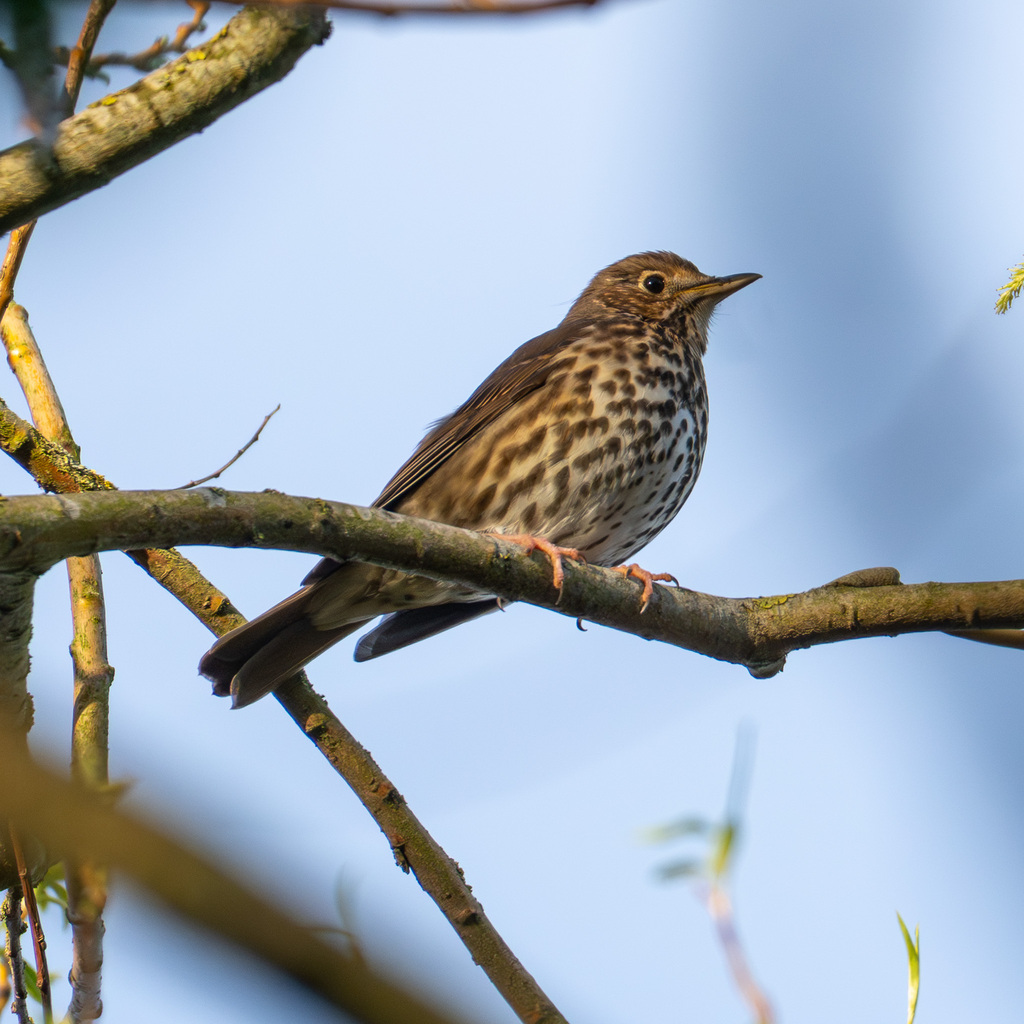
Song Thrush
Photo © Andrew Skotnicki
Photo © Andrew Skotnicki — CC BY 4.0 — Source: iNaturalist photo #635513298Identification
The song thrush is a medium-sized thrush measuring 20 to 23.5 centimetres in length. Its most distinctive features are plain brown upperparts contrasted with neatly black-spotted cream or buff underparts that pale towards the belly. Both sexes appear similar. The underwing is warm yellow, the bill yellowish, and the legs and feet pink. Juveniles resemble adults but show buff or orange streaks on the back and wing coverts.
In Europe, the most similar species is the redwing, which can be distinguished by its strong white eyebrow stripe, red flanks, and red underwing visible in flight. The larger mistle thrush has white tail corners, while the Chinese thrush, though similarly plumaged, displays black face markings and occurs outside the song thrush's range.
Range & Habitat
The song thrush breeds across much of Europe and into Siberia, though it is absent from the greater part of Iberia, lowland Italy and southern Greece. The species is partially migratory; many birds winter in southern Europe, North Africa and the Middle East. Four recognised subspecies occur across the range, with the nominate form covering the majority of breeding areas. The species has also been introduced into New Zealand and Australia.
Song thrushes favour forests, gardens and parks as breeding habitat. While the species is not globally threatened, serious population declines have been observed in some European regions, potentially linked to changes in farming practices.
Behaviour & Diet
Song thrushes are omnivorous and have a remarkable habit of using a favourite stone as an "anvil" to crack open snail shells. The species builds a distinctive neat, mud-lined cup nest in a bush or tree, laying four to five dark-spotted blue eggs. Like all perching birds, song thrushes are susceptible to external and internal parasites and vulnerable to predation by cats and birds of prey.
The male's song is loud and distinctive, featuring clear runs of repeated musical phrases given from elevated perches such as trees and rooftops. An individual male may possess a repertoire of more than 100 phrases, many copied from parents and neighbouring birds, and occasionally including mimicry of human technology and other bird species. For its weight, this species produces one of the loudest bird calls.
Best Time & Places to See It
The song thrush's loud, distinctive song makes it most detectable during breeding season. In the widespread subspecies, singing occurs from November to July, while the Outer Hebridean race sings mainly from February to June. Gardens, parks and woodlands throughout most of Europe offer good opportunities to observe this species during breeding season, though many birds migrate south in winter.
Photography Tips
The song thrush's warm yellow underwing is a striking feature best captured when the bird is in flight. The neat black spots on the cream or buff underparts photograph well in good light and are useful for identification. Males singing from elevated perches—rooftops, high branches and prominent trees—offer excellent opportunities for photography. The species' relatively loud song means you can often locate singing males by ear, making it easier to position yourself for photographs.
Abel Tasman National Park
Abruzzo, Lazio and Molise National Park
Aggtelek National Park
Alpilles Regional Nature Park
Alta Murgia National Park
Altai Tavan Bogd National Park
Aoraki / Mount Cook National Park
Appennino Lucano Val d’Agri Lagonegrese National Park
Appennino Tosco-Emiliano National Park
Nothing matches these filters.
No community photos yet. Log in to add the first one.
No community observations of this species yet.