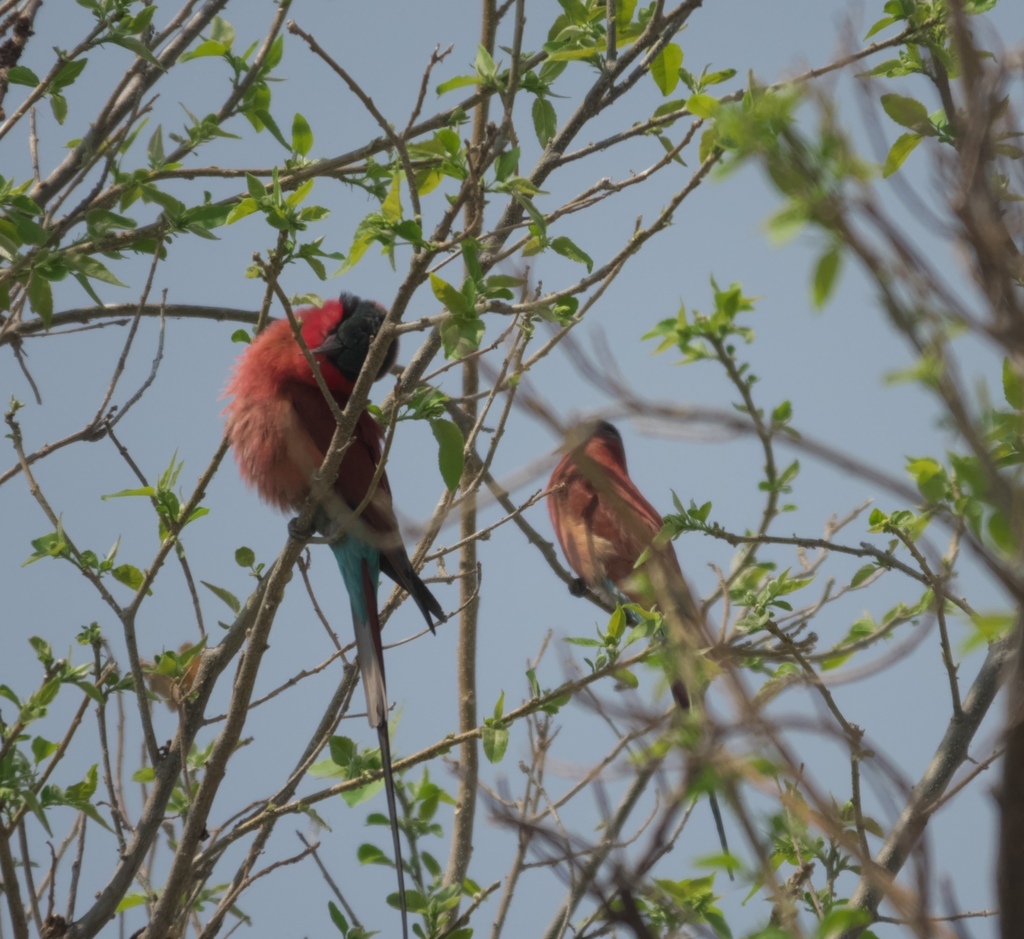
Southern Carmine Bee-eater
Photo © Robert Webster
Photo © Robert Webster — CC BY-SA 4.0 — Source: iNaturalist #316000615Identification
The Southern Carmine Bee-eater is a strikingly colourful bird, living up to its family's reputation for vibrant plumage. As its name suggests, this species is predominantly carmine (a deep crimson-red) in colour throughout most of its body. However, it can be distinguished from its close relative, the Northern Carmine Bee-eater, by its blue crown and blue undertail coverts, which provide an elegant contrast to the dominant carmine colouration. Like all bee-eaters, this species is richly adorned, making it a jewel among African birds.
Range & habitat
The Southern Carmine Bee-eater is found across sub-equatorial Africa, with a range extending from KwaZulu-Natal and Namibia in the south to Gabon, the eastern Democratic Republic of the Congo, and Kenya in the north. This species is highly migratory, following a predictable seasonal pattern. Birds breed in Zimbabwe and Zambia between August and November, then migrate southward to South Africa for the southern summer months. From March to August, the population shifts northward to Equatorial Africa.
In terms of habitat preferences, these bee-eaters favour low-altitude river valleys and floodplains. When breeding, they require vertical earthen banks suitable for tunnelling, though they will readily dig vertical burrows in the level surfaces of small salt islands. The species is highly sociable year-round, gathering in large flocks both during and outside the breeding season, roosting communally in trees or reedbeds while dispersing widely during daylight hours to forage.
Behaviour & diet
The Southern Carmine Bee-eater's diet consists primarily of bees and other flying insects, which they capture using their characteristic hawking technique—sallying out from a perch to snatch prey in mid-air. Their hunting perches are remarkably varied, ranging from branches and vegetation to the backs of large animals such as kori bustards. This adaptability extends to their interactions with other wildlife; they are frequently observed circling around larger animals and even vehicles to catch insects flushed by movement.
These birds are particularly attracted to wildfires, where they gather to exploit the abundance of insects driven into the air by smoke and flames. They are often seen circling high in the air during these events, taking advantage of the concentrated food source. Breeding occurs in burrows at the end of tunnels measuring 1 to 2 metres long, dug into earthen banks. Clutches typically contain between 2 and 5 eggs.
Best time & places to see it
The best time and location to encounter Southern Carmine Bee-eaters depends on the season. During the breeding season (August to November), visit Zimbabwe and Zambia where large flocks gather. For southern summer viewing, South Africa offers opportunities from December onwards. Those travelling in Equatorial Africa between March and August may find the species in Gabon, the eastern Democratic Republic of the Congo, and Kenya. River valleys and floodplains are your most productive habitats, particularly where vertical banks suitable for nesting are present. Early mornings and late afternoons, when birds are most active, offer the best viewing opportunities.
Photography tips
Photographing Southern Carmine Bee-eaters requires patience and positioning. Since they hawk insects from perches, positioning yourself near likely perching spots—such as dead branches overlooking water or vegetation—increases your chances of capturing flight sequences. The birds' brilliant carmine and blue plumage photographs beautifully in good light, so aim for early morning or late afternoon golden hour when possible. Their habit of circling high in the air during wildfires or around moving animals presents challenges, but a telephoto lens (at least 400mm equivalent) is essential for distant birds. The striking colour contrast between their carmine bodies and blue crown and undertail makes even distant shots visually compelling. Patience near communal roosts at dawn or dusk may reward you with flock photography opportunities.
Mapungubwe National Park
Musina Local Municipality, South Africa
+358 birds+29 mammals
Where the Limpopo River cuts through sandstone ridges at the convergence of South Africa, Botswana, and Zimbabwe, Mapungubwe National Park preserves a landscape of profound ecological…
VIEW NATIONAL PARKChobe National Park
Botswana
+446 birds+45 mammals
Where the Chobe River cuts a sinuous path through northern Botswana, the landscape transforms into one of Africa's most dynamic wetland-savanna mosaics. This national park encompasses…
VIEW NATIONAL PARKNxai Pan National Park
Botswana
+226 birds+16 mammals
Across the northwestern reaches of Botswana stretches a landscape of profound seasonal transformation—a sprawling pan system where shallow depressions fill and empty with the rains, creating…
VIEW NATIONAL PARKKhaudum National Park
Botswana
+213 birds+13 mammals
Where the Okavango's northern tributaries meander through miombo woodland and riverine forest, Khaudum National Park unfolds across a landscape of profound ecological richness and isolation. This…
VIEW NATIONAL PARKMurchison Falls National Park
Uganda
+608 birds+33 mammals
Where the Victoria Nile compresses through a narrow gorge and explodes across a 45-meter precipice, the landscape speaks in thunder. Murchison Falls National Park sprawls across…
VIEW NATIONAL PARKPilanesberg National Park
Moses Kotane Local Municipality, South Africa
+364 birds+49 mammals
Granite peaks and volcanic ridges rise unexpectedly from the savanna floor across this 734-square-kilometre expanse in the North West province, creating a landscape of profound ecological…
VIEW NATIONAL PARKKruger National Park
Ba-Phalaborwa Local Municipality, South Africa
+540 birds+91 mammals
Across the low-lying savanna of northeastern South Africa unfolds one of Africa's largest and most ecologically intact protected areas, where acacia woodlands merge into mopane scrub…
VIEW NATIONAL PARKMarakele National Park
Modimolle Local Municipality, South Africa
+341 birds+36 mammals
Granite ridges and sprawling grasslands dominate this 1,176-square-kilometre reserve in Limpopo's heartland, where bushveld transitions between rocky outcrops and open savanna. The park's rugged topography creates…
VIEW NATIONAL PARKKhaudum National Park
Namibia
+221 birds+13 mammals
Where the Kavango River flows through northeastern Namibia, vast miombo woodlands and riverine forests create one of southern Africa's most remote and biodiverse wilderness corridors. Khaudum…
VIEW NATIONAL PARKNkasa Rupara National Park
Namibia
+283 birds+17 mammals
Where the Zambezi's floodplains spill across the border between Namibia and Botswana, Nkasa Rupara National Park unfolds across 518 square kilometers of wetland and woodland mosaic.…
VIEW NATIONAL PARKBwabwata National Park
Namibia
+377 birds+35 mammals
Where the Kavango River winds through northeastern Namibia, vast floodplains and dense riparian woodland create one of southern Africa's most ecologically dynamic protected landscapes. Spanning 14,249…
VIEW NATIONAL PARKMakgadikgadi Pans National Park
Gucta, Botswana
+272 birds+27 mammals
Where salt-crusted flatlands stretch endlessly toward a shimmering horizon, one of Africa's most extraordinary ecosystems awakens with the rains. The Makgadikgadi Pans comprise vast mineral-rich basins…
VIEW NATIONAL PARKNo community photos yet. Log in to add the first one.
No community observations of this species yet.