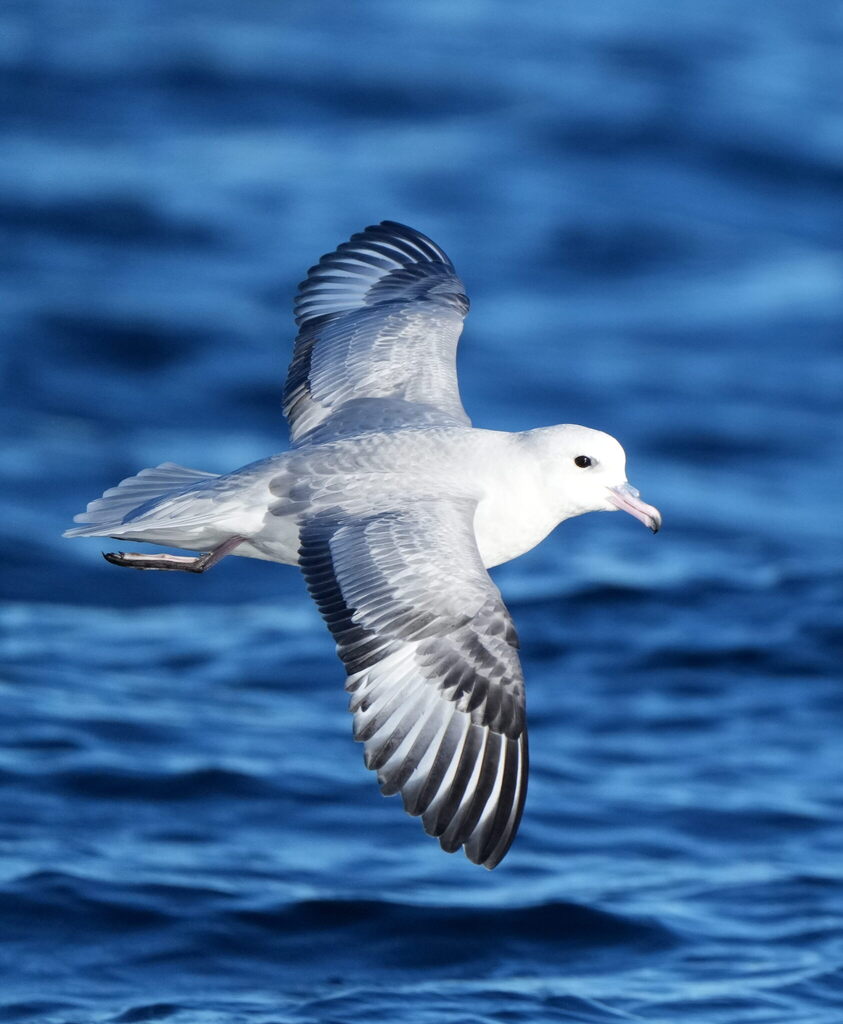
Southern Fulmar
Photo © William Harland
Photo © William Harland — CC BY 4.0 — Source: iNaturalist #373160931Identification
The southern fulmar is a fairly large, bulky seabird measuring 45 to 50 cm in length with a wingspan of 110 to 120 cm. Males are slightly heavier than females, averaging around 795 g compared to 740 g. The plumage is distinctively pale silvery-grey above and white below, with a white head and pale grey crown. The most striking feature is a large white patch on the blackish wingtips, combined with a dark rear edge to the wings. The legs and feet are pale blue, while the bill is pink with a black tip. First-year birds can be distinguished by their more slender bills. In flight, the southern fulmar uses a characteristic mixture of shallow flaps and long glides, often scanning the water below with wings held stiff and broad.
Range & Habitat
The southern fulmar is endemic to the Southern Hemisphere, with breeding colonies established on numerous islands around Antarctica including the South Sandwich Islands, South Orkney Islands, South Shetland Islands, Bouvet Island, and Peter I Island, as well as along the mainland Antarctic coast. At sea during summer, the species concentrates along the outer edge of the pack ice in very cold waters between −1.5 and 0.5 °C. In winter, birds regularly migrate north to around 40°S latitude, and some venture further north into the cool Humboldt Current waters off Peru. Small numbers appear off South Africa, southern Australia, and New Zealand, while unconfirmed sightings have been reported from the west coast of North America. The species is common and widespread, with a population of at least 4 million individuals—approximately one million pairs breed on the South Sandwich Islands alone.
Behaviour & Diet
Southern fulmars breed in cliff colonies that may contain hundreds of birds, arriving in October to nest in ice-free areas. Their courtship display involves pairs sitting together while calling, waving their heads, and preening one another. A single white egg is laid in late November or early December on a sheltered ledge, crevice, or scree slope, lined with stone chips. Incubation lasts approximately 45 days, with both parents alternating in stints of 3 to 9 days. Young fledge after around 52 days, though poor weather and predation by skuas and sheathbills can cause significant mortality. Breeding success improves markedly as birds age, rising from 48% in six- to eight-year-olds to 87% in birds aged 18 to 20 years.
The southern fulmar frequently gathers in flocks, often alongside other seabird species, particularly where food concentrates. Krill and other crustaceans form the diet's most important component, supplemented by small fish such as Antarctic silverfish and various squid species. Food is typically picked from the water's surface, though the bird will occasionally dive.
Best Time & Places to See It
Southern fulmars are most reliably encountered during the breeding season from October through December in Antarctic and sub-Antarctic waters. Visitors to the South Sandwich Islands, South Orkney Islands, South Shetland Islands, Bouvet Island, and Peter I Island can expect to see breeding colonies on clifftop nesting sites. During winter months (May to September), birds disperse northward to around 40°S latitude and can be found in open ocean habitats. Northern-ranging individuals occasionally appear in cooler waters off Peru, South Africa, southern Australia, and New Zealand. After storms, birds may be washed up on beaches across the Southern Ocean region.
Photography Tips
The southern fulmar's pale plumage and distinctive white wing patches make it relatively straightforward to photograph against the dark Southern Ocean, particularly in the low-angle light typical of polar regions. The bird's habit of scanning the water while flying offers opportunities to capture characteristic flight behavior with wings held stiff. During breeding season, clifftop colonies provide excellent opportunities for capturing birds in their nesting habitat, though rough terrain and harsh Antarctic weather require careful planning. The bird is usually silent outside breeding season, but photographing courting pairs at the nest site may reward you with captures of their distinctive calling behavior and mutual preening displays. Early morning and late evening light will enhance the subtle silvery-grey tones of the upperparts.
Sea Lion Island
Sealion Island Settlement, Falkland Islands
+74 birds+3 mammals
Windswept tussock grasslands roll across volcanic terrain where Southern Ocean swells crash against rocky shores, creating one of the Falkland Islands' most dramatic wildlife theatres. This…
VIEW ISLAND & ARCHIPELAGOKidney Island
Stanley, Falkland Islands
+47 birds
Wind-scoured tussock grassland sweeps across this remote South Atlantic outcrop, where peaty soils and exposed rock formations create a landscape as austere as it is vital.…
VIEW ISLAND & ARCHIPELAGOCape Dolphin
falskland islands, Falkland Islands
+54 birds+1 mammals
Where windswept grasslands meet dramatic coastal cliffs, the Falkland Islands' northern reaches reveal one of the Southern Hemisphere's most compelling seabird sanctuaries. The terrain here is…
VIEW NATURE RESERVEVolunteer Point
Stanley, Falkland Islands
+70 birds+3 mammals
Windswept grasslands meet volcanic black sand beaches where three penguin species converge in the South Atlantic's most theatrical wildlife theatre. This remote peninsula on East Falkland…
VIEW NATURE RESERVEWest Point Island
West Point, Falkland Islands
+67 birds+3 mammals
Windswept cliffs plunge dramatically into the South Atlantic, their rust-coloured rock faces sculpted by millennia of gales and spray. This northwestern outpost of the Falkland Islands…
VIEW ISLAND & ARCHIPELAGOCabo de Hornos National Park
Cape Horn, Chile
+88 birds+9 mammals
Where the Andes plunge into the Southern Ocean and the Drake Passage churns between two continents, Cabo de Hornos National Park sprawls across one of Earth's…
VIEW NATIONAL PARKMonte León National Park
Argentina
+100 birds+4 mammals
Where the Patagonian steppe meets the Atlantic, Monte León National Park protects a landscape of windswept coastal cliffs, rocky outcrops, and semi-arid grassland spanning over 1,200…
VIEW NATIONAL PARKDeception Island
Gabriel de Castilla Base, Antarctica
+26 birds+10 mammals
Steaming geothermal vents pierce a landscape of blackened volcanic sand and ice, where the earth's raw power still trembles beneath your feet. This horseshoe-shaped caldera, flooded…
VIEW ISLAND & ARCHIPELAGOCuverville Island
Cuverville Island, Antarctica
+19 birds+10 mammals
Granite peaks and sculpted ice define this windswept archipelago off the Antarctic Peninsula, where steep rocky shores plunge into waters thick with drifting brash ice. Cuverville…
VIEW ISLAND & ARCHIPELAGONeko Harbour
Neko Harbour, Antarctica
+18 birds+10 mammals
Towering peaks of fractured ice rise abruptly from gunmetal waters, their faces scarred by millennia of glacial advance and retreat. This pocket of the Antarctic Peninsula…
VIEW PROTECTED LANDSCAPEParadise Bay
Brown Station, Antarctica
+18 birds+9 mammals
Where the Antarctic Peninsula's rugged coastline meets the Southern Ocean, Brown Station stands sentinel over Paradise Bay—a protected landscape of ice-carved inlets, towering glacial faces, and…
VIEW PROTECTED LANDSCAPEBrown Bluff
Brown Bluff, Antarctica
+23 birds+9 mammals
Where rust-colored volcanic peaks pierce the Antarctic Peninsula's icy realm, a geologist's dreamscape unfolds beneath towering cliffs of iron oxide and ancient lava. Brown Bluff rises…
VIEW PROTECTED LANDSCAPEPort Lockroy
Port Lockroy, Antarctica
+19 birds+9 mammals
Towering peaks of black rock pierce through Antarctic pack ice on the Gerlache Strait, where one of the continent's most accessible harbors cradles a living microcosm…
VIEW PROTECTED LANDSCAPEHalf Moon Island
Cámara Base, Antarctica
+25 birds+8 mammals
Jagged volcanic peaks rise from the cobalt waters of the South Shetland Islands, their slopes carpeted in moss and lichen where hardy vegetation clings to windswept…
VIEW ISLAND & ARCHIPELAGOPetermann Island
Petermann Island, Antarctica
+16 birds+9 mammals
Icebound cliffs rise dramatically from the Bellingshausen Sea, their weathered faces sculpted by millennia of Antarctic wind and tide. This slender wedge of rock and ice,…
VIEW ISLAND & ARCHIPELAGOPaulet Island
Paulet Island, Antarctica
+20 birds+6 mammals
Windswept ice and weathered rock converge at this remote Antarctic outcrop, where jagged peaks pierce through perpetual pack ice and glacial moraines descend toward cobalt waters.…
VIEW ISLAND & ARCHIPELAGODanco Island
Danco Island, Antarctica
+17 birds+10 mammals
Dramatic black rock pierces the Antarctic Peninsula's icy waters, crowned with permanent snow and ringed by calving glaciers that thunder into the sea. This volcanic outcrop…
VIEW ISLAND & ARCHIPELAGOWilhelmina Bay
Wilhelmina Bay, Antarctica
+20 birds+10 mammals
Sheer cliffs of black volcanic rock plunge into waters so pristine they reflect the Antarctic sky like polished obsidian. This remote western Antarctic inlet, ringed by…
VIEW PROTECTED LANDSCAPELemaire Channel
Orne Harbour, Antarctica
+25 birds+13 mammals
Where granite peaks plunge into steel-grey waters, the Lemaire Channel carves one of Antarctica's most dramatic passages. This narrow strait, squeezed between the Antarctic Peninsula and…
VIEW PROTECTED LANDSCAPESalisbury Plain
South Georgia, South Georgia and the South Sandwich Islands
+33 birds+4 mammals
Where tussock grasses bow to relentless Antarctic winds and glacial meltwater carves braided channels through obsidian volcanic soil, one of Earth's most remote wildlife sanctuaries reveals…
VIEW PROTECTED LANDSCAPESt. Andrews Bay
South Georgia, South Georgia and the South Sandwich Islands
+34 birds+6 mammals
Where windswept tundra dissolves into obsidian beaches, one of the planet's most extraordinary wildlife theaters unfolds across St. Andrews Bay. This remote corner of South Georgia…
VIEW PROTECTED LANDSCAPEFortuna Bay
Stromness, South Georgia and the South Sandwich Islands
+37 birds+5 mammals
Where tussock grasslands sweep down to black-sand beaches and elephant seals haul out in thunderous colonies, the raw sub-Antarctic landscape reveals itself in its most dramatic…
VIEW PROTECTED LANDSCAPEPrion Island
Prince Olav Harbour, South Georgia and the South Sandwich Islands
+36 birds+2 mammals
Windswept tussock grasslands rise sharply from boulder-strewn beaches where the Southern Ocean hurls its grey swells against black volcanic rock. This remote speck in South Georgia's…
VIEW ISLAND & ARCHIPELAGOCooper Bay
Cooper Bay, South Georgia and the South Sandwich Islands
+28 birds+5 mammals
Where black-sand beaches meet towering cliffs striped with cascading meltwater, one of the Southern Ocean's most dramatic amphitheaters reveals itself. Cooper Bay cuts a deep indent…
VIEW PROTECTED LANDSCAPEElsehul Bay
Bird Island Station, South Georgia and the South Sandwich Islands
+33 birds+4 mammals
Granite peaks rise sheer from the Southern Ocean, their weathered faces streaked with cascading meltwater and cloaked in tussock grass that bends beneath relentless winds. This…
VIEW PROTECTED LANDSCAPENo community photos yet. Log in to add the first one.
No community observations of this species yet.