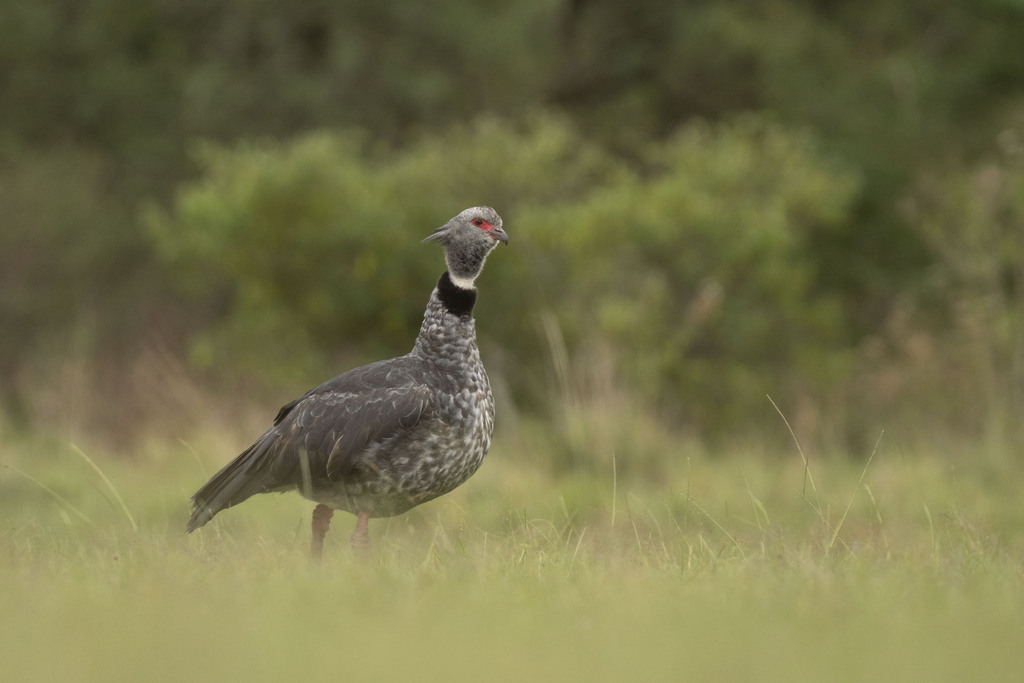
Southern Screamer
Photo © Luciano Massa
Photo © Luciano Massa — CC BY 4.0 — Source: iNaturalist photo #418729648Identification
The southern screamer is one of the largest birds of southern South America, measuring 83 to 90 cm in length and weighing approximately 4.4 kg. It is a stout-bodied bird with a disproportionately small head and a "chicken-like" grayish-brown bill. The most distinctive feature is a velvety black collar around the base of the neck, contrasting with gray head and upperparts. The front of the neck, breast, and sides are pale gray, faintly mottled and streaked with white, while the belly is unmarked pale gray or white. Wings and tail are dusky, and notably, the wing bears two sharp spurs at the manus—a characteristic feature of screamers. The legs and feet are rosy. Males and females share identical plumage.
Range & Habitat
The southern screamer is distributed across much of eastern South America, found in Argentina, Bolivia, Brazil, Paraguay, and Uruguay, with documented vagrants in southeastern Peru. Its range extends from the eastern half of Bolivia south into Argentina as far as Buenos Aires Province, and eastward through Paraguay into southwestern Brazil and Uruguay. The species inhabits tropical and subtropical wetlands, including lakes, marshes, and flooded meadows with scattered trees—environments that provide both open water and grazing opportunities.
Behaviour & Diet
Southern screamers are generally non-migratory, though seasonal movements between coastal and inland areas have been noted in Brazil's Rio Grande do Sul. Though excellent swimmers, they prefer moving on the ground and are exceptional fliers and soarers. They feed primarily on leaves, stems, and seeds of aquatic plants, supplemented with some crops, typically grazing like geese, though they occasionally dig for food. Outside the breeding season, they forage in flocks of up to about 100 birds. The species forms long-term pair bonds, sometimes lasting for life, with courtship involving mutual preening and duet calling. Pairs build large nests of sticks and reeds near shallow water, often returning to the same nesting site for several years. Clutches typically contain three to five eggs, sometimes up to seven, laid in October and November. Both parents incubate the eggs for 43 to 46 days and care for the young until fledging at eight to ten weeks.
Best Time & Places to See It
Southern screamers are year-round residents throughout their range, making them observable in any season, though concentrations may vary locally. They are most easily located in the wetland habitats they favour—lakeshores, marshes, and flooded meadows with scattered trees. Argentina, particularly Buenos Aires Province, offers reliable viewing opportunities, as do wetland areas in Paraguay and southern Brazil. October and November are excellent months when breeding birds are actively displaying and calling, making them easier to locate and observe.
Photography Tips
The southern screamer's distinctive black collar and pale underparts provide good contrast for photography. Look for birds in open wetland settings where they can be approached from a distance. Early morning and late afternoon often provide the best lighting for capturing the rosy legs and subtle plumage details. Photographing birds in flight showcases their powerful flight capabilities and wing spurs. Since they often call during flight and when perched, watching for calling birds—identifiable by their loud, characteristic "oh-WOOOW" or "be-SERK" calls—can help locate subjects for photography.
Emas National Park
Brazil
+333 birds+23 mammals
Across the high plateaux of central Brazil, where the cerrado grasslands roll toward distant horizons under an immense sky, Emas National Park anchors one of South…
VIEW NATIONAL PARKPeixe National Park Lagoon
Brazil
+293 birds+4 mammals
Where the coastal plains of Rio Grande do Sul meet the Atlantic, Peixe National Park Lagoon sprawls across nearly 2,200 square kilometres of shallow waters, reed…
VIEW NATIONAL PARKChapada dos Guimarães National Park
Brazil
+450 birds+1 mammals
Where weathered sandstone plateaus rise above the cerrado grasslands of central Brazil, Chapada dos Guimarães National Park protects 624 square kilometres of ecological transition zone that…
VIEW NATIONAL PARKPantanal Matogrossense National Park
Brazil
+322 birds+17 mammals
Where the flooded forests of central Brazil meet vast seasonally inundated grasslands, Pantanal Matogrossense National Park sprawls across nearly 2,900 square kilometers of one of the…
VIEW NATIONAL PARKManu National Park
Manu, Peru
+892 birds+26 mammals
Across the eastern slopes of the Peruvian Andes, tropical rainforest descends into the Amazon basin with a complexity that few terrestrial ecosystems match. Manu National Park…
VIEW NATIONAL PARKEl Palmar National Park
Distrito Sexto, Argentina
+244 birds+14 mammals
Across the Paraná River floodplain in northeastern Argentina, palms rise from wetland and grassland in a landscape shaped by water and time. El Palmar National Park…
VIEW NATIONAL PARKCampos del Tuyú National Park
Argentina
+169 birds+5 mammals
Subtropical forest graces the borderlands where Misiones Province meets Paraguay, a landscape shaped by the Paraná Plateau's weathered topography and the warm, humid climate of northeastern…
VIEW NATIONAL PARKRío Pilcomayo National Park
Argentina
+271 birds+13 mammals
Where the Río Pilcomayo cuts through northeastern Argentina's subtropical lowlands, a sprawling mosaic of wetlands, grasslands, and seasonally flooded forests creates one of South America's most…
VIEW NATIONAL PARKEl Rey National Park
Municipio de Las Lajitas, Argentina
+317 birds+4 mammals
Where the eastern slopes of the Andes descend into northwestern Argentina's subtropical transition zone, El Rey National Park unfolds across 841 square kilometers of dramatically varied…
VIEW NATIONAL PARKCalilegua National Park
Municipio de Calilegua, Argentina
+288 birds+8 mammals
Where the eastern Andean slopes plunge into northwestern Argentina's humid subtropics, nearly 2,645 square kilometers of steep terrain and luxuriant forest compose one of South America's…
VIEW NATIONAL PARKParque Provincial Pampa del Indio
Laguna Limpia, Argentina
+231 birds+4 mammals
Across the flat horizons of Chaco Province, where the Paraná River system spills into vast wetlands and grasslands, Parque Provincial Pampa del Indio protects one of…
VIEW NATURE RESERVEChaco National Park
Municipio de Presidencia de la Plaza, Argentina
+258 birds+7 mammals
Across the humid subtropical lowlands of northeastern Argentina, where the Paraná River basin feeds vast seasonal wetlands and gallery forests, Chaco National Park protects one of…
VIEW NATIONAL PARKNo community photos yet. Log in to add the first one.
No community observations of this species yet.