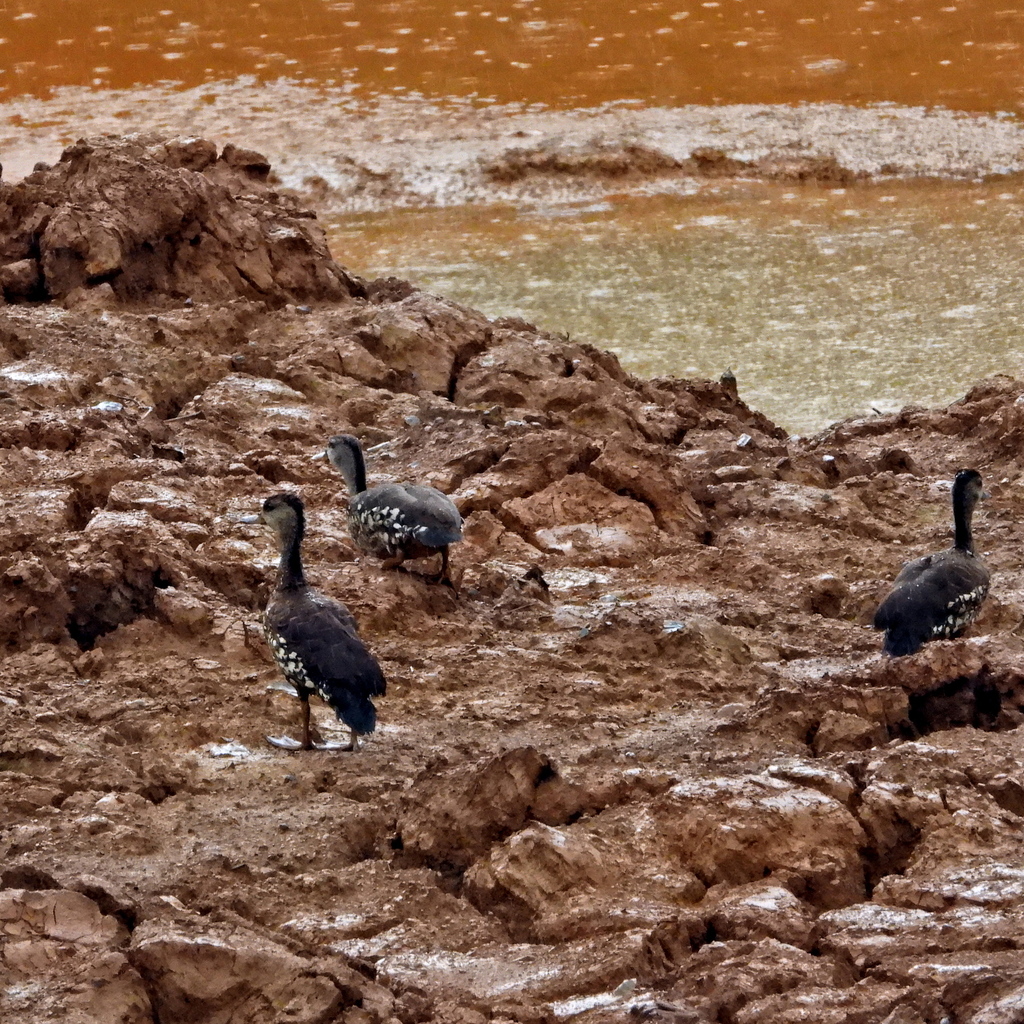
Spotted Whistling Duck
Photo © Abu Hamas
Photo © Abu Hamas — CC BY-SA 4.0 — Source: iNaturalist #204245197Identification
The Spotted Whistling Duck is one of the smaller members of its genus, measuring 43–50 cm tall. Males weigh 590–650g while females are slightly heavier at 610–860g. The most distinctive feature is the white spotting on the flanks and breast that gives the species its name. The head and neck display striking plumage: grey sides of the face and neck with a dark brown or black crown extending from the crown to the hindneck, creating a distinctive eyepatch. A light brown "cape" with a thick collar effect extends down the back, darkening toward the tail. The underbelly is significantly lighter brown, often spotted, contrasting with the darker wings. In flight, a white bar on the upper tail coverts aids identification. The bill is dark with red portions and a small white mark on the lower mandible, while legs are dull pink with black webbed feet. The posture is notably upright with wings pressed firmly against the body. Juveniles show white streaks rather than spots on the flanks and display duller overall coloring. After reaching adult plumage at six months, these ducks undergo a single annual molt, typical of whistling ducks.
Range & Habitat
The Spotted Whistling Duck is found throughout the Philippines, New Guinea, Indonesia (from the Eastern Lesser Sundas islands extending to New Guinea), and Australia (including Weipa, Iron Ranges, and Wonga Beach). The Indonesian population may have been introduced by storm dispersal. These ducks prefer small ponds and marshes surrounded by trees in humid, low-altitude habitats. They are closely associated with wooded waterways and build their nests in hollows within trees surrounding their aquatic habitats.
Behaviour & Diet
Spotted Whistling Ducks are nocturnal feeders, obtaining food primarily at night. Their diet consists of grass seeds, aquatic invertebrates, aquatic plants, and small fish. They feed through dabbling at the water surface, filtering material through their bills, and diving. When diving, birds bounce on the surface to enter the water headfirst, remaining submerged for a maximum of 15 seconds before bouncing back to the surface. Food is consumed while underwater, as observers have never documented food in the bill after diving. These ducks form strong pair bonds, with males and females being visually similar, making sex determination difficult without direct weighing.
Best Time & Places to See It
Breeding season runs from September through April, making these months ideal for observation. Look for these ducks around small ponds and marshes surrounded by trees in their range across the Philippines, Indonesia, New Guinea, and northern Australia. Since they are nocturnal feeders, early morning and evening hours offer the best viewing opportunities near their preferred low-altitude, humid wooded waterways.
Photography Tips
The Spotted Whistling Duck's distinctive plumage and upright posture offer excellent photographic subjects. In flight, watch for the characteristic white bar on the upper tail coverts and the hunched profile with pointed tail—these field marks will help confirm identification in your images. The contrasting brown tones of the cape and the white spotting on the breast and flanks photograph well in natural light. Since these ducks are most active at dawn and dusk, plan your photography sessions for these times to capture them feeding in their natural wooded marsh habitats.
Daintree National Park
Dedin, Australia
+362 birds+37 mammals
Daintree National Park is one of the world’s oldest and most biologically diverse tropical rainforests, protecting an extraordinary landscape where ancient forests meet the Great Barrier…
VIEW NATIONAL PARKEndeavour River National Park
Philadelphia, Australia
+203 birds+1 mammals
Where the Endeavour River winds through northeastern Queensland's tropical lowlands, a compact mosaic of rainforest, open woodland, and riverine corridor creates one of Australia's most ecologically…
VIEW NATIONAL PARKRinyirru National Park
Lakefield, Australia
+258 birds+7 mammals
Where the savanna grasslands of far north Queensland meet seasonal wetlands and eucalypt woodlands, Rinyirru National Park sprawls across more than 12,500 square kilometres of rugged,…
VIEW NATIONAL PARKKulla National Park
Coen, Australia
+11 birds
Across the tablelands and coastal lowlands of far north Queensland, where the landscape transitions from eucalypt woodland to open grassland and remnant rainforest pockets, Kulla National…
VIEW NATIONAL PARKAketajawe Lolobata National Park
Oba Tengah, Indonesia
+123 birds+2 mammals
Across the northeastern arm of Halmahera, where the Wallace Line once marked the boundary between Asian and Australasian fauna, lies a sprawling wilderness of over 13,800…
VIEW NATIONAL PARKManusela National Park
Maluku Tengah, Indonesia
+112 birds+3 mammals
Across the Maluku Tengah district of Indonesia's eastern archipelago, a sprawling expanse of 4,175 square kilometers of largely intact tropical forest rises from coastal lowlands toward…
VIEW NATIONAL PARKNo community photos yet. Log in to add the first one.
No community observations of this species yet.