Steller’s Eider
Photo © tlaloc27
Photo © tlaloc27 — CC BY 4.0 — Source: iNaturalist #373793983Identification
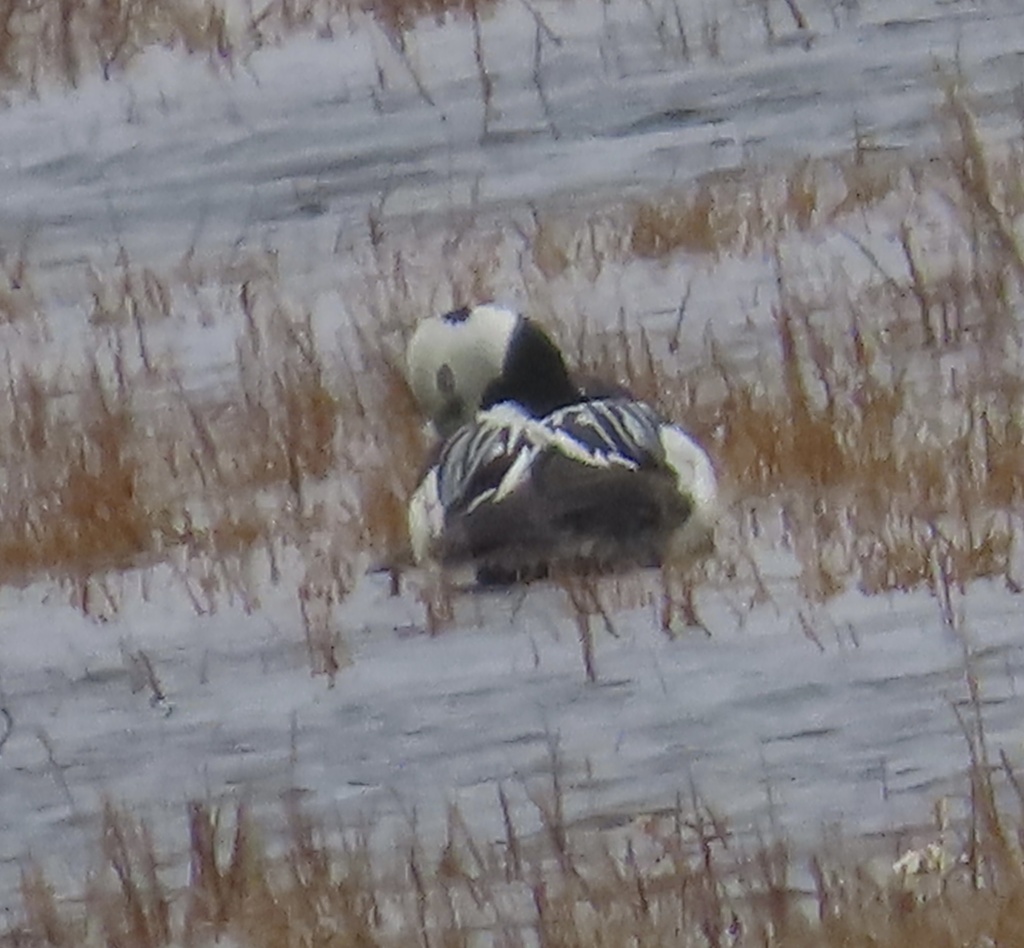
Steller's eider is the smallest of the four eider species, with both males and females weighing an average of 860 grams. These compact ducks are distinguished by a relatively large head with a flat crown and angled nape, paired with a long, thick bill and a relatively longer tail than other eiders. Both sexes share an iridescent bluish-purple speculum on the secondary wing feathers, bordered in white along the entire length of the secondaries.
Breeding males are striking, with a black cap, chin, collar, eye-ring, and rump contrasting sharply with a white head and shoulders. Light green patches decorate the area behind the head and in front of the eye, while the cinnamon breast and shoulders are marked with a prominent black spot. Long tertial feathers drape over the folded wing in dark purple-black with white stripes. Females are dark to cinnamon brown with a pale-white eye-ring. In eclipse (non-breeding) plumage, males become primarily dark brown like females, though they retain the distinctive white inner forewing visible in flight.
Range & Habitat
Steller's eiders are migratory Arctic sea ducks with three recognised breeding populations: one in Alaska and two in Arctic Russia. The Russian-Atlantic population breeds west of the Khatanga River in western Siberia and winters in the Barents and Baltic seas, while the Russian-Pacific population breeds east of the Khatanga River, wintering in the southern Bering Sea and northern Pacific Ocean. In Alaska, they nest on the Arctic Coastal Plain and in exceptionally small numbers in the Yukon–Kuskokwim Delta, with less than one percent of the world's population breeding there.
During breeding season, Steller's eiders nest in marshy tundra along the coast, in areas dominated by water sedge and pendant grass, preferring elevated surfaces covered by shallow vegetation such as mosses and grasses. Winter habitat consists of coastal bays and lagoons offering suitable forage, with occasional feeding in deeper sheltered waters. Moulting habitat comprises relatively shallow coastal lagoons with eelgrass, tidal flats for foraging, and beaches and sandbars for resting during the flightless period.
Behaviour & Diet
Despite being sea ducks, Steller's eiders are specialists in foraging near the shore using diverse techniques including brief diving and swimming underwater to depths of up to nine meters, as well as wading and dabbling. Notably, they employ surface feeding techniques more than other sea ducks and prefer relatively small prey. Research has shown these ducks are particularly skilled at catching highly mobile prey; they may specialise in crustaceans even when higher-energy food sources like capelin become available—a preference possibly reflecting their inability to exploit deeper habitats.
Winter diet includes molluscs, echinoderms, polychaete worms, and mussels, while during summer months in the tundra they feed on aquatic insects and plant material such as crowberries and pondweeds. Steller's eiders reach sexual maturity at two years of age and can live up to 21 years and four months. Males engage in leks—elaborate competitive displays—on both wintering and breeding grounds, where groups of males attempt to attract individual females through consistent sequences of head-shaking displays performed in silence.
Best Time & Places to See It
Due to extensive contraction of its breeding range, the Alaska-breeding population of Steller's eider was listed as vulnerable in 1997 by the International Union for the Conservation of Nature. The species is now protected in Estonia, Finland, Norway, Russia, and the United States, and is the subject of an ongoing recovery plan by the European Union and U.S. Fish and Wildlife Service. Some non-breeding populations spend their summers in northern Norway, on the east coast of Russia and adjacent waters, and south-west Alaska, providing additional opportunities for observation outside primary breeding areas.
Photography Tips
The striking plumage of breeding males makes Steller's eiders rewarding photography subjects, particularly their distinctive black and white head patterns and prominent cinnamon breast markings. The iridescent bluish-purple speculum and white-bordered secondaries are best captured in flight, so anticipate take-offs from water. Their relatively small size compared to other eiders and their preference for shallow coastal waters mean they are often viewable from shore, though a spotting scope or telephoto lens will be essential for quality images from a distance.
Northwest Spitsbergen National Park
Norway
+58 birds+17 mammals
Where the High Arctic converges with the Norwegian mainland, Northwest Spitsbergen National Park sprawls across one of Earth's most extreme and pristine wildernesses. Crowned by jagged…
VIEW NATIONAL PARKNorthern Isfjorden National Park
Norway
+40 birds+12 mammals
Where the Arctic fjord system cuts deep into Svalbard's northwestern coast, Northern Isfjorden National Park protects a landscape of stark geological drama—towering cliff faces, tidewater glaciers,…
VIEW NATIONAL PARKSchleswig-Holsteinisches Wattenmeer National Park
Germany
+378 birds+49 mammals
Where the North Sea ebbs and flows across a vast expanse of exposed mud and sand, the Schleswig-Holsteinisches Wattenmeer National Park reveals one of Europe's most…
VIEW NATIONAL PARKKatmai National Park
Lake and Peninsula Borough, United States
+160 birds+19 mammals
Across southwestern Alaska's Lake and Peninsula Borough, nearly 27,000 square kilometers of subarctic wilderness sprawl between volcanic peaks and coastal wetlands, anchored by the confluence of…
VIEW NATIONAL PARKLahemaa National Park
Lääne-Viru County, Estonia
+237 birds+25 mammals
Where the Baltic coast meets temperate forest in northwestern Estonia, Lahemaa National Park sprawls across more than 1,300 square kilometers of deeply character-filled terrain. Coastal wetlands…
VIEW NATIONAL PARKSt. Paul Island
Saint Paul, United States
+255 birds+8 mammals
Windswept tundra rolls across this remote Pribilof island, where volcanic basalt cliffs plunge into the Bering Sea and fog rolls in thick enough to erase the…
VIEW PROTECTED LANDSCAPEKodiak National Wildlife Refuge
United States
+221 birds+22 mammals
Where temperate rainforest meets subarctic coast, Kodiak National Wildlife Refuge sprawls across Alaska's largest island, a sanctuary defined by steep valleys carved by tidewater glaciers and…
VIEW WILDLIFE SANCTUARYAlaska Maritime National Wildlife Refuge
Alaska, United States
+391 birds+58 mammals
Where the North Pacific collides with Alaska's rugged coastline, a sprawling archipelago of islands, rocky outcrops, and coastal headlands forms one of North America's most remote…
VIEW WILDLIFE SANCTUARYYukon Delta National Wildlife Refuge
Bethel, United States
+156 birds+12 mammals
Across the Yukon Delta sprawls one of North America's most expansive coastal wetland sanctuaries, where the boreal subarctic climate strips down existence to essentials. This vast…
VIEW WILDLIFE SANCTUARYIzembek National Wildlife Refuge
Cold Bay, United States
+138 birds+9 mammals
Where the Aleutian archipelago reaches westward into the Bering Sea, subarctic tundra and shallow coastal waters converge to create one of Alaska's most ecologically vital wildlife…
VIEW WILDLIFE SANCTUARYBecharof National Wildlife Refuge
United States
+146 birds+2 mammals
Across southwestern Alaska's windswept lowlands, where the Bristol Bay watershed spills into vast tidal flats and sedge marshes, lies one of North America's most pristine subarctic…
VIEW WILDLIFE SANCTUARYNo community photos yet. Log in to add the first one.
No community observations of this species yet.