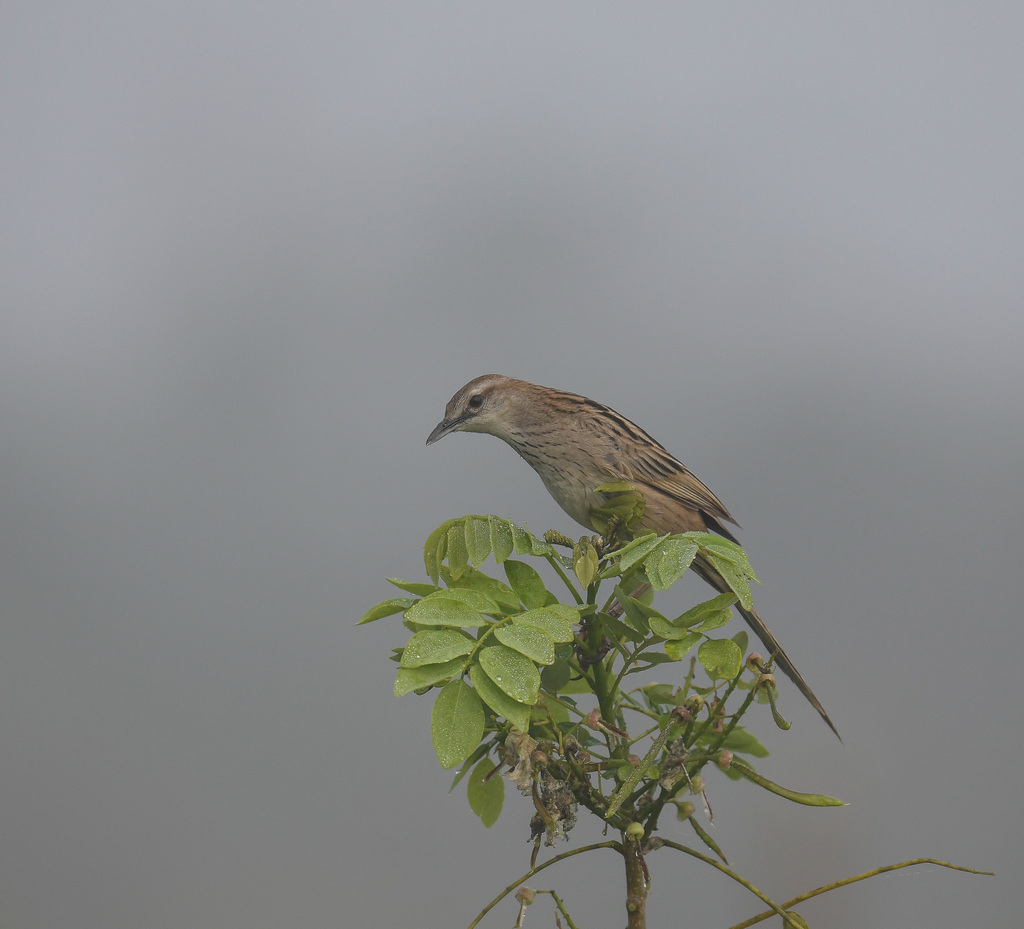
Striated Grassbird
Photo © Rejoice Gassah
Photo © Rejoice Gassah — CC BY 4.0 — Source: iNaturalist #302823287Identification
The Striated Grassbird is a member of the family Locustellidae, formerly known as "Old World warblers." It is now the sole species within the genus Megalurus, following a comprehensive molecular phylogenetic study in 2018 that reorganized the grassbird family. The bird is notably noisy and conspicuous, making it relatively easy to locate despite its grassland habitat. Its most distinctive field marks are a streaked crown and streaked upper breast, features that distinguish it from related species and make identification straightforward for attentive observers.
Range & Habitat
The Striated Grassbird boasts an extremely large geographic range across southern and Southeast Asia. It is found in Bangladesh, Cambodia, China, India, Indonesia, Laos, Malaysia, Myanmar, Nepal, Pakistan, the Philippines, Thailand, and Vietnam. This extensive distribution across multiple countries and varied ecosystems reflects the species' adaptability to grassland and reed-bed environments throughout the region, though specific habitat preferences within this broad range are not detailed in available sources.
Behaviour & Diet
The Striated Grassbird is highly vocal and conspicuous in its behaviour, a characteristic that makes it appealing to birdwatchers and photographers. Rather than skulking secretively like many grassland birds, it often sits exposed on the tops of grasses, bushes, and even telephone wires while calling. This bold, visible behaviour pattern—combined with its noisy nature—means that patient observers can usually locate this species without excessive difficulty. While specific details about its diet and foraging techniques are not provided, its presence atop vegetation suggests it hunts insects in typical warbler fashion.
Best Time & Places to See It
Given its extensive range across thirteen countries in South and Southeast Asia, the Striated Grassbird can be found across a vast region of grasslands, reed beds, and scrubby habitats. The species is evaluated as Least Concern, with an extremely large range and a population not believed to be decreasing rapidly. Its conspicuous and noisy habits mean it is more readily detected than many grassland species. However, specific seasonal patterns, migration timing, or particularly reliable localities for observation are not documented in available information. Visitors to grassland habitats throughout the species' range should listen for its calls and watch exposed perches on grasses and low vegetation.
Photography Tips
The Striated Grassbird's habit of sitting exposed on top of grasses, bushes, and telephone wires presents excellent photography opportunities compared to many other grassland birds. Its conspicuous behaviour and preference for visible perches mean photographers can often approach and frame the subject without the extreme difficulty encountered with skulking species. The streaked crown and upper breast are key field marks worth capturing clearly in photographs. Early morning hours, when grassland birds are most vocal and active, would offer the best light and behaviour for compelling images of this vocal and exposed grassbird.
Orang National Park
Rangagarapathar, India
+298 birds+1 mammals
Where the Brahmaputra's floodplains meet the foothills of Assam, Orang National Park unfolds across a mosaic of riverine grasslands, forests and wetlands that pulse with the…
VIEW NATIONAL PARKKhao Yai National Park
Prachantakham District, Thailand
+377 birds+46 mammals
Evergreen dipterocarp forest blankets the rolling terrain of this national park in eastern Thailand, where limestone hills rise abruptly from the forest floor and seasonal streams…
VIEW NATIONAL PARKPanna National Park
Badgadi Kalan, India
+271 birds+17 mammals
Where granite gorges slice through central India's Vindhyan plateau, a landscape of stark beauty unfolds across nearly six hundred square kilometers. The Ken River carves through…
VIEW NATIONAL PARKTaman Negara Bukit Lambir National Park
Miri, Malaysia
+153 birds+7 mammals
Rainforest cascades down sandstone ridges where crystal streams carve through ancient geology, creating a landscape of profound biological richness in Sarawak's interior. This 68-square-kilometre sanctuary protects…
VIEW NATIONAL PARKTaman Nasional Baluran
Situbondo, Indonesia
+189 birds+9 mammals
Across the northeastern tip of East Java, where monsoon winds sweep down from the Bali Strait, a landscape of contrasts unfolds within 374 square kilometres of…
VIEW NATIONAL PARKTaman Nasional Meru Betiri
Jember, Indonesia
+93 birds+1 mammals
Across East Java's southeastern coast, where the Indian Ocean meets a landscape of volcanic soils and monsoon-fed forests, sprawls a national park that epitomizes the ecological…
VIEW NATIONAL PARKWest Bali National Park
Gerokgak, Indonesia
+240 birds+8 mammals
Across West Bali's northwestern reaches, where the Indian Ocean meets volcanic slopes and limestone cliffs plunge toward turquoise shallows, sprawls a protected realm of roughly 325…
VIEW NATIONAL PARKGunung Merbabu National Park
Magelang, Indonesia
+61 birds+2 mammals
Where volcanic slopes rise sharply from the plateau of Central Java, Gunung Merbabu National Park encompasses nearly 200 square kilometers of montane forest that transitions through…
VIEW NATIONAL PARKMount Merapi National Park
Hargobinangun, Indonesia
+150 birds+3 mammals
Where the volcanic slopes of central Java rise into mist and montane forest, Mount Merapi National Park guards one of Indonesia's most dynamic landscapes. Spanning roughly…
VIEW NATIONAL PARKGaoligong Mountain National Nature Reserve
Nujiang Lisu Autonomous Prefecture, China
+443 birds+13 mammals
VIEW NATURE RESERVENo community photos yet. Log in to add the first one.
No community observations of this species yet.