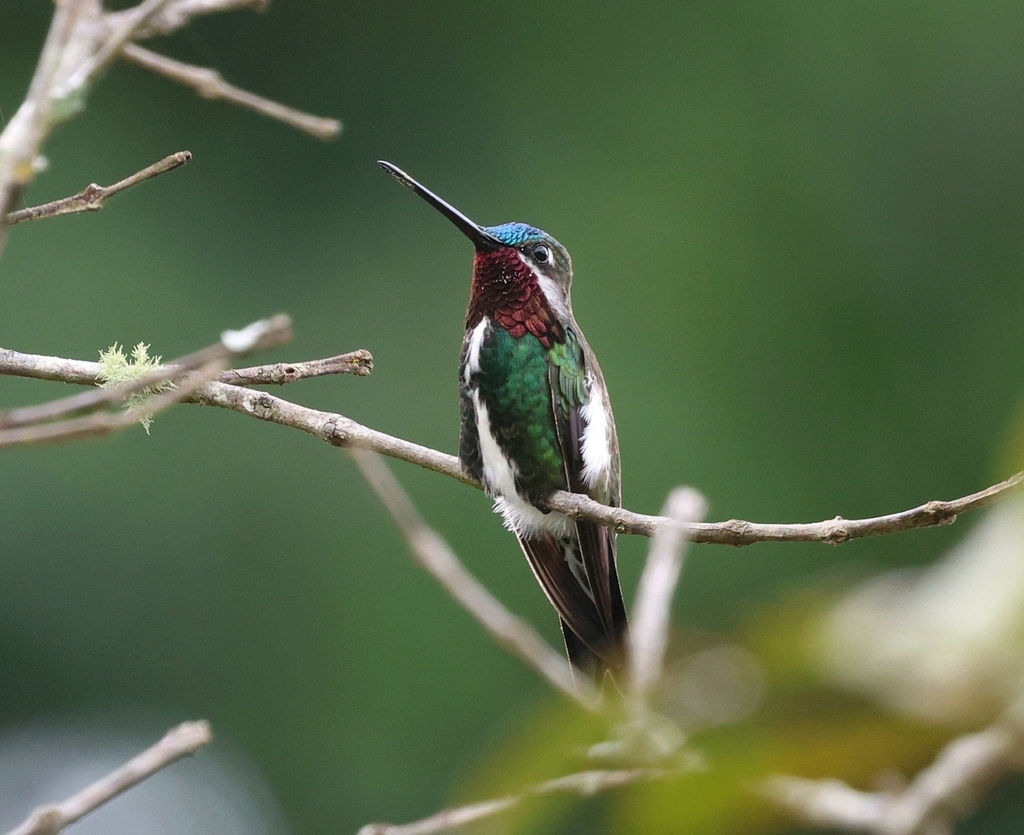
Stripe-breasted Starthroat
Photo © Miguel
Photo © Miguel — CC BY-SA 4.0 — Source: iNaturalist photo #503082921Identification
The stripe-breasted starthroat is a small hummingbird, measuring 11.2 to 12.4 cm in length and weighing just 5 to 6.5 grams. Both sexes share distinctive field marks: a long, slightly decurved black bill, a white streak behind the eye, and a characteristic white "moustache" stripe. The forked tail is more deeply indented in males than females.
Males in breeding plumage are particularly striking, displaying bronzy-green upperparts crowned with an iridescent green cap. The gorget is a glittering violet with flared sides, while the underparts are greenish-black with a prominent white stripe running down the centre. The central tail feathers are black, with the remaining feathers dark blue-green. After breeding, males' throats molt to a grayish tone with black spotting. Females are subtler, with blackish-green throat feathers edged in white, a grayish chest and belly with a white central stripe, greenish flanks, and a green tail with steel-blue bands and white tips on the outer feathers.
Range & Habitat
This species is endemic to eastern Brazil, occurring from Pernambuco southward to São Paulo state. It has occasionally been recorded as a vagrant in Argentina's Iguazú National Park. The stripe-breasted starthroat inhabits both forest and savannah environments at elevations from sea level up to 800 metres.
Behaviour & Diet
The stripe-breasted starthroat is essentially sedentary, though it may occasionally wander to higher elevations than its usual range. It feeds primarily on nectar from a wide variety of flowering plants, typically foraging between 3 and 8 metres above ground. The species is territorial, particularly defending flower patches from others of its own species, though it shows less aggression toward other hummingbird species. Supplementing its nectar diet, it also captures small insects by hawking in flight.
Breeding typically occurs from February to April, though incubation has been recorded as early as November. Females construct small cup nests placed on horizontal tree branches 6 to 8 metres above ground, with some nests found at greater heights and at least one documented on a utility wire. The female incubates a clutch of two eggs for 14 to 16 days, with fledging occurring 21 to 24 days after hatching. The bird's vocalization is distinctive: its song is a "subdued, buzzy scratchy warble" described phonetically as "bzzzrrrr..bzzzrrr..chi-chi-chi-chi..bzrrr," while it also produces a liquid "tsik" call.
Best Time & Places to See It
The stripe-breasted starthroat is considered locally common throughout its Brazilian range and occurs in at least one Brazilian national park. The breeding season from February to April offers the best opportunity to observe males in their spectacular iridescent breeding plumage. The species' essentially sedentary nature makes it a reliable subject for patient observers within its eastern Brazilian range, particularly in forest and savannah habitats at lower elevations.
Photography Tips
Photographing this species requires attention to the male's brilliant breeding plumage, particularly the glittering violet gorget which requires proper angle and lighting to capture its iridescence. Since the birds typically forage between 3 and 8 metres above ground, a telephoto lens will be essential for capturing detailed shots from below. The white facial markings—the streak behind the eye and "moustache"—provide useful reference points for composition. Patient stakeouts at flowering patches during the breeding season will reward photographers with opportunities to capture males defending their territories and displaying their striking colours.
Serra do Cipó National Park
Brazil
+379 birds+5 mammals
Where granite escarpments rise above the Atlantic Forest transition zone in southeastern Brazil, Serra do Cipó National Park unfolds across a landscape of dramatic ridges, cascading…
VIEW NATIONAL PARKItatiaia National Park
Brazil
+519 birds+12 mammals
Where granite peaks pierce the Atlantic rainforest canopy in southeastern Brazil, Itatiaia National Park rises as one of the country's oldest and most ecologically vital protected…
VIEW NATIONAL PARKSerra do Teixeira National Park
Brazil
+160 birds+5 mammals
Rugged plateaus and deep escarpments define this 3,112-square-kilometre sweep of the Brazilian Northeast, where the crystalline bedrock of the Borborema Plateau rises abruptly from the surrounding…
VIEW NATIONAL PARKSerra dos Órgãos National Park
Brazil
+446 birds+13 mammals
Granite peaks thrust skyward through the Atlantic Forest canopy in the mountains immediately north of Rio de Janeiro, their bare rock faces rising above a landscape…
VIEW NATIONAL PARKChapada dos Veadeiros National Park
Brazil
+324 birds+6 mammals
Where granite plateaus rise above the cerrado savanna in central Brazil, Chapada dos Veadeiros National Park unfolds across 6,665 square kilometres of some of the world's…
VIEW NATIONAL PARKChapada Diamantina National Park
Brazil
+346 birds+5 mammals
Where granite peaks and sandstone cliffs rise abruptly from the Brazilian interior, Chapada Diamantina National Park sprawls across 4,215 square kilometers of some of Brazil's most…
VIEW NATIONAL PARKSerra do Gandarela National Park
Brazil
+333 birds+3 mammals
Where granite massifs rise through Atlantic Forest in southeastern Brazil's highlands, Serra do Gandarela National Park protects nearly 1,000 square kilometres of montane terrain that few…
VIEW NATIONAL PARKCatimbau National Park
Brazil
+118 birds+6 mammals
Where sandstone plateaus rise from the semi-arid scrublands of northeastern Brazil, Catimbau National Park unfolds across more than 1,000 square kilometres of geological drama and surprising…
VIEW NATIONAL PARKBrasília National Park
Plano Piloto, Brazil
+338 birds+15 mammals
Cerrado grassland and scattered woodland sweep across the central Brazilian plateau where this national park sprawls across more than a thousand square kilometres of the Federal…
VIEW NATIONAL PARKNo community photos yet. Log in to add the first one.
No community observations of this species yet.