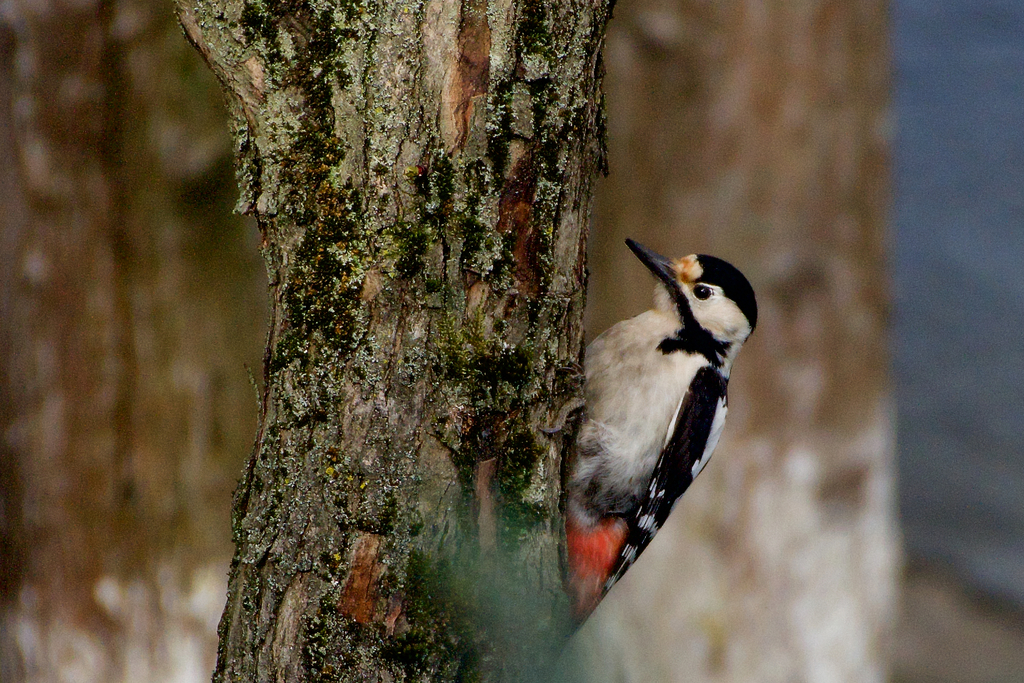
Syrian Woodpecker
Photo © Codrin Bucur
Photo © Codrin Bucur — CC BY 4.0 — Source: iNaturalist photo #187676023Identification
The Syrian woodpecker is a medium-sized woodpecker measuring 23 cm (9.1 in) in length. Males display glossy black upper parts with a distinctive crimson spot on the nape, white on the forehead, sides of the face and neck, and a large white patch on the shoulder. The flight feathers are black with white spots forming three wingbars, while the underparts are buffish white with a reddish abdomen and under tail coverts. Females lack the crimson nape marking, though young birds show crimson on the crown instead. The bird has a long slate-black bill and greenish-grey legs.
The Syrian woodpecker closely resembles the great spotted woodpecker but can be distinguished by its longer bill, greater white on the head, and lack of white tail barring. It differs from the smaller lesser spotted woodpecker through its crimson abdomen and white shoulder patches. When the bird spreads its short, stiff tail—used for climbing support—the white spots on the outer tail feathers become visible.
Range & Habitat
This resident breeding bird is found from southeastern Europe eastward to Iran, with its range expanding further northwest into Europe in recent years. The Syrian woodpecker inhabits open woodlands, cultivated areas with scattered trees and scrubs, and parks. Despite its striking plumage, it often remains inconspicuous in these environments.
The species depends on old trees for both food and nesting sites, making mature woodland and parkland its preferred habitat. It is well-adapted to human-modified landscapes, including agricultural areas with established tree cover.
Behaviour & Diet
The Syrian woodpecker's presence is often revealed by its mechanical drumming—a vibrating rattle produced by rapid bill strikes on tree trunks or branches. This drumming is longer than that of the great spotted woodpecker and decreases in volume, while being faster and shorter than the white-backed woodpecker's. Both sexes drum, using it as a territorial signal rather than merely for mating. The bird's call is a sharp "quit, quit," softer than the great spotted woodpecker's and resembling a common redshank.
The diet consists mainly of wood-boring insect larvae, particularly those of moths and beetles, supplemented by bees such as Xylocopa pubescens. The woodpecker typically alights on tree trunks and works upward, tapping bark and extracting prey from crevices with its sticky tongue. Seeds, nuts, and berries supplement the diet when insects are scarce. Its movement is characteristically jerky, hopping rather than climbing. The bird often feeds in a heads-up vertical position but frequently assumes upside-down attitudes while foraging. Notably, in Israel, the species has been observed damaging polyethylene irrigation pipes, creating rounded holes 2-10 mm in diameter, though the reason for this behaviour remains unclear.
Best Time & Places to See It
The Syrian woodpecker is a year-round resident throughout its range, making it observable in any season. Listen for its distinctive mechanical drumming, which carries considerable distance and is particularly audible in hollow branches. The bird is often inconspicuous despite its striking appearance, so audio cues are valuable for locating it.
Look for this species in open woodlands, mature parkland, and cultivated areas with scattered old trees from southeastern Europe to Iran. Recent range expansion means populations are establishing in new areas to the northwest of the traditional range.
Photography Tips
The Syrian woodpecker's black-and-white plumage with crimson accents offers excellent photographic contrast, particularly the male's nape spot and the white shoulder patches. Position yourself near old trees where the bird forages, typically working up the trunk. Patience is essential, as the bird can be inconspicuous despite its bold markings.
The most dramatic shots capture the bird in its characteristic feeding positions, including the less common upside-down foraging postures. Using the mechanical drumming sound as a guide will help you locate and track individual birds through the foliage. Early morning often provides the best lighting for capturing the glossy black upper parts and white markings.
Danube Delta Biosphere Reserve
Tulcea, Romania
+277 birds+27 mammals
Where the Danube surrenders to the Black Sea, a vast labyrinth of channels, reed beds, and freshwater lakes sprawls across nearly 13,400 square kilometers of eastern…
VIEW NATIONAL PARKAggtelek National Park
Szin, Hungary
+119 birds+13 mammals
Where limestone karst terrain rises and plunges across North Hungary's borderlands, Aggtelek National Park unfolds across 543 square kilometres of one of Europe's most geologically dramatic…
VIEW NATIONAL PARKHortobágy National Park
Hortobágy, Hungary
+260 birds+17 mammals
Across the North Great Plain of Hungary stretches one of Europe's most expansive semi-natural grassland systems, where horizon-wide vistas of steppe and wetland create a landscape…
VIEW NATIONAL PARKDuna-Ipoly National Park
Dömös, Hungary
+208 birds+19 mammals
Where the Danube curves through central Hungary, the limestone hills and forested valleys of Duna-Ipoly National Park create a landscape that feels caught between seasons and…
VIEW NATIONAL PARKFertő–hanság National Park
Fertőszéplak, Hungary
+246 birds+11 mammals
Where the Austro-Hungarian plains meet the foothills of Western Transdanubia, nearly 900 square kilometres of wetland, reed bed, and mixed woodland form one of Central Europe's…
VIEW NATIONAL PARKBükk National Park
Répáshuta, Hungary
+161 birds+15 mammals
Where forested limestone ridges rise across northern Hungary, Bükk National Park unfolds across nearly 900 square kilometres of temperate woodland, rocky gorges, and karst formations that…
VIEW NATIONAL PARKZemo Svaneti Planned National Park
Hamashi-Totoleshi, Georgia
+159 birds+6 mammals
Where granite peaks pierce the clouds above the Caucasus, sweeping alpine meadows give way to pristine beech and spruce forests that have remained largely untouched for…
VIEW NATIONAL PARKPirin National Park
Bansko, Bulgaria
+124 birds+10 mammals
Where jagged limestone peaks pierce the Macedonian sky, ancient glacial valleys cradle some of Bulgaria's most pristine wilderness. This southwestern corner of the Balkans rises to…
VIEW NATIONAL PARKRila National Park
Mala tsarkva, Bulgaria
+138 birds+4 mammals
Where granite peaks pierce the Balkan skyline, pristine conifer forests blanket steep mountain slopes in an ecological tapestry that has remained largely undisturbed for centuries. Bulgaria's…
VIEW NATIONAL PARKStrandzha Nature Park
Kondolovo, Bulgaria
+215 birds+19 mammals
Where the Rhodope Mountains descend toward the Black Sea coast, ancient forests rise above limestone plateaus in a tapestry of ecological richness rarely found elsewhere in…
VIEW NATURAL PARKCentral Balkan National Park
Zhidov dol, Bulgaria
+135 birds+16 mammals
Where granite peaks pierce the Bulgarian highlands, ancient beech and conifer forests blanket mountains that rise dramatically from the Balkan range's heart. This wilderness encompasses three…
VIEW NATIONAL PARKVitosha Nature Park
Chuypetlovo, Bulgaria
+137 birds+12 mammals
Where ancient granite peaks rise above the Bulgarian capital, a wild sanctuary unfolds across nearly 27,000 hectares of pristine montane wilderness. Vitosha's character shifts dramatically with…
VIEW NATURAL PARKVratsa Balkan
Zgorigrad, Bulgaria
+128 birds+10 mammals
Where limestone cliffs plunge into deep river canyons and beech forests give way to rocky karst plateaus, one of Bulgaria's most dramatic mountain landscapes unfolds across…
VIEW NATURE RESERVEKampinos National Park
Roztoka, Poland
+183 birds+18 mammals
Sandy pine forests and wetland mosaics spread across the glacial plains northwest of Warsaw, where Kampinos National Park protects one of central Europe's most distinctive lowland…
VIEW NATIONAL PARKBiebrza National Park
Goniądz, Poland
+242 birds+33 mammals
Where the Narew River sprawls across northeastern Poland's flatlands, Biebrza National Park unfolds as one of Europe's largest and most ecologically vital wetland complexes. Encompassing roughly…
VIEW NATIONAL PARKPindos National Park
Ioannina Regional Unit, Greece
+163 birds+12 mammals
Where limestone peaks rise abruptly from the Pindus range in northwestern Greece, a landscape of dramatic gorges, alpine meadows, and dense beech forests creates one of…
VIEW NATIONAL PARKVikos–Aoos National Park
Ioannina Regional Unit, Greece
+136 birds+4 mammals
Where limestone gorges plunge through the Pindus Mountains, the Vikos–Aoos National Park guards one of Greece's most dramatic inland wilderness areas. The park's defining feature is…
VIEW NATIONAL PARKOlympos National Park
Pieria Regional Unit, Greece
+137 birds+3 mammals
Where the Thessalian plains give way to soaring limestone massifs, Olympos National Park rises as one of the Aegean's most dramatic mountain wilderness areas. This IUCN…
VIEW NATIONAL PARKKerkini Lake National Park
Serres, Greece
+291 birds+18 mammals
Where the Strymon River widens into a sprawling freshwater lake hemmed by the Rhodope Mountains, Kerkini National Park unfolds across northern Greece as one of southeastern…
VIEW NATIONAL PARKNo community photos yet. Log in to add the first one.
No community observations of this species yet.