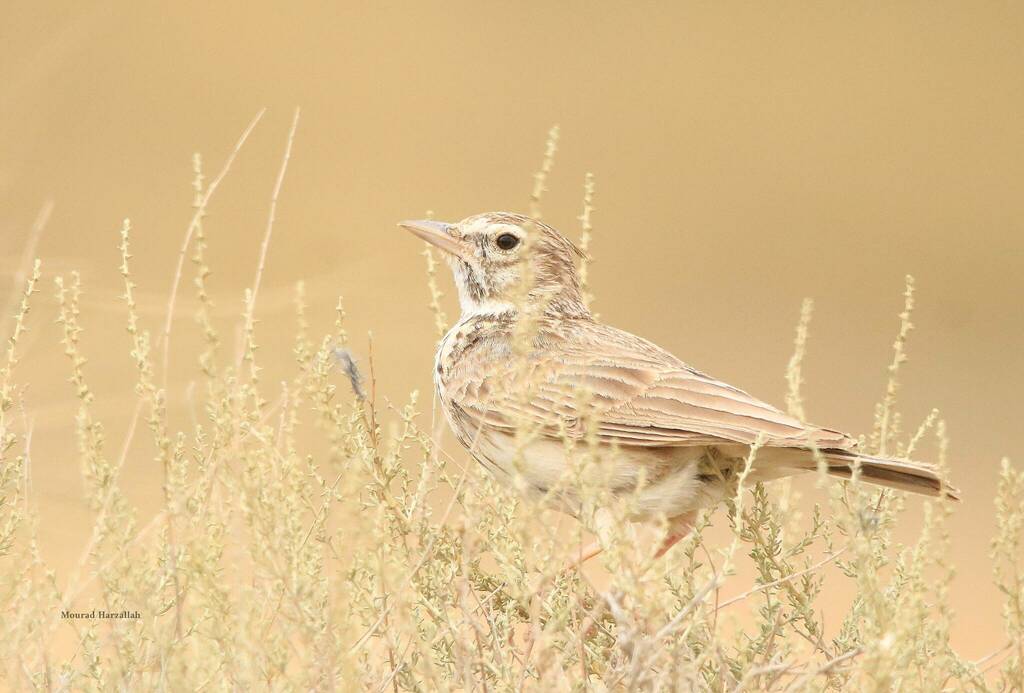
Thekla’s Lark
Photo © Mourad Harzallah
Photo © Mourad Harzallah — CC BY 4.0 — Source: iNaturalist photo #249381573Identification
Thekla's Lark is a smallish lark, slightly smaller than the Eurasian Skylark, distinguished by its long, spiky, erectile crest. Its colouring is predominantly brownish-grey or brown, with a greyer back and rump than the similar Crested Lark. The breast is streaked with black, and the body is mainly dark-streaked grey above and whitish below. In flight, it shows distinctive grey underwings, contrasting with the reddish underwings of the Crested Lark. It is also greyer than the Eurasian Skylark and lacks the white wing and tail edges of that species. Thekla's Lark has a shorter bill than the Crested Lark, and the sexes are similar in appearance.
Range & Habitat
Thekla's Lark is native and resident across a wide range spanning the Iberian Peninsula, North Africa, and East Africa south to Kenya. It is found in France, Spain, Portugal, Algeria, Egypt, Eritrea, Ethiopia, Kenya, Libya, Morocco, Somalia, Tunisia and Western Sahara. Twelve subspecies are recognized, with populations showing deep genetic divergence, particularly between East African and Mediterranean populations. This is a sedentary, non-migratory species.
The bird inhabits dry open country, often at some altitude. Its typical habitat consists of rugged areas with scrub, bare patches of ground and semi-arid grassland, making it well-adapted to arid and semi-arid environments across its range.
Behaviour & Diet
Thekla's Lark nests on the ground, laying two to six eggs per clutch. Its diet comprises weed seeds and insects, with insects being especially important during the breeding season. The song is melodious and varied, featuring mournful whistles and mimicry. Notably, its vocalizations are softer and more tuneful than those of the Crested Lark, and may be delivered during flight or from the ground and exposed perches.
Best Time & Places to See It
As a sedentary, year-round resident throughout its range, Thekla's Lark can be found in its habitat at any time of year. The species is common across much of its wide distribution, making it a reliable sighting for travellers visiting appropriate habitats. Spain and Portugal offer accessible opportunities for European birders, while North African countries such as Morocco provide encounters with various subspecies. East African destinations including Ethiopia and Kenya offer chances to see the genetically distinct East African populations.
Photography Tips
The bird's characteristic spiky crest and streaked plumage are best captured in good natural light to show the subtle grey and brown tones. The grey underwings visible in flight provide a distinctive field mark worth documenting. Look for birds singing from the ground or exposed perches, as these positions offer good opportunities for photography. Early morning light is ideal for capturing both the bird's plumage details and its behaviour, particularly when it sings from an exposed vantage point.
Delta de l’Ebre Natural Park
Awash National Park
Bale Mountains National Park
Bardenas Reales
Cabañeros National Park
Cabo de Gata-Níjar Natural Park
Cañón del Río Lobos Natural Park
Cap de Creus Natural Park
Cap de Ferrutx Nature Reserve
Nothing matches these filters.
No community photos yet. Log in to add the first one.