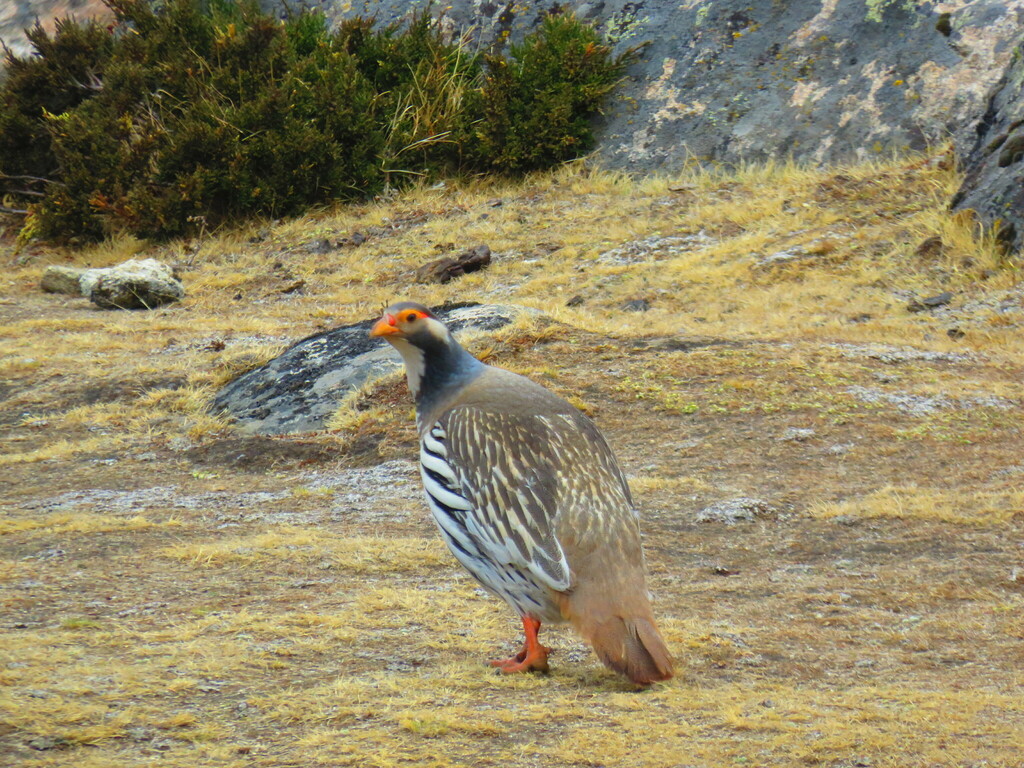
Tibetan Snowcock
Photo © n_armstrong
Photo © n_armstrong — CC0 1.0 — Source: iNaturalist photo #235432113Identification
The Tibetan snowcock is a medium-sized gallinaceous bird noticeably smaller than its relative, the Himalayan snowcock. It displays distinctive plumage that aids identification in its high-altitude habitat. The head and neck are predominantly grey, with a characteristic white crescent patch behind the eye. A dark cheek contrasts with the white chin, throat, and breast, which are marked by two grey bands across the breast. The wing coverts and tertials are grey with white trim, and most notably, the secondaries feature a broad white trailing edge that forms a prominent wing band visible in flight.
The underparts are white with black streaks adorning the flanks and belly. The tail is rufous brown, and the undertail coverts are black. The legs and beak are reddish in colour. Sexual dimorphism is subtle: females have buff colouration in the postocular patch, blackish and buff marks on the sides of the head and neck, and lack the tarsal spurs present on males.
Range & Habitat
The Tibetan snowcock inhabits the high-altitude regions of the Western Himalayas and the Tibetan Plateau, with its range extending across the Pamirs of Tajikistan, through the Himalayas from Ladakh to Arunachal Pradesh, across Tibet, Pakistan, and into China. The species shows considerable geographic variation, with five recognised subspecies displaying subtle differences in plumage darkness and colouration. In parts of its range, the Tibetan snowcock's distribution shows clear separation from the Himalayan snowcock, though in other areas the two species overlap.
This species is primarily found on alpine pastures, stony ridges above the tree line, grass-covered plateaus, and barren, stony plains with minimal vegetation. During winter or when heavy snowfall occurs, birds descend to lower altitudes than their typical summer range. The species is classified as "Least Concern" by the IUCN due to its large distribution range and absence of visible population declines.
Behaviour & Diet
Tibetan snowcocks prefer higher altitudes than their Himalayan counterparts and display fascinating social and vocal behaviours. During winter, they move in coveys and are notably vocal, calling in the morning and evening but becoming quiet during midday hours. Their calls include a distinctive chuckling that gradually increases in volume, whistles, and curlew-like notes. When approached from below on slopes, they typically move upwards, pausing periodically to observe the intruder; if alarmed, they fly swiftly downward across valleys. In flight, they produce characteristic whistling sounds. Remarkably, resting flocks position one or more adult birds on high boulders as sentries, warning the group with loud, prolonged whistles.
During summer, birds form pairs, with males believed to be monogynous. Nests are simple scrapes, sparsely lined and sheltered beneath stones or bushes on leeward hillsides, typically on bare ground without vegetation. Females lay four to six eggs, with males standing sentinel during incubation. Both parents accompany broods and perform distraction displays when young are threatened, with chicks hiding between stones for protection. Multiple broods sometimes form single foraging groups.
Best Time & Places to See It
The Tibetan snowcock is best observed during summer months when birds are concentrated on their breeding grounds across alpine plateaus and ridges. Early morning and evening hours offer the best opportunities, as the species is most vocal during these periods. Travellers should target the higher elevations of the Himalayas, particularly in regions from Ladakh through Nepal and Sikkim to Arunachal Pradesh, as well as the Tibetan Plateau and adjacent areas of western China. Winter observations are possible at lower altitudes when snow forces birds downslope, though accessing these regions may present logistical challenges.
Photography Tips
Photographers should position themselves on slopes to observe birds' characteristic upward movement when approached, allowing predictable photo opportunities. The species' distinctive white wing band is best captured during flight, so anticipating takeoffs will yield rewarding images. Early morning light is ideal for capturing the subtle grey, white, and rufous tones of the plumage. Exercise patience during midday hours when the species becomes quiet and inactive; resume efforts at dusk. The landscape of high alpine plateaus and rocky terrain provides dramatic compositional elements that complement portraits of this remarkable high-altitude specialist.
Langtang National Park
Helambu, Nepal
+364 birds+14 mammals
Where the southern slopes of the Himalayan highlands descend toward the subtropical valleys of central Nepal, Langtang National Park sprawls across one of the subcontinent's most…
VIEW NATIONAL PARKSagarmatha National Park
Khumjung, Nepal
+219 birds+7 mammals
Soaring peaks and deep glacial valleys define this alpine wilderness in northeastern Nepal, where the terrain rises from forested foothills into a realm of high-altitude tundra…
VIEW NATIONAL PARKGiant Panda National Park
Mianyang, China
+447 birds+47 mammals
Where the eastern slopes of China's Sichuan plateau descend into cloud-wrapped valleys, one of Asia's most biodiverse landscapes unfolds across more than 350,000 square kilometres. This…
VIEW NATIONAL PARKSanjiangyuan National Park
Nagqu, China
+187 birds+25 mammals
Where the headwaters of three great Asian rivers emerge from a high alpine plateau, the landscape unfolds in tundra and dwarf shrubland—a world of austere beauty…
VIEW NATIONAL PARKQiangtang National Nature Reserve
Ngari Prefecture, China
+34 birds+5 mammals
Across the high Tibetan plateau north of Nagqu sprawls one of Earth's most extreme alpine tundra ecosystems, where vast expanses of sparse grassland and barren terrain…
VIEW NATURE RESERVEQinghai Lake National Nature Reserve
Hainan Tibetan Autonomous Prefecture, China
+243 birds+11 mammals
At 3,200 metres above sea level on the Tibetan plateau, where winter temperatures plunge far below freezing and snow blankets the landscape for half the year,…
VIEW NATURE RESERVENo community photos yet. Log in to add the first one.
No community observations of this species yet.