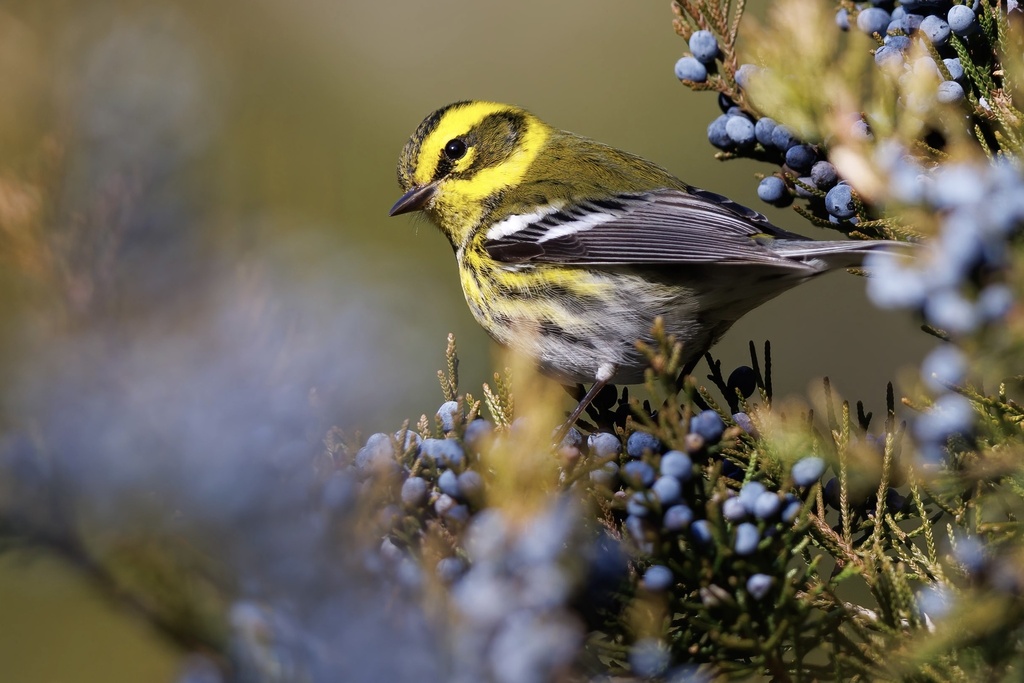
Townsend’s Warbler
Photo © Matt Felperin
Photo © Matt Felperin — CC BY 4.0 — Source: iNaturalist photo #347054257Identification
Townsend's warbler is a small, distinctly marked songbird with a striking yellow face crossed by a bold black cheek stripe that extends into an ear patch. The bird has olive upperparts streaked with black on the back and flanks, two white wing bars, and a white belly. Adults show marked sexual dimorphism: males sport a black cap and black throat with a yellow lower breast, while females display a dark cap and yellow throat. Immature birds resemble females but have a dark green cap and cheeks. The warbler's thin, pointed bill is perfectly adapted for gleaning insects from vegetation.
Range & Habitat
Townsend's warbler breeds in coniferous forests with large trees along the northwestern coast of North America. During winter, populations are highly migratory: birds from Haida Gwaii undertake short-distance movements south along the Pacific coast, while other populations winter in Mexico, Central America, and the southwestern United States. This species is closely related to the hermit warbler, and where their ranges overlap, the two species interbreed.
Behaviour & Diet
An active forager, Townsend's warbler hunts primarily in the higher branches of conifers, gleaning insects and spiders from foliage and sometimes hovering or catching prey in mid-air. The species is highly insectivorous during breeding season, but outside the nesting period, birds join mixed foraging flocks and diversify their diet to include berries, plant nectar, and honeydew collected directly from scale insects. The male's song is a characteristic buzzy zee-zee-zee-bzz-zee or weazy weazy weazy weazy twea, reminiscent of its eastern relative the black-throated green warbler, with a sharp tup call.
Best Time & Places to See It
Seek Townsend's warblers in coniferous forests of the Pacific Northwest during breeding season. Winter sightings are possible along the Pacific coast from southern British Columbia southward, as well as in Mexico and Central America. Look for them foraging actively in the upper canopy, often in mixed-species flocks during non-breeding months.
Photography Tips
The warbler's small size and preference for high branches make photography challenging. Use a telephoto lens and be prepared for active movement through foliage. Dawn chorus periods offer the best light and activity levels. The strong facial pattern and crisp wing bars photograph well in bright, clear conditions. Patience and a blind or stationary position near productive foraging areas will yield better results than active pursuit through dense forest.
Arizona in Winter
Nothing matches these filters.
Tombstone Territorial Park
Alaska Maritime National Wildlife Refuge
Alligator River National Wildlife Refuge
Arches National Park
Arenal Volcano National Park
Banff National Park
Baru Volcano National Park
Bear River Migratory Bird Refuge
Big Bend National Park
Nothing matches these filters.
No community photos yet. Log in to add the first one.
No community observations of this species yet.