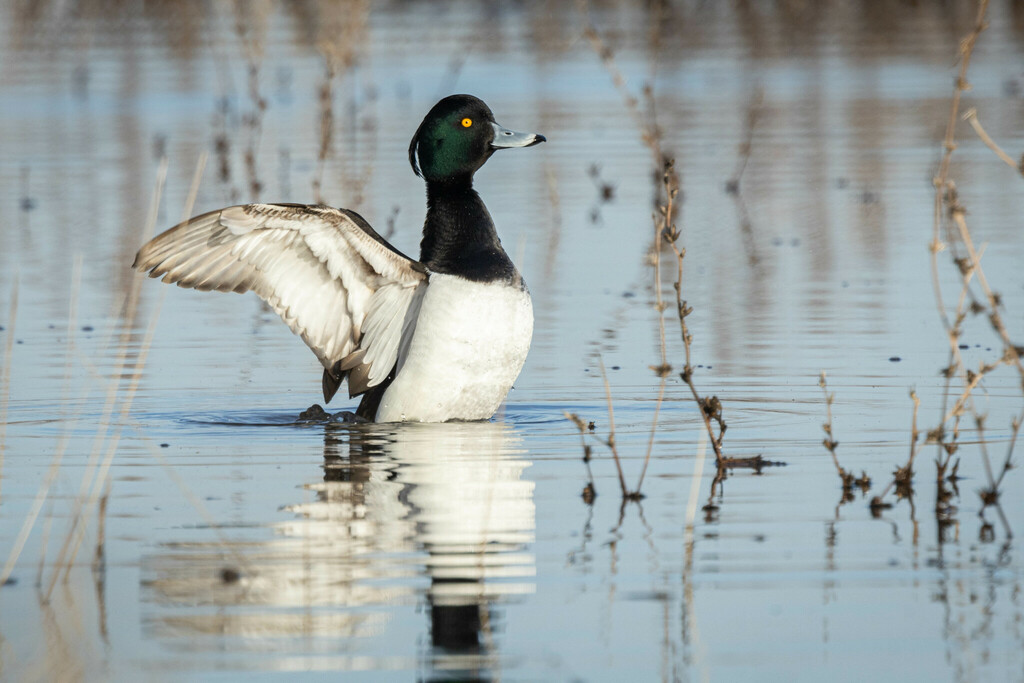
Tufted Duck
Photo © Антон Лабачоў
Photo © Антон Лабачоў — CC BY 4.0 — Source: iNaturalist photo #365730555Identification
The tufted duck is a small diving duck easily recognised by its distinctive features. Males are striking in appearance, with all-black plumage contrasted by white flanks and a blue-grey bill with golden yellow eyes. The most identifying feature is the prominent tuft on the back of the head, from which the species derives its name. Females are brown with lighter flanks and can be more challenging to identify, though some individuals display white around the base of the bill. This white marking may cause confusion with scaup species, but it is never as extensive as in those ducks, and tufted ducks lack the characteristic tuft. The species is monotypic, meaning no recognised subspecies exist.
Vocalisation provides useful identification clues. The female's call is a harsh, growling "karr" usually given in flight, while males are mostly silent except during courtship, when they produce a simple "wit-oo" whistle. These calls distinguish the tufted duck from similar species such as the greater and lesser scaup, which lack the tuft and emit different calls entirely.
Range & Habitat
The tufted duck is found throughout temperate and northern Eurasia, with a global population of nearly one million birds. The species is partially migratory, with most populations migrating to milder regions to overwinter in the south and west of Europe and southern Asia, while populations in the British Isles remain year-round. In winter, tufted ducks form large flocks on open water. Occasionally, individuals appear as winter visitors along both coasts of North America, and one remarkable record documents a bird reaching as far south as Melbourne, Australia.
The species has expanded its range in recent decades, believed to be due to increased availability of open water from gravel extraction and the spread of freshwater mussels, a favourite food source. Breeding habitat consists of areas close to marshes and lakes with abundant vegetation to conceal nests. They also inhabit coastal lagoons, shorelines, and sheltered ponds.
Behaviour & Diet
Tufted ducks feed mainly by diving, though they will occasionally upend from the water's surface. Their diet consists primarily of molluscs and aquatic insects, supplemented with some plant material. They are known to feed at night as well as during daylight hours. The species typically breeds between mid-May and the end of July in northern Europe. Nests are built by females in depressions lined with grass, reeds, and down, with island sites being preferred. Clutches consist of 8–11 greenish-grey eggs that hatch synchronously after around 25 days of incubation. Young birds are precocial and nidifugous, capable of feeding themselves, and typically fledge between 45 and 50 days of age. Most individuals first breed at one year old, though some breed at two years.
Best Time & Places to See It
Winter is the optimal season for observing tufted ducks, as they gather in large flocks on open water throughout their winter range across Europe, the British Isles, and southern Asia. The milder south and west of Europe offer reliable viewing opportunities. Those in North America may occasionally spot tufted ducks along both coasts during winter months. For those interested in breeding behaviour and nesting, visiting temperate and northern Eurasian regions during the May to July breeding season would be rewarding, though nests are typically concealed among marsh and lake vegetation.
Photography Tips
The stark contrast between males' black plumage and white flanks creates striking photographic opportunities, particularly when capturing the characteristic head tuft in profile. Males' blue-grey bills and golden yellow eyes are distinctive features worth highlighting in close-up shots. Females present a greater challenge due to their brown coloration and subtle markings, requiring patience and good lighting to capture identifying details such as the white around the bill base. Winter flocking behaviour provides opportunities for large-scale compositions showing multiple birds on open water. Early morning and late afternoon light will best reveal the subtle tonal variations in female plumage and enhance the reflections on water.
Private Full-Day Birdwatching Tour from Algarve to Southwest Spain
Nothing matches these filters.
Alaska Maritime National Wildlife Refuge
Alpilles Regional Nature Park
Altai Tavan Bogd National Park
Åsnens National Park
Avesnois Regional Nature Park
Baikal National Park
Bannau Brycheiniog National Park
Bardenas Reales
Bardiya National Park
Nothing matches these filters.
No community photos yet. Log in to add the first one.
No community observations of this species yet.